

This post may contain affiliate links. If you buy through them, we may earn a small commission at no extra cost to you.
Backpacking for beginners goes wrong in a predictable way. People buy the gear first, pick a route that would be a solid day hike, carry twice the weight they need, and arrive at camp in the dark wondering why anyone does this. Almost none of that is about fitness.
The ten steps below are the ones that turn a miserable first night into the trip that hooks you. Most of them are decisions you make at the kitchen table, days before you reach the trailhead.
Table of Contents
How Backpacking Differs From Day Hiking
The obvious difference is that you sleep out. The one that catches people is weight. A day pack sits at ten or twelve pounds and you barely notice it. A first backpacking load is often thirty five, and thirty five pounds changes your pace, your balance, your footing on descents and how much your feet hurt at the end.
The second change is that everything becomes a system. On a day hike you carry snacks. On an overnight you carry a way to sleep warm, a way to make water safe, a way to cook, and a way to keep all of it dry. Each of those has a failure mode, and dealing with them in advance is most of the skill.
If you already hike comfortably, you are most of the way there. Our guide for beginner hikers covers the ground skills, and the honest test is whether you can walk eight miles with a loaded pack, not whether you can walk eight miles.
Backpacking for Beginners: The 10 First Steps
1. Pick a One Night Trip Close to Home
Three to six miles in, one night, and a trailhead within a couple of hours of your door. That is the whole brief. A short first trip means that if something is badly wrong, a leaking tent, boots that do not fit, a stove that will not light, you can walk out in an hour rather than committing to another two days of it.
Choose somewhere with a reliable water source and an established campsite. Novelty is not the point on trip one; finding out what your kit actually does is.
2. Borrow or Rent Before You Buy
A full backpacking kit is expensive, and the version you would buy today is not the version you would buy after two trips. Outfitters and many outdoor shops rent tents, packs and sleeping bags for very little, and one weekend with rented gear teaches you more about what you want than a month of reading.
The exception is anything that touches your feet. Rented boots are a blister factory, so use your own and make sure they are broken in, following the fit rules in how to choose hiking boots.
3. Get the Big Three Right First
Pack, shelter and sleep system are called the big three because they dominate both your budget and your carried weight. Get those three right and the rest is detail. Get them wrong and no amount of clever small gear rescues the trip.
The pack is the one that has to fit your body rather than your wish list, which is why torso length matters far more than litres. Our round up of the best backpacking backpacks compares six by load and body type. If budget is the constraint, something like the Teton 65L Scout carries a first kit perfectly well, and if you are still mostly doing day trips the sizing logic in our daypack guide carries across.
4. Weigh Everything, Then Halve the Extras
Put a kitchen scale on the table and weigh every item before it goes in. This is tedious and it is the single most effective thing a beginner can do, because the problem is almost never one heavy item. It is forty small ones that each felt reasonable.
A workable target for a first overnight is under thirty pounds including food and water. The big three set your floor; everything after that is choices. The techniques in our guide to ultralight packing apply directly, and the honest rule is that if you did not use it last trip, it does not come on the next one.
5. Plan Your Water, Not Just Your Route
Water weighs about two pounds a litre, so carrying a full day of it is how people end up with brutal loads. The alternative is knowing where the sources are and carrying only what you need to reach the next one, plus a filter.
Check that the sources are seasonal or reliable, because a spring marked on a map in spring may be dust in September. Our hydration guide covers how much you actually need per hour, which is usually less than people carry and more than they drink.
6. Pack the Heavy Things Against Your Back
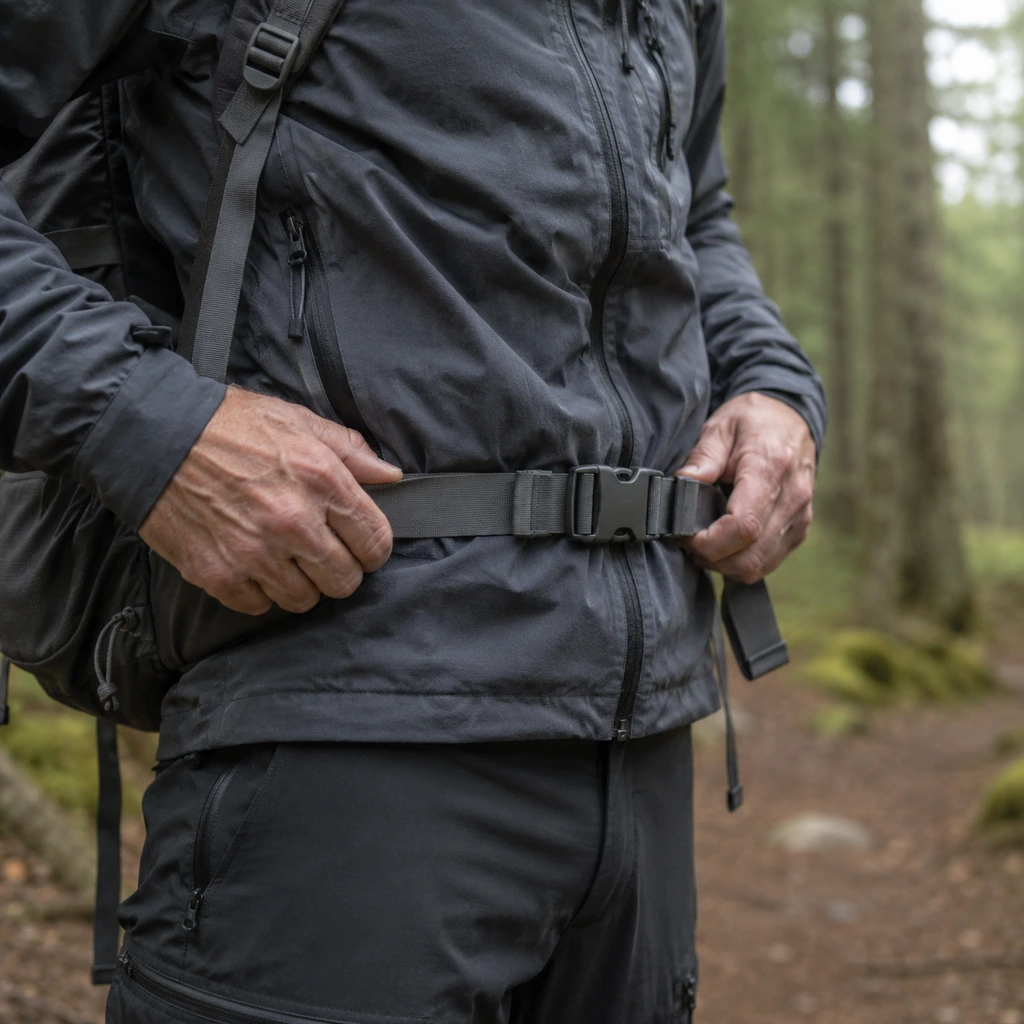
Load position changes how a pack feels more than load weight does. Heavy items, food bag, water, stove, go in the middle of the pack and tight against your spine, roughly between your shoulder blades and your waist. Light bulky things, sleeping bag and spare clothes, go at the bottom. Things you need during the day go in the lid and hipbelt pockets.
Get this wrong and a well fitted pack will still pull you backwards on every climb. Get it right and the same weight feels ten pounds lighter.
7. Eat More Than You Think You Need
Walking all day with a load burns far more than a normal day, and running low turns a hard afternoon into a miserable one. Plan roughly a pound and a half to two pounds of food per person per day, and weight it towards calorie-dense things: nuts, oil, cheese, chocolate, anything that carries a lot of energy per gram.
Bring one more meal than the trip needs. Our guide to trail nutrition covers what actually keeps working at hour seven, and food storage matters too, because a bag left out is a bag a rodent finds.
8. Walk Slower Than Feels Natural
Under load, the pace that feels right in the first mile is the pace that finishes you by mile five. Aim for something you could hold while talking in full sentences, and take short frequent stops rather than long collapses.
Expect roughly two miles an hour with a pack on rolling ground, and less with real climbing. If the route involves serious elevation, our guide to training for elevation from sea level explains why the ascent, not the distance, decides your day.
9. Set Camp Before Dark
Arrive with at least an hour of daylight left. Pitching a tent for the first time, filtering water, finding a level spot and cooking are all several times harder by head torch, and the first night is the one where you are slowest at every one of them.
That still means carrying a light, because plans slip. A compact rechargeable such as the Black Diamond Spot 400 weighs almost nothing, and our round up of the best headlamps covers what to look for, and our night hiking guide covers the walking-in-the-dark case you are trying to avoid. If the sky is clear once camp is up, our guide to stargazing for beginners is a good use of the hour after dinner.
10. Leave a Plan With Someone
Write down the trailhead, the route, where you intend to camp and when you will be back, and give it to someone who will notice if you are not. Backpacking takes you out of signal quickly and into terrain where a twisted ankle is a genuine problem rather than an inconvenience.
For solo trips or anywhere properly remote, a satellite messenger is worth the money, and our guide to using satellite messengers covers how they work. Check the forecast the morning you leave, not three days before; our notes on predicting trail weather explain why mountain forecasts move.
What Goes In the Pack
Grouped the way you will actually use it, rather than as one long list.
The Big Three
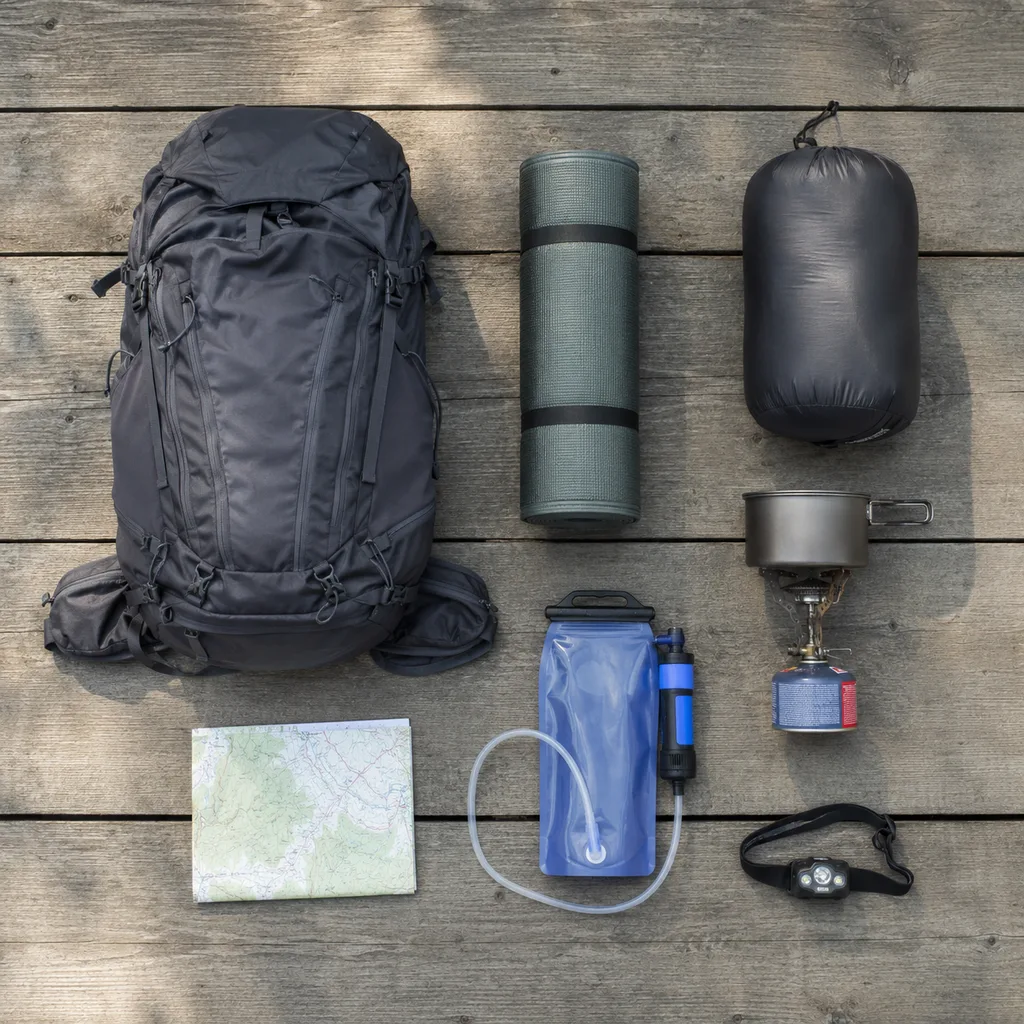
A pack sized 50 to 65 litres for a first kit, a shelter you have pitched at least once in the garden, and a sleeping system rated colder than you expect the night to be. The sleeping system is two items, not one: a bag and a pad. People remember the bag and forget that most of the cold comes up through the ground.
Pad insulation is measured as an R value, and for three season use you want roughly 3 or above. Our round up of sleeping pads covers the trade off between comfort, warmth and packed size.
Water and Kitchen
- A filter or purifier, plus a backup method such as tablets. The Sawyer Squeeze weighs two ounces and filters to 0.1 micron, which is why it is on most first kit lists
- Two litres of carrying capacity, whether bottles or a reservoir
- A small canister stove, a pot and a long spoon
- A lighter and a spare, kept in different places
- A bag for food storage that can be hung or sealed
Cook something at home on the stove before you leave. Discovering that you do not know how the valve works is much better done in a kitchen.
Clothing and Safety
Layers rather than one heavy garment, and nothing cotton. A rain shell that genuinely works, an insulating layer for camp, dry socks to sleep in, and a hat. Our guide to what to wear on the trail covers the fabrics, and the wet weather advice in camping in the rain is worth reading before your first damp night.
Safety is small and light: a first aid kit with blister treatment, a map you can read without a phone, a whistle, and a repair kit of tape and cord. None of it weighs much and all of it matters on the one trip it is needed.
Common Beginner Mistakes
- Choosing a route by distance alone and ignoring the elevation profile
- Buying the whole kit before ever spending a night out
- Carrying three days of water because the map was not checked for sources
- Packing the heavy items at the bottom, which pulls the load away from your back
- Setting off too fast and paying for it from mile four onward
- Arriving at camp in the dark on the one night you have never pitched the tent
- Bringing cotton, which stays wet and stops insulating the moment it does
The subtler one is treating the first trip as a test to pass. It is a shakedown. Finding out that your pack rubs or your stove is fiddly is the trip working correctly, not failing.
A Realistic First Trip
Friday evening: pack at home, weigh it, take out the three heaviest things you cannot justify. Saturday morning: drive out early, start walking by mid morning, cover four or five miles with a long lunch stop. Reach camp by mid afternoon, pitch in daylight, filter water, cook early.
Sunday: pack up slowly, walk out the way you came, and write down what you did not use before you forget. That list is the single most valuable thing you bring home, because it is what makes trip two five pounds lighter.
Autumn is a good season for a first attempt. The bugs are gone, the temperature suits walking under load, and the nights are long enough to matter without being cold enough to punish a mistake. Our guide to fall hiking covers the seasonal conditions, and dispersed camping covers camping outside established sites once you are ready for it.
Frequently Asked Questions
How fit do I need to be to start backpacking?
If you can comfortably day hike six to eight miles, you can manage a short overnight. The difference is the load, so the useful preparation is walking your usual routes with a weighted pack rather than adding distance. Backpacking for beginners is limited by shoulders and feet long before lungs.
How much should my pack weigh?
Under thirty pounds all in for a first overnight is a good target, and under twenty five is comfortable. The traditional guidance of twenty percent of body weight is a ceiling rather than a goal. Weigh everything at home, because the total is always more than the estimate.
What size pack do I need?
Fifty to sixty five litres covers almost every beginner trip from one night to a long weekend. Larger packs invite you to fill them. Far more important than capacity is torso length, which is what the pack is actually sized by, so measure it before choosing anything.
Do I need a water filter or are tablets enough?
A filter is faster, tastes better and lets you drink immediately, which matters when you arrive thirsty. Tablets are light, cheap and make an excellent backup for when a filter clogs or freezes. Most experienced backpackers carry both, because the filter is the one that fails.
Is it safe to backpack alone?
It can be, with preparation. Start with popular trails, tell someone your plan and expected return, and carry a satellite messenger if you are going beyond signal. The realistic risks are an ankle injury and a navigation error, and both are far more manageable when someone knows where you are.
Book one night, borrow what you can, weigh everything and pick a trail you could walk out of in an hour. Everything else you will learn on the trail, which is the only place it really gets learned.
Discover more from Maive Verse
Subscribe to get the latest posts sent to your email.