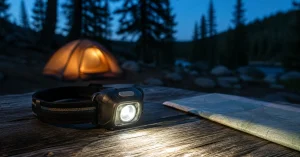
Lit headlamp on a picnic table at a forest campsite at blue hour beside a glowing tent

Best Headlamps for Camping: 6 Top Picks for 2026

This post may contain affiliate links. If you buy through them, we may earn a small commission at no extra cost to you.

The best headlamps for camping are rarely the brightest ones. Sunset comes earlier every week from here, and the lamp that makes an autumn evening pleasant is the one with a low mode that goes genuinely low, a red beam that does not blind the person opposite you, and a runtime you can trust after two nights out.

Below are six of the best headlamps for camping that are actually stocked on Amazon right now, each chosen for a different job rather than ranked one to six. Ratings and review counts were checked at the time of writing, and every spec quoted comes from the manufacturer listing. If you are not sure what output you need yet, read our guide to how many lumens a camping headlamp needs first.

Autumn is the season that exposes a bad headlamp. In July you barely switch one on before bed; by late September you are cooking in the dark, and by the clocks changing you are setting up a whole campsite by torchlight. Cold also cuts battery capacity, damp gets into badly sealed housings, and the walk to the toilet block stops being trivial. A lamp that felt fine on a summer weekend can be genuinely annoying in October.
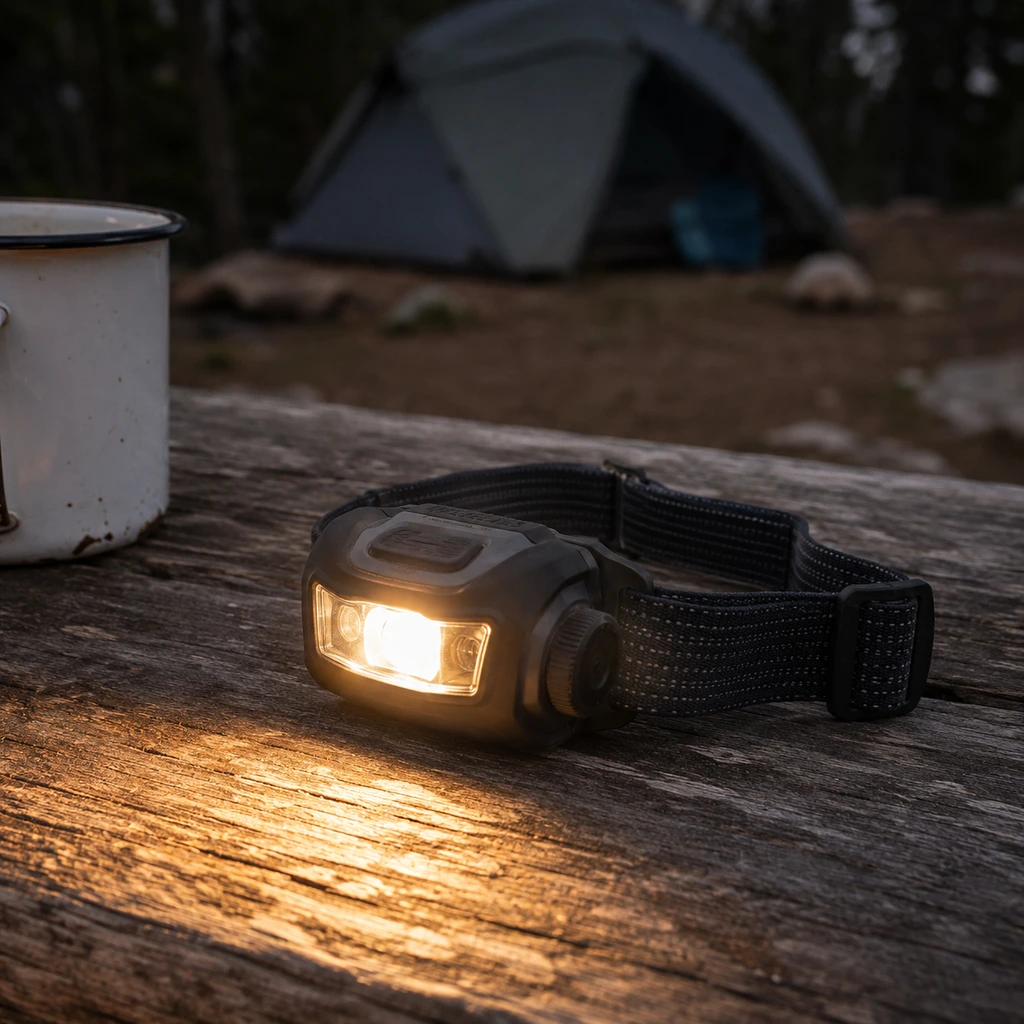
Testing the best headlamps for camping on a wooden camp table at dusk

How We Chose These Headlamps

The best headlamps for camping all clear four bars before anything else, and one of them rules out most of the cheap lamps on the first page of search results.

  • A low mode that is actually low. Tent fabric reflects light straight back at you. A lamp whose dimmest setting is 80 lumens is useless inside a tent, no matter what it does on high.
  • Red light. It preserves dark adaptation and keeps you from wrecking everyone else’s. Lamps that reach red only after cycling through full white were marked down.
  • Honest runtime. Brands that publish burn times at a stated output rather than only an ANSI FL1 burst figure got the benefit of the doubt.
  • Weather sealing. IPX4 is the floor for anywhere it rains, which is most of the country in autumn. See our notes on camping in the rain.
  • A real Amazon listing. Several widely recommended models have no on-brand listing in the United States, so they are not here however good they are.

Two things we deliberately did not weight heavily. Maximum output was almost irrelevant past about 400 lumens, because nothing you do in a camp needs more and everything you do needs the battery that output consumes. Brand was the other. Two of the six are Amazon house-favourite names rather than gear-shop brands, and they earned their places on review depth and on features that hold up, not on reputation.

We also checked availability and return signals on every listing, because a lamp that is out of stock or quietly unpopular is not a recommendation. Nothing on this list carried a frequently returned flag at the time of writing.

Weight, battery type and beam shape then separated the six, because those are the three things that decide whether a headlamp suits car camping, a dispersed site or a night walk back to the trailhead.

The Best Headlamps for Camping at a Glance

The six best headlamps for camping side by side. Rule four of them out here, then read the two that are left. The column that matters most for camping is the last one, not the first: every lamp on this list is bright enough for a campsite, and they differ in how they are powered, how much they weigh and how the beam is shaped.

HeadlampMax outputPowerRed modeBest for
Black Diamond Spot 400400 lumens3x AAA, includedYesBest overall
Petzl ACTIK CORE625 lumensRechargeable or AAAYes, continuousBest rechargeable
Coast FL75700 lumensBattery poweredYesBrightest and focusable
Nitecore NU25360 lumensRechargeableYesLightest
LHKNL Headlamp, 2 packRechargeable LEDRechargeableYesBest value pair
Foxelli MX20165 ft beam3x AAA, includedYesBest budget
Outputs are the manufacturer figures from each Amazon listing, measured as a fresh battery burst.

The Six Headlamps in Detail

Black Diamond Spot 400: Best Overall

The Spot has been the default recommendation for years, and the 400 version is the one to buy. It runs on three AAA cells that come in the box, puts out up to 400 lumens, and carries a red night vision mode alongside a proximity setting that is soft enough to use across a picnic table without annoying anybody.

The housing is rugged polycarbonate with waterproof construction, which is the part that matters in a wet autumn. Black Diamond also sells a rechargeable cell that drops straight into the same battery compartment, so you are not locked into disposables if you would rather not be. That flexibility is the quiet reason this one keeps winning.

The interface is a single button with dimming, which takes a night to learn and then disappears. At 4.6 stars across more than eleven hundred ratings, it is the least controversial lamp on this list, and the one to pick if you do not want to think about the decision any further.

The one thing to know before buying: the AAA cells are the weight penalty. Three alkaline cells put this in the middle of the pack rather than the light end, and in genuine cold they fade faster than a lithium cell would. Swapping in lithium AAA cells for a winter trip is a cheap fix and roughly halves that problem.

Specs That Matter

  • Up to 400 lumens, dimmable through the full range
  • Runs on 3x AAA, included, or an optional rechargeable cell
  • Red night vision mode plus a soft proximity mode
  • Waterproof rugged housing, polycarbonate body
  • Adjustable headband, low profile, stable when moving

Who It Is For

Campers who want one lamp that handles the tent, the camp kitchen and the walk back, without a battery strategy.
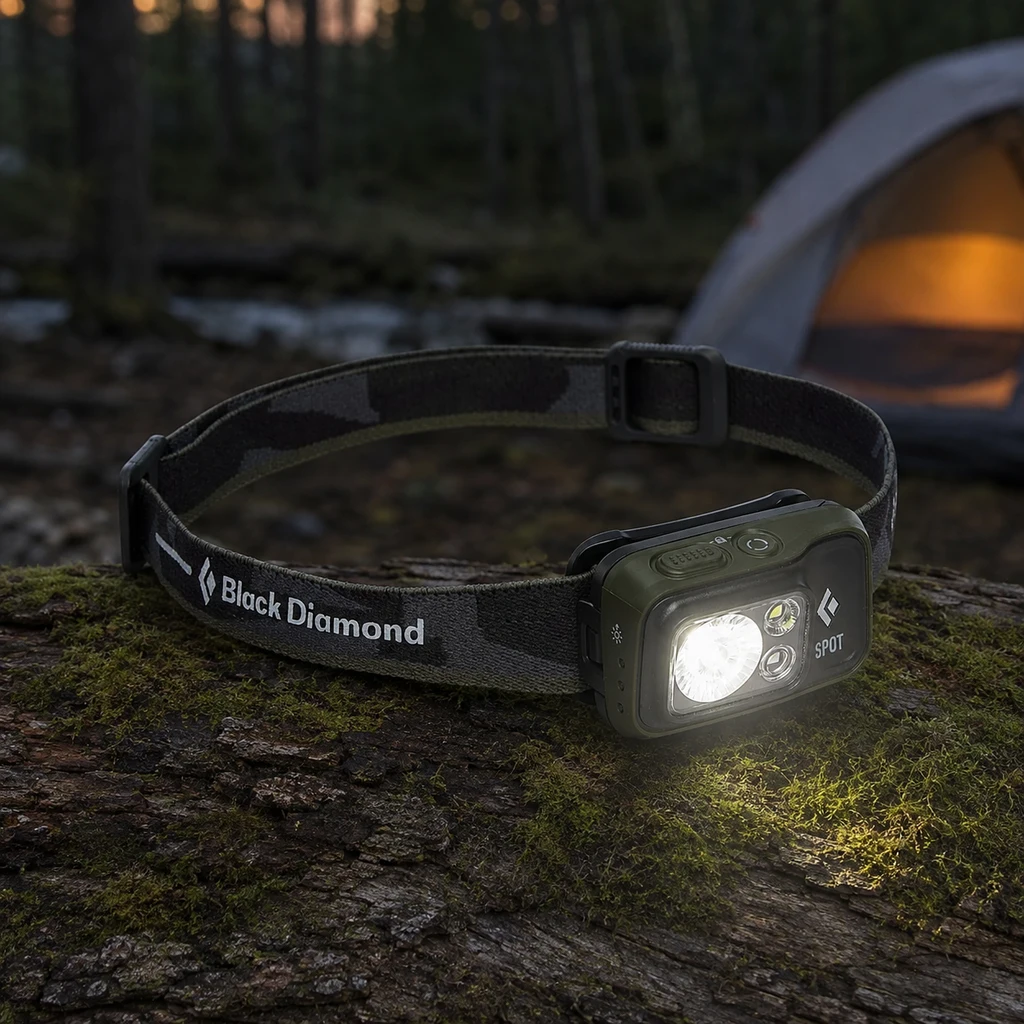
Black Diamond Spot 400 headlamp lit on a mossy log at a forest campsite at dusk

Petzl ACTIK CORE: Best Rechargeable

If you camp often enough that AAA cells become a running cost, the ACTIK CORE is the upgrade. It ships with Petzl’s CORE rechargeable battery and puts out 625 lumens at 88 grams, which is a genuinely good power to weight figure for a lamp in this class.

The feature that sells it is the HYBRID design: the lamp detects which energy source is fitted and adjusts automatically, so you can run the CORE cell all weekend and drop in three AAA batteries when it dies on a long trip. That removes the single biggest objection to rechargeable headlamps, and it is why this is the one to take somewhere cold, where battery performance falls off fast.

It runs a mixed beam, wide for close work and focused for movement, across three white levels plus continuous red. A charge indicator shows the battery level each time you switch on or off, a tilt plate aims the beam, and the symmetrical headband is made from recycled material and can be removed and washed. There is even a glow in the dark ring around the LED so you can find it in a dark tent.

Two caveats. The CORE battery is a proprietary pack, so a spare costs more than three AAA cells, and at 4.4 stars this is the lowest rated lamp here, mostly from people who expected the 625 lumen figure to be a setting they could hold rather than a burst. Read it as a very good 250 lumen lamp that can shout when it needs to and you will be happy with it.

Specs That Matter

  • 625 lumens, 88 grams
  • HYBRID: rechargeable CORE battery or 3x AAA, detected automatically
  • Mixed beam, wide and focused, three white levels
  • Continuous red lighting, not a cycle-through afterthought
  • Charge level indicator on every power on and off
  • Removable, washable headband made from recycled materials

Who It Is For

Regular campers, anyone who hates buying batteries, and cold weather trips where a backup power source matters.
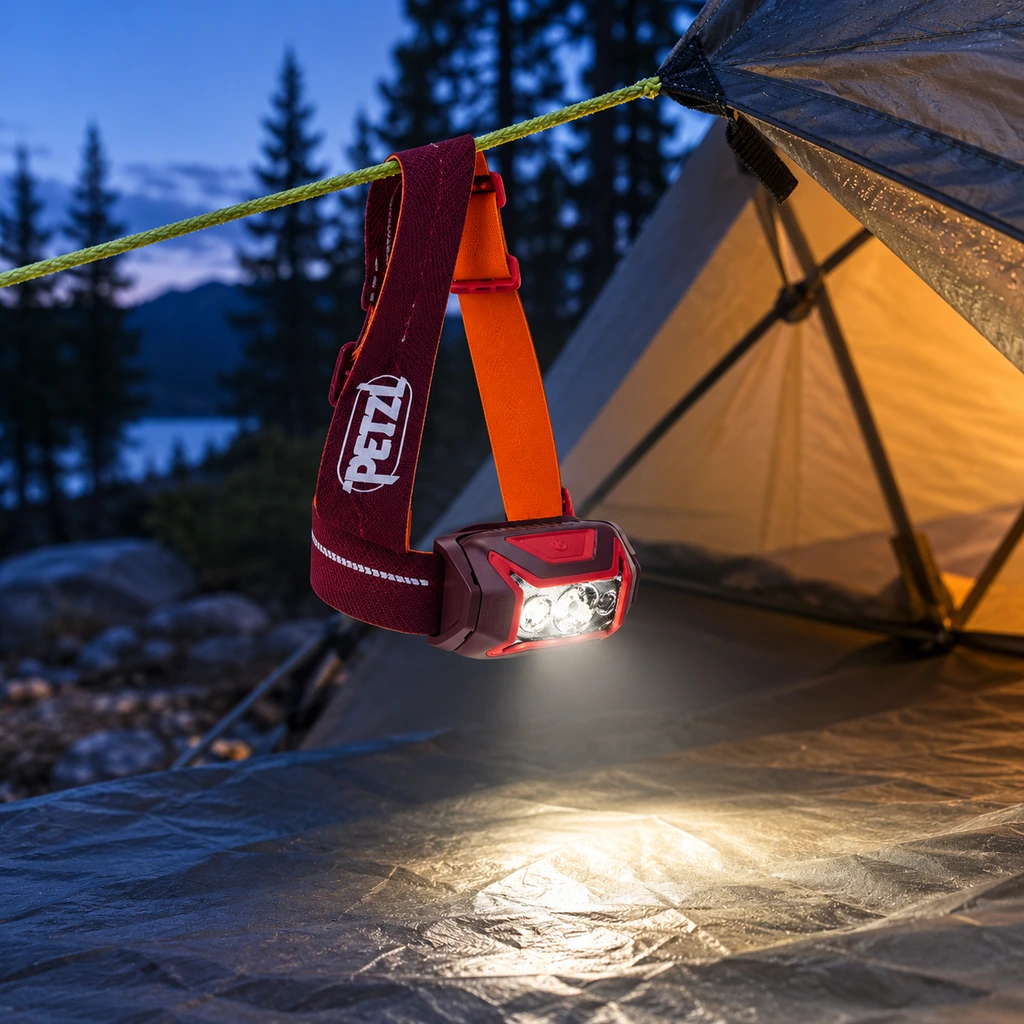
Petzl ACTIK CORE headlamp hanging lit from a tent guyline at blue hour

Coast FL75: Brightest and Most Focusable

At 700 lumens this is the brightest lamp here, but the reason to buy it is the optic rather than the output. Coast’s Pure Beam twist focus lets you turn the bezel to move continuously between a wide defocused flood and a tight main beam, with a clean transition and no dark ring in the middle.

That matters more than it sounds. Most headlamps make you choose flood or spot when you buy; this one lets you choose at the moment you need it, which is exactly the problem you hit when you are cooking one minute and looking for the trail the next. It also runs dual colour, white and red.

It is a chunkier lamp than the others and its review base is the thinnest here at just over three hundred ratings, though they average 4.6 stars. The housing includes clips for attaching it to a hard hat, which tells you the audience Coast originally built it for, and it is the pick if you want reach for walking out after dark.

Be realistic about the trade. Seven hundred lumens through a focused optic will light a hillside, and it will also flatten the night vision of anyone standing near you, so this is a lamp that needs its red mode used with some discipline in a shared camp. It is also the bulkiest here, which is fine on a car camping trip and less fine in a jacket pocket.

Specs That Matter

  • 700 lumens, the highest output on this list
  • Pure Beam twist focus, continuous flood to spot
  • Dual colour, white and red
  • Helmet compatible with integrated clips
  • Battery powered, LED, black housing

Who It Is For

Anyone who needs real reach as well as camp light, and people who want one beam that does both jobs.
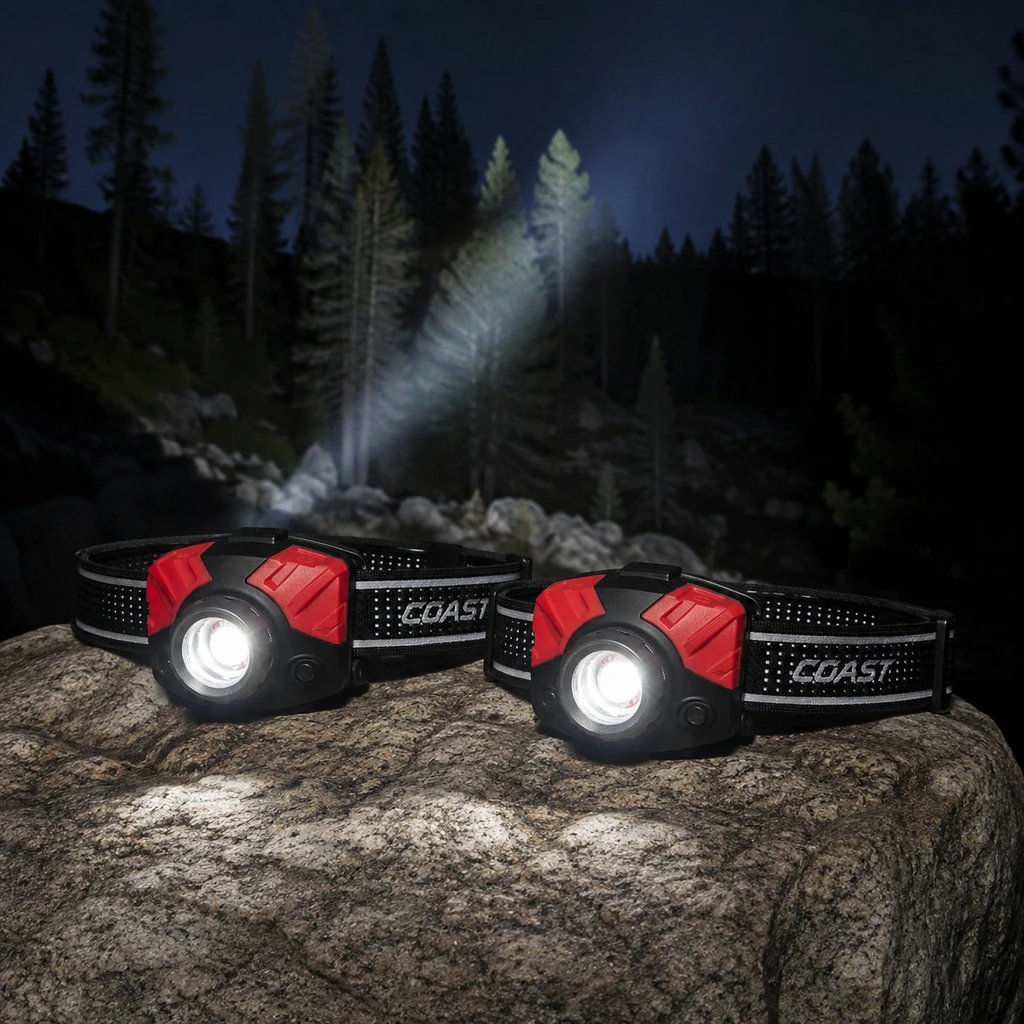
Coast FL75 headlamp on a granite boulder with its focused beam cutting into dark pines

Nitecore NU25: Lightest

Under an ounce, and small enough to forget in a pocket. The NU25 is built around a CREE XP-G2 S3 emitter that produces a 360 lumen wide beam with about 88 yards of throw, which is a lot of light for something this size.

The clever part is the second emitter. Alongside the main LED there is a high CRI auxiliary light that renders colours far more naturally, which is genuinely nicer for close work like cooking or fixing a zip, plus a separate red LED for preserving night vision. Three light sources in a lamp that weighs less than a slice of bread is unusual.

It is rechargeable only, so there is no AAA fallback, and this listing is the first generation 2017 version rather than the later revision, which is worth knowing before you buy. At 4.7 stars it is the highest rated lamp here. If you count grams, as you would with the ultralight packing approach, this is the one.

The compromise is runtime and repairability. A lamp this small carries a small cell, so on high it will not last an evening, and with no AAA fallback a flat battery in the field means no light at all. Carry a power bank if this is your only lamp, or treat it as the light one you take on top of something sturdier.

Specs That Matter

  • 360 lumens, roughly 88 yards of throw
  • CREE XP-G2 S3 main LED, wide beam
  • High CRI auxiliary LED for natural colour up close
  • Separate red LED for night vision
  • Weighs less than one ounce, rechargeable
  • This listing is the first generation 2017 version

Who It Is For

Backpackers, bikepackers and anyone whose main complaint about headlamps is that they feel heavy on the forehead.

Nitecore NU25 headlamp lit beside a folded paper map showing how small it is

LHKNL Rechargeable Headlamp, 2 Pack: Best Value

With more than thirty six thousand ratings at 4.5 stars, this is one of the most bought headlamps on Amazon, and it arrives as a pair. For a family or a group trip that is the whole argument: two rechargeable lamps for roughly what one branded lamp costs, so nobody is left walking to the toilet block by phone torch.

It weighs 1.87 ounces, the head pivots through 60 degrees and locks so it does not sag while you walk, and it runs eight lighting modes including white and red. There is a motion sensor for hands free switching and a long press that turns the lamp off from any mode, which sounds trivial until you have cycled through six settings to get to off in a tent at 2am.

Sealing is IPX4, so splashes and light rain are fine but immersion is not. It is not built to the standard of the Petzl or the Black Diamond and the plastics tell you so, but as the pair you hand to guests, or keep in the car for car camping, the value is hard to argue with.

Set expectations on two points. The motion sensor is genuinely useful with full hands and genuinely irritating when you wave at somebody, and it can be turned off. And the quoted brightness is not an independently verified lumen figure, so treat it as a bright budget lamp rather than a rival to the Petzl on output. At this price for two, that is a fair deal.

Specs That Matter

  • Sold as a two pack, both rechargeable
  • 1.87 ounces each, 60 degree locking pivot
  • Eight lighting modes, white and red
  • Motion sensor plus long press off from any mode
  • IPX4 rated, fine for rain, not for immersion

Who It Is For

Families, group trips and anyone equipping more than one head without spending twice.

LHKNL rechargeable headlamp lit on an open car tailgate at a campsite at night

Foxelli MX20: Best Budget

The MX20 is the lamp to buy when the budget is genuinely tight and you still want something that will not die in the first shower. It runs three AAA cells, which are included, and Foxelli quotes up to 45 hours of runtime, which is the sort of number that only makes sense on a lamp that is not chasing headline output.

The beam reaches about 165 feet across a range of white and red modes, all cycled through one glove friendly button, and the body tilts through 45 degrees. It is rated IPX5, a step above the LHKNL, so spraying water is not a problem. At 3.2 ounces with batteries fitted it is the heaviest lamp here per lumen, but you will not notice on a camp chair.

It carries 4.7 stars across more than fourteen thousand ratings, which for a budget lamp is a strong record. Treat it as the spare that lives in the camping box permanently and it will keep earning its place.

What you give up is refinement. There is no dimming, just fixed modes cycled with one button, and the beam is a plain flood with no real throw, so it is not the lamp for finding a trail junction. As a camp light with a runtime figure the expensive lamps cannot touch, it is excellent value.

Specs That Matter

  • Roughly 165 feet of beam, white and red modes
  • Up to 45 hours of runtime on 3x AAA, included
  • IPX5 rated, handles spraying water
  • 3.2 ounces with batteries, 45 degree tilt
  • Single glove friendly button for all modes

Who It Is For

First headlamps, spares, kids, and anyone who wants long runtime more than high output.

Foxelli headlamp hung from a tent ceiling loop lighting a sleeping bag and a book

How to Choose Between Them

Six lamps, six jobs. The best headlamps for camping are the ones matched to the way you actually camp, not to the biggest number in the table.

One Lamp for Everything

The Spot 400. It is the only one here that is genuinely good at all three of tent light, camp light and walking light, and the optional rechargeable cell means you can change your mind about batteries later. If you are buying your first headlamp and want to stop reading, buy this one.

Camping Most Weekends

The ACTIK CORE. The running cost of AAA cells adds up fast at that frequency, and the hybrid design means a flat battery is an inconvenience rather than the end of your evening. It is also the most comfortable lamp here at 88 grams.

Walking Out in the Dark

The Coast FL75, or the Spot 400 if you want something lighter. Beam reach is the spec that matters once you leave the campground, and the twist focus is the most flexible optic on this list. Pair it with the technique in our guide to hiking after sunset.

Counting Grams

The NU25, without much argument. Nothing else here is under an ounce, and the high CRI auxiliary emitter is a real quality of light advantage for close work despite the small size.

Equipping a Family

The LHKNL two pack, plus a Foxelli or two as spares. Kids lose headlamps, and a cheap lamp that is present beats an expensive one that is in somebody else’s pocket. Our notes on camping with kids explain why redundancy wins.

On budget: the gap between the cheap lamps and the good ones here is not really brightness, it is control. The expensive lamps dim smoothly, reach red without cycling through white, hold their tilt and tell you the truth about runtime. If those things sound like details, the cheap pair will serve you fine. If you have ever stood in a tent clicking through six modes trying to get back to off, they are worth the money.

If you are buying two, the combination most people end up happy with is one good lamp and one cheap spare: an ACTIK CORE or Spot 400 for whoever is cooking and navigating, and a Foxelli in the box for the person who forgot theirs. That covers more real situations than two mid priced lamps do.

Lumens, Runtime and the Specs That Actually Matter

Three numbers get printed on every box, and only one of them usually matters. Getting this right is most of what separates the best headlamps for camping from the ones that look identical on a listing page.

Lumens Are a Ceiling, Not a Setting

Almost every quoted figure is the ANSI FL1 burst, measured in the first thirty seconds from a fresh cell. Many lamps step down within a minute or two to protect the LED from heat, so a 600 lumen lamp may settle nearer 300 for the rest of the night. The brands that publish a burn time curve are the ones telling you the truth. We go through this in detail in the lumens guide.

Beam Shape Beats Beam Power

A wide flood lights your hands, the pot and the ground beside you. A spot pushes a narrow column out to where the trail markers are. Camping is mostly flood, with brief moments of spot, which is why lamps that offer both, like the ACTIK CORE and the FL75, punch above their output figures.

Weight Sits on Your Forehead All Evening

Anything under about 100 grams disappears. Above roughly 150 grams with batteries you will start adjusting the strap, and a front heavy lamp bounces when you walk. This is the spec people ignore in the shop and complain about on the trip, the same way they do with a badly loaded daypack.

Two more specs deserve a mention because they show up in complaints rather than in marketing. The first is the interface: how many button presses stand between off and the mode you want. A lamp that reaches red only after passing through full white will wreck your night vision every single time, and no amount of output makes up for that. The second is mode memory, meaning whether the lamp switches back on at the setting you left it. Without it, a lamp you used on high at midnight comes on at high in the tent the next morning.

Tilt is the last one. A ratcheting tilt plate that holds its angle lets you aim light at a pot or a map without craning your neck, while a mechanism that sags under its own weight is something you will be adjusting all evening. All six here tilt; the Petzl and the LHKNL hold their angle best.

Rechargeable, AAA, or Both

This is the decision that quietly determines whether your lamp still works on night three, and it is the one place where the best headlamps for camping genuinely differ from each other.

  • Rechargeable is lighter, cheaper over time and better for the bin. It fails badly if you have no way to charge and no spare.
  • AAA is heavier and an ongoing cost, but a fresh set is available in any grocery store and cold weather performance is easier to manage.
  • Hybrid lamps take either. The ACTIK CORE and, with the optional cell, the Spot 400 both sit here, which is why they are the two picks for longer trips.
  • On any trip past two nights, carry a backup power source. A small bank also covers a phone, and it belongs on the same shelf as the rest of your camping essentials.
  • Cold cuts capacity sharply. Sleep with cells in the warm part of your sleep system on frosty nights and they will hold charge better.

There is a third option worth knowing about, which is running rechargeable AAA cells in a lamp that takes them. It gets you most of the cost saving of a rechargeable lamp while keeping the ability to buy replacements anywhere, and it works in the Spot 400, the Foxelli and, in hybrid mode, the ACTIK CORE. The catch is that rechargeable AAA cells sit at a slightly lower voltage than alkalines, so some lamps read them as nearly flat and run dimmer than they should. Test the combination at home before it matters.

Whatever you choose, decide it before the trip rather than at the trailhead. A headlamp is the one piece of camp gear whose failure turns a pleasant evening into an early night, and it is the cheapest thing on the packing list to have a backup for.

One more consideration if you camp with a vehicle: a headlamp is not your only light source, and it should not be doing every job. A lantern over the table, as covered in our roundup of the best camping lanterns, takes the load off your headlamp battery and stops everyone at the table getting a beam in the face each time somebody looks up. The headlamp then does what it is uniquely good at, which is lighting whatever you are pointed at with both hands free, whether that is a stove, a guyline or the fire you are trying to light.

Making a Headlamp Last

Even the best headlamps for camping die from three things: leaked cells, grit in the switch, and a perished headband. All three are avoidable in about a minute each trip.

  • Take the batteries out between trips. A leaking AAA cell will destroy a contact plate over a winter in the garage.
  • Rinse salt or dust off the housing and dry it before it goes away, especially anything with a twist bezel.
  • Wash the headband occasionally. Sweat perishes elastic faster than sunlight does, and most bands are removable.
  • Store it somewhere dry and known, with the rest of your off season camping gear, so you are not buying a fourth one.
  • Check it the night before you leave rather than at the trailhead, alongside the rest of the pack down list.
  • Keep a spare set of cells taped inside the camping box so the backup is never the thing you forgot, the same discipline as the rest of your camp safety kit.
  • Label your lamps if you camp as a group. Identical black headlamps in a dark tent is a solved problem, and a wrap of coloured tape solves it.

Field repairs are limited, so carry the two things that fix most failures: a spare set of cells and a short length of cord. A snapped headband can be knotted or replaced with cord in a couple of minutes, and a lamp with a working head and no strap can be hung from a tent loop or a branch and used as a small lantern for the rest of the trip.

If a lamp gets soaked beyond its rating, take the cells out immediately, open the battery compartment and let it dry somewhere warm but not hot for a day before testing it. Most lamps that die from water actually die from corrosion in the days afterwards rather than from the dunking itself.

Frequently Asked Questions

How many lumens should a camping headlamp be?

For general camping, 200 to 350 lumens is the practical sweet spot, with a low mode that drops under 20 for tent use. Higher output is useful in bursts for route finding, but it costs runtime and it is not the setting you spend the evening on. The full breakdown by task is in our camping headlamp lumens guide.

Is Black Diamond or Petzl better?

They are close, and the honest split is by power source. Black Diamond’s Spot 400 is the better buy if you want AAA cells with an optional rechargeable upgrade. Petzl’s ACTIK CORE is the better buy if you want rechargeable first with an AAA fallback. Build quality and beam quality are comparable, both brands service their products properly, and both hold value. If you camp in genuine cold, the Petzl edges it purely because the hybrid design gives you a fallback when a lithium pack sulks below freezing. If you camp two or three times a year, the Black Diamond is the more sensible spend.

Is 1000 lumens bright for camping?

Very, and more than you need. A 1000 lumen lamp is genuinely useful for scanning a hillside, but you will use that mode for seconds while carrying the weight and battery penalty all trip. None of the six here needs to go that high to do the job well. There is also a courtesy argument. In a shared campground a 1000 lumen beam swung across a neighbouring tent is the lighting equivalent of a car alarm, and it is one of the quiet reasons experienced groups run low white and red almost exclusively once camp is set.

Do I still need a lantern if I have a headlamp?

They do different jobs. A lantern lights a space so a group can share it; a headlamp lights whatever you are looking at, hands free. A lantern also lights faces, which matters for the social half of an evening, and it is why the two together feel better than either alone at twice the output. Most camps end up running both, which is why our roundup of the best camping lanterns is worth reading next.

What IPX rating do I need?

IPX4 is the practical floor and covers rain and splashes, which is what the LHKNL and most budget lamps offer. IPX5 adds spraying water, as on the Foxelli. Only go looking for IPX7 or IPX8 if you paddle or expect the lamp to be dropped in a creek. Worth knowing: the X in IPX means dust resistance was never tested, not that the lamp has none, and ratings assume the battery door is properly closed. A gritty seal or a door left ajar makes the number on the box meaningless.

Can I use a headlamp for hiking as well as camping?

Yes, and most people do. Hiking asks for more reach and a firmer strap, so the FL75 and the Spot 400 travel best between the two. Hiking also asks more of the strap and the tilt, because a lamp that sags while you walk is far more irritating than one that sags while you sit. If your hiking is mostly autumn day walks that finish near dusk, our fall hiking guide covers when to put it on your head rather than in the pack, and the boot fitting guide covers the other half of walking safely in the dark.

Finally, do not overlook where the lamp lives between uses. The people who lose headlamps are the people who have no fixed home for them, and a headlamp in a drawer at home is worth nothing at a campsite. Keep it clipped inside the lid of the camping box with the spare cells, and check it in the same pass you use for the rest of the checklist. That single habit has saved more evenings than any spec on this page.

Four camping headlamps laid out in a row beside AAA batteries and a charging cable

If you are new to all of this, the honest order of purchase is shelter, sleep, then light. A headlamp is cheap relative to a tent or a sleeping pad, so it is tempting to treat it as an afterthought, and it is also the item you will touch most times per trip. Spending a little more here has a better return per dollar than almost anything else in the camping kit list.

One last practical note. Buy the lamp a few weeks before you need it and use it at home in a dark room, cycling through every mode until your thumb knows the sequence without thinking. Learning an unfamiliar interface at midnight in the rain, with cold hands, is how people end up standing in a field on full beam wondering how to get back to red. Ten minutes on the sofa solves it permanently.

Six lamps, six different evenings. The best headlamps for camping are not the brightest, they are the ones you reach for without thinking. For most people the Spot 400 is the answer and the reading can stop there; for regular campers the ACTIK CORE is worth the step up, and for a family the LHKNL pair costs less than one good lamp. Whichever you pick, check the low mode and the red mode before the trip rather than on it, and put fresh cells in before you leave. Then go and enjoy the fact that it now gets dark at a civilised hour.


Discover more from Maive Verse

Subscribe to get the latest posts sent to your email.

Discover more from Maive Verse

Subscribe now to keep reading and get access to the full archive.

Continue reading