


This post may contain affiliate links. If you buy through them, we may earn a small commission at no extra cost to you.
Fall trail running is the best running of the year and the most likely to put you on the ground. The temperature is finally right, the trails empty out, and the same falling leaves that make it beautiful hide every root and rock you were relying on seeing.
Autumn changes three things at once: the surface under your feet, the light you have to finish in, and how fast you cool down when you stop. Handle those three and the season is a gift. Ignore them and you spend October nursing an ankle. If you are new to the surface entirely, our beginner trail running guide covers the basics first.
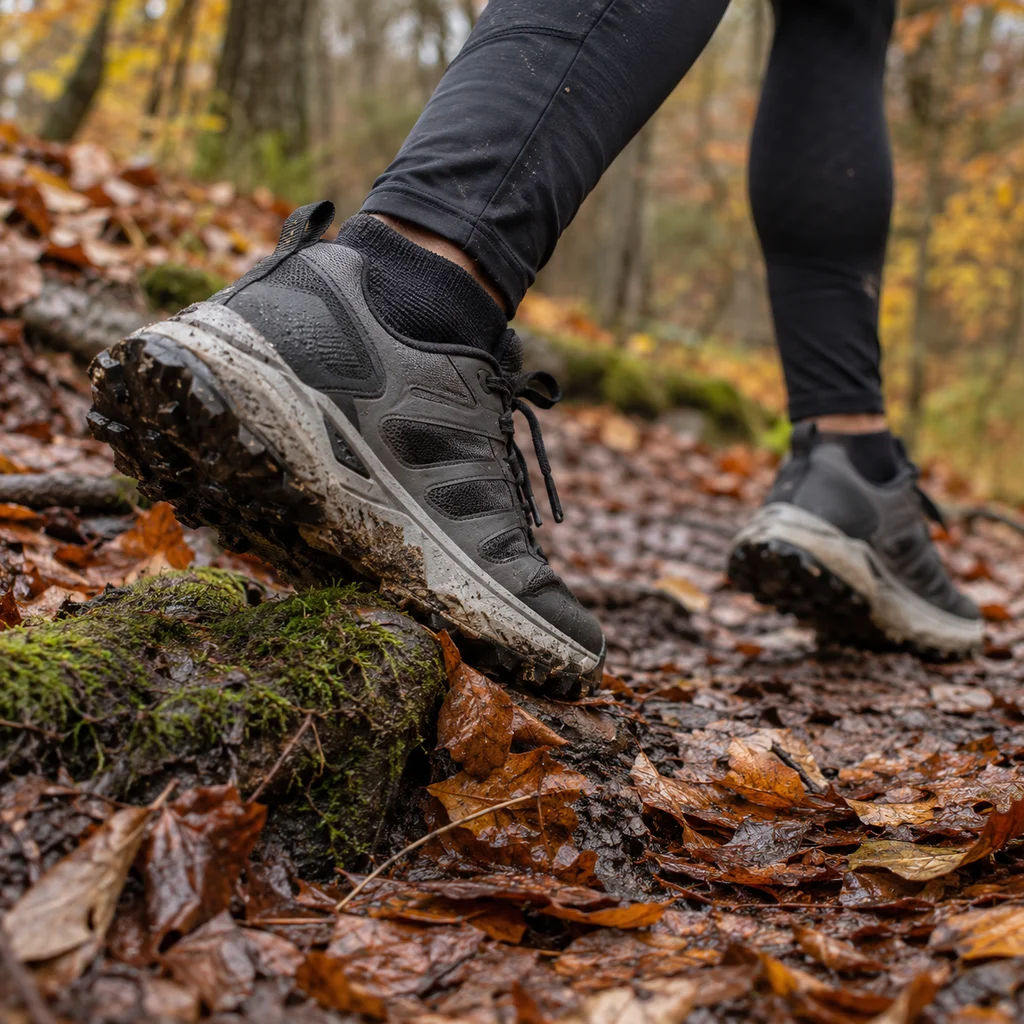
Table of Contents
What Actually Changes in Autumn
The Surface Stops Telling You the Truth
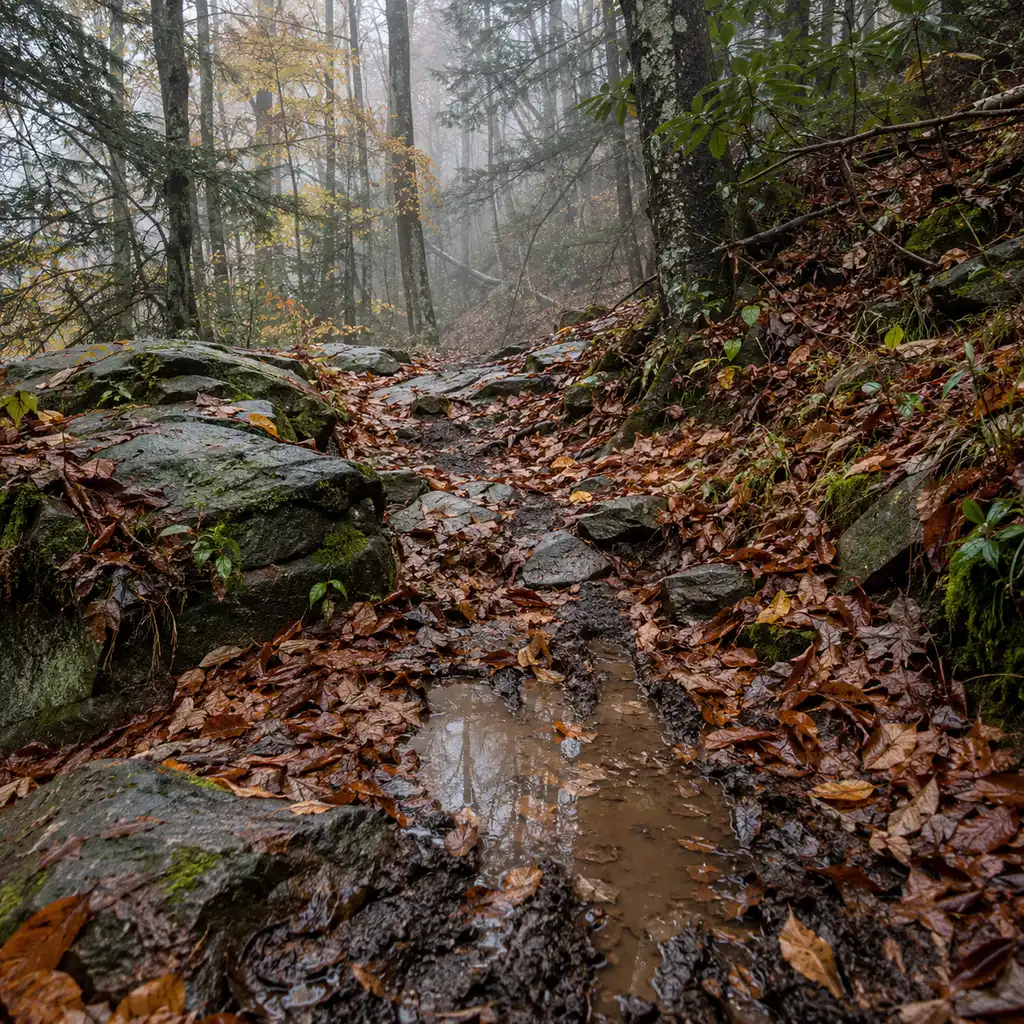
A dry summer trail shows you its hazards. An inch of wet leaves hides roots, holes, loose rock and the edge of the trail itself, and leaves on wet rock are close to frictionless. You are running on a surface you cannot read, which is the single biggest difference between a July run and an October one on the same loop.
The Light Runs Out Faster Than You Plan
Sunset moves earlier by roughly a minute and a half a day through autumn, so the after work run that finished in daylight in August finishes in dusk by the end of September and in the dark by late October. Under tree cover it is functionally dark a good twenty minutes before official sunset. Plan the finish time the way you would plan an autumn day hike, backwards from dark rather than forwards from the trailhead.
You Cool Down Faster Than You Warm Up
Cold air plus a wet base layer plus a slow walk back to the car is how people get genuinely cold after an autumn run. In summer you dry out. In November you do not, and the drop happens fast once you stop moving. It is the same failure that catches people camping in wet weather: the problem starts when the activity does.
Fall Trail Running: 8 Ways to Handle It
1. Shorten Your Stride on Leaf Cover
A short stride keeps your foot under your body, which means you can react when the ground is not where you expected. A long reaching stride commits your weight forward of your foot, and when that foot slides on a wet leaf there is nothing you can do about it. Shorten and quicken, do not slow down and lengthen.
2. Run the Loop You Know
Autumn is the wrong season to explore an unfamiliar technical trail. Run routes you have memorised in summer, because your memory of where the roots are is doing work your eyes cannot do under leaf cover. Save new trails for spring or for daylight weekends. If you want new ground this season, walk it first, which doubles as a decent loaded walk if you take a pack.
3. Assume Every Root Is Wet
Wet wood and wet rock are the two surfaces that end runs. Treat every root, every boardwalk plank and every slab as if it were ice: cross it with your foot flat, weight centred, and no change of direction while you are on it. Step over rather than onto wherever you can. Poles help on the worst of it, and the technique guide transfers straight across to running poles.
4. Take the Light Before You Need It
Carry a headlamp on any run that starts after mid afternoon, even a short one. A phone torch is not a substitute: it lights one narrow patch, it occupies a hand you may need, and it dies in the cold. The habits in our after dark guide apply directly, and our headlamp picks cover what to carry.
5. Layer for Stopping, Not for Running
Dress so the first ten minutes are slightly too cold, then carry one more layer than you think you need for the walk back. A light wind shell weighs almost nothing in a vest pocket and is the difference between pleasant and miserable if you twist an ankle and have to walk out. Same principle as layering for hiking.
6. Change Your Footing Expectations, Not Just Your Shoes
Deeper lugs help in mud and do very little on wet leaves or wet rock, where the limit is the surface rather than the tread. Autumn shoes should have aggressive lugs for the mud and you should still run as though you have none on anything smooth. Our trail shoe round up covers what different outsoles are actually for.
7. Tell Someone the Route and the Time
Empty autumn trails are the appeal and the risk. If you go over on an ankle two miles out at dusk in November, nobody is coming past. Send the route and an expected finish time to one person before you start, every time, and take a phone with enough battery to matter in the cold.
8. Slow the Descents
Descending is where wet leaves cost people their season. Gravity is already doing the work, your foot placement is least controlled, and a slide downhill has further to travel. Give up the descent times you set in August and take them back in spring. Your legs will thank you for it, and the descending muscles take the longest to adapt, as the research on long distance walking shows.
Reading Autumn Ground
Wet Leaves on Rock
The worst surface in the woods and the one that looks most harmless. Where a trail crosses slab or a rocky step and leaves have collected, walk it. There is no technique that makes that surface reliable.
Mud and Rutted Tread
Run through the middle rather than around the edges. Skirting a mud patch widens the trail and kills the vegetation holding it together, which is straightforward trail etiquette. Shoes wash; trails do not repair.
Hidden Holes and Soft Edges
Leaf drifts collect in exactly the dips and holes you want to avoid, so treat any deep pile as unknown depth. On a trail with a drop on one side, run the inside line: an edge that has been softened by rain and covered by leaves will not hold. Read the weather before you go, using the same forecasting habits you would for a big day out.
The Kit That Earns Its Place
Something to Carry Water and a Layer
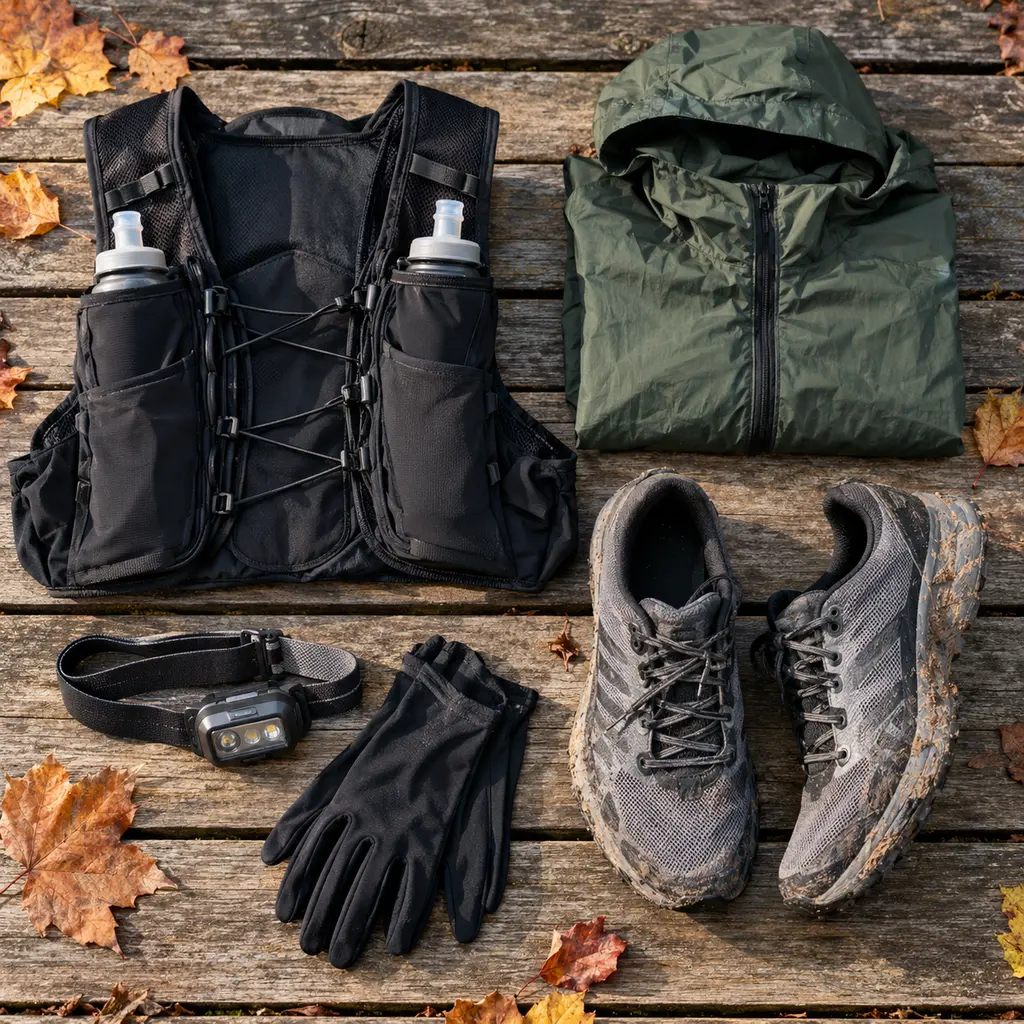
A running vest is the piece that makes autumn running work, because it carries the shell, the light and the phone that this season demands without any of it bouncing. Budget: a minimal phone and bottle vest covers a short local loop. Mid range: the Criuage 2L hydration vest adds a bladder and real pocket space. Premium: the Nathan TrailMix 7L is the do everything option. Our round up of the best trail running vests compares six.
Light and Layers
A headlamp from mid September, a wind shell that packs to nothing, and gloves earlier in the season than you expect, because hands are the first thing to go. None of it is heavy and all of it lives in the vest.
Feet
Lugs for mud, and socks that are not cotton so a wet foot stays warm. If your shoes are last season’s and the tread is rounded off, autumn is when you notice, and the fit rules for boots transfer to trail shoes.
Late Autumn: Frost, Dark and Falling Over
The First Frosts Change the Rules Again
Once overnight temperatures drop below freezing, the wet mud you ran through last week becomes frozen ruts with edges, and any boardwalk or bridge is genuinely icy in the shade long after the open trail has thawed. Frozen ground is faster and much less forgiving: a trip that would have been a stumble in soft mud is a fall on concrete. Morning runs are the ones affected, because the same trail is fine by afternoon.
Puddles hide the worst of it. A skim of ice over a puddle looks like water and behaves like glass, so run the edge of a frozen puddle rather than through it, which is the opposite of the mud advice earlier and one of the few times widening your line is the right call.
If You Go Over Out There
Stop and assess before you stand up and test it, because adrenaline will let you put weight on something you should not. If it holds, walk out rather than running out: a compromised ankle on leaf covered ground is how a sprain becomes a break. Put the shell on immediately, because you will be moving slower and generating far less heat than you were a minute ago.
This is where the layer you did not want to carry earns a season’s worth of inconvenience. It is also why the route and finish time you sent someone matters, and why a satellite messenger is worth considering if you run genuinely remote trails alone.
Common Autumn Mistakes
- Running an unfamiliar technical trail under leaf cover for the first time.
- Leaving the headlamp at home for a run that starts at four in the afternoon in October.
- Chasing summer descent times on a wet surface.
- Dressing for the effort rather than for the walk back if something goes wrong.
- Running around mud instead of through it, which widens trails, see leave no trace.
- Skipping water because it is cold out. You dehydrate in autumn too, as the hydration numbers show.
- Telling nobody where you went on an empty trail at dusk.
A Sensible Autumn Week
Built around the reality that quality running gets harder as the light and the footing go.
| Day | Session | Where | Why |
|---|---|---|---|
| Tuesday | Easy 40 minutes | Known trail loop | Daylight if possible, feet get used to the surface |
| Thursday | Intervals, 30 minutes | Road or grass park | Hard efforts need footing you can trust |
| Saturday | Long run, 60 to 90 minutes | Trail, morning | Best light of the week, take the shell |
| Sunday | Walk or easy hike | Anywhere | Recovery on your feet, see the trails in daylight |
Put the fast work on a surface you can trust and keep the trails for easy and long. That single swap prevents most autumn injuries, and it pairs well with adding a loaded walk on an off day.
Frequently Asked Questions
Is trail running safe in autumn?
Yes, with adjustments. The added risks are hidden hazards under leaves, slick wet wood and rock, and running out of daylight. Shorter stride, familiar routes, a headlamp and slower descents cover nearly all of it.
What shoes are best for wet leaves?
Deep lugs help in mud but do very little on wet leaves over rock, where the surface itself is the limit. Buy for the mud, run as if you have no grip on anything smooth, and accept that some sections should be walked.
How do I stay warm without overheating?
Start slightly cold. A thin base layer plus a packable wind shell handles most autumn conditions, and the shell comes off five minutes in and lives in your vest until you stop.
Should I run trails in the dark?
On a route you know well, with a proper headlamp and a spare, and with someone knowing your plan. An unfamiliar technical trail in the dark in autumn is where the risk stops being reasonable.
Do I need a running vest for short runs?
Not in summer. In autumn it is what carries the shell and the headlamp that the season requires, which is why so many people who ran bare handed all summer start wearing one in September.
The whole of fall trail running is three adjustments: shorten your stride, carry the light and the layer, and give up the descent times until spring. Do that and you get the best months of the year on empty trails. Our vest round up covers what to carry it all in, and the fall hiking guide covers the same season at walking pace.
Discover more from Maive Verse
Subscribe to get the latest posts sent to your email.