

Master trail etiquette in 2026. Learn 5 essential rules for shared multi-use paths to ensure safety, minimize impact, and manage trail speed.
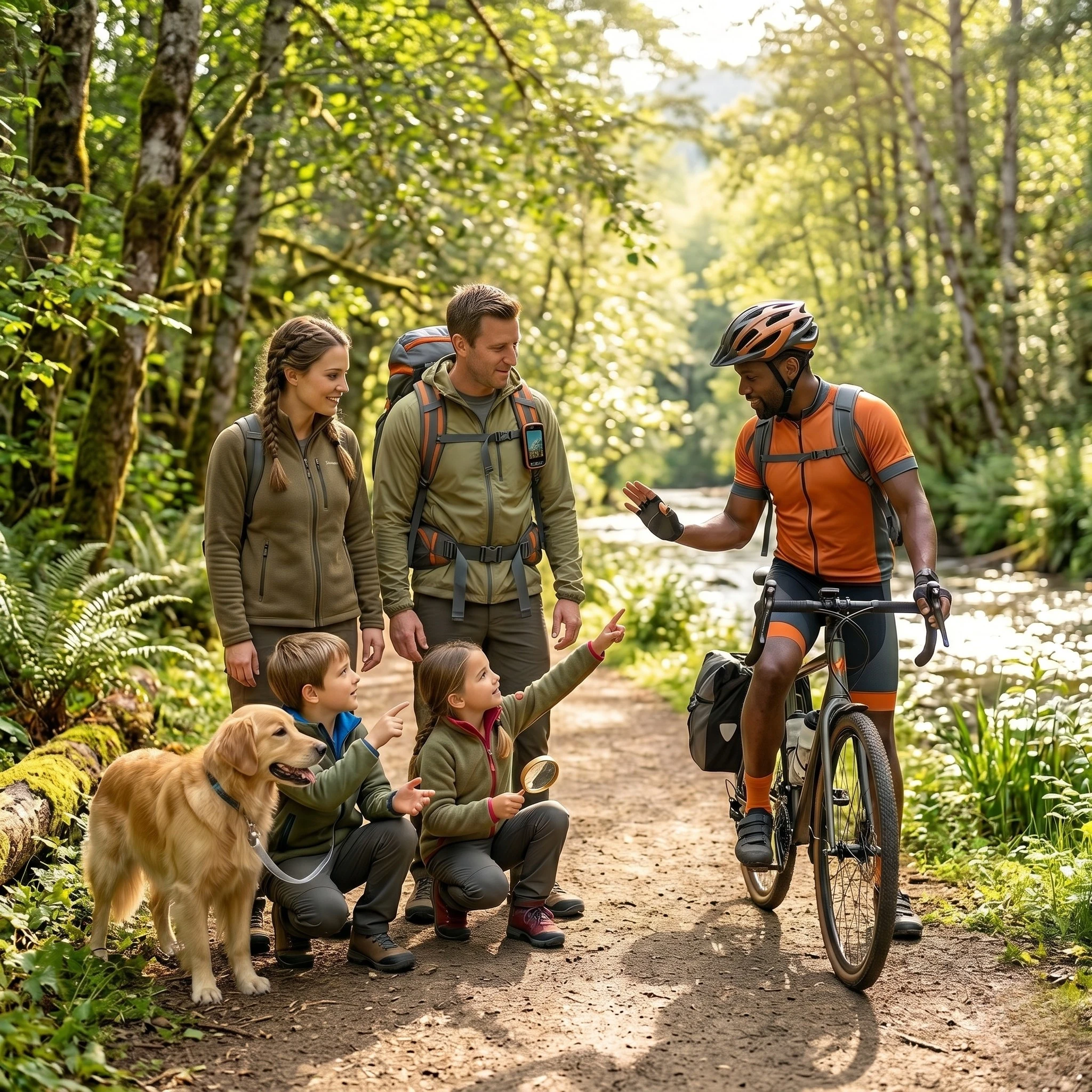
Table of Contents
The Physics of Shared-Path Velocity and Kinetic Energy
Implementing a standardized code of trail etiquette is a technical necessity for maintaining safety on modern shared multi-use paths. In 2026, the diversity of trail users—ranging from pedestrian families and slow-paced wanderers to high-velocity gravel cyclists—demands a rigorous approach to speed and space management. When multiple users share a single, narrow path, the mechanical risk of collision increases dramatically. To analyze this risk, meteorologists and trail engineers calculate the kinetic energy ($E_k$) of different users using the classical formula:$$E_k = \frac{1}{2} m v^2$$
Where:
- $m$ is the combined mass of the user and their equipment in kilograms.
- $v$ is the velocity in meters per second.
Because kinetic energy increases exponentially with the square of the velocity, a cyclist traveling at $10\text{ m/s}$ ($\approx 22\text{ mph}$) carries far more potential for destructive force than a pedestrian walking at $1.5\text{ m/s}$ ($\approx 3.3\text{ mph}$). This mechanical disparity requires that those traveling at higher velocities bear the primary responsibility for deceleration and yielding. A failure to manage this kinetic differential can lead to significant accidents. Understanding these dynamics is essential for preserving the safe, welcoming environments advocated in our Soft Hiking Guide (Internal Link) tutorials.
Deceleration Mechanics and the Hierarchy of Yielding
The foundation of modern trail safety is the yielding hierarchy, which determines who has the right of way during an intersection. The standard protocol dictates that cyclists must yield to pedestrians, and both cyclists and pedestrians must yield to equestrians. This hierarchy is based on the maneuverability and predictability of each user group.
To determine safe stopping distances, the navigator must calculate the total deceleration distance ($d_s$) required to come to a complete stop:$$d_s = v t_r + \frac{v^2}{2a}$$
Where:
- $v$ is the initial velocity.
- $t_r$ is the human reaction time ($\approx 1.5\text{ seconds}$ under trail conditions).
- $a$ is the deceleration rate supported by the trail surface (e.g., gravel provides less traction than asphalt).
Because loose gravel reduces the deceleration rate ($a$), a loaded bicycle requires a significantly longer distance to stop than a pedestrian, making early speed adjustment a mandatory safety protocol. This proactive approach to trail speed is a cornerstone of the Solo Bikepacking Safety Guide frameworks used to manage risk in remote areas. When approaching horses, cyclists must come to a complete stop and speak out loud to confirm that the animal has recognized their presence before slowly passing.
| User Type | Average Velocity ($v$) | Yield Priority | Mechanical Constraint |
|---|---|---|---|
| Equestrian | $2.0\text{ m/s}$ | 1 (Highest) | Large mass, unpredictable flight response |
| Pedestrian | $1.5\text{ m/s}$ | 2 | Low kinetic energy, unpredictable lateral movement |
| Cyclist | $8.0\text{ m/s}$ | 3 (Lowest) | High kinetic energy, restricted stopping friction |
Audio Signaling and Electronic Integration Protocols
As shared paths become more congested, the use of clear, predictable audio signals is the primary method for preventing collisions. A cyclist or high-speed pedestrian must announce their presence well before reaching the slower user’s deceleration zone.

The technical standard for overtaking is the “Bell and Voice” protocol. When a faster user approaches from behind, they should ring a mechanical bell at a distance of approximately 50 feet ($15\text{ meters}$), followed by a clear, calm verbal announcement such as “passing on your left.” This dual signal provides the trailing user with adequate time to secure children or pets without causing a panic reaction.
Furthermore, users who utilize headphones must wear “open-ear” bone-conduction models to maintain situational awareness. Blocking the ear canal entirely is a significant safety violation, as it prevents the detection of critical trail signals.
Environmental Preservation and Social Stewardship
The long-term sustainability of shared trails is dependent on strict adherence to environmental protection standards. The physical compaction of soil off the established path destroys delicate root systems, alters water runoff, and causes irreversible trail erosion.
Riders and hikers must strictly follow the guidelines established by the Leave No Trace Center for Outdoor Ethics. This means that users must remain in the center of the established path, even when navigating muddy sections or puddles. Stepping off the trail to avoid water causes “trail braiding”—the widening of paths that degrades local vegetation. Additionally, pet waste must be immediately bagged and carried to a trash receptacle; leaving bags on the side of the trail is a significant violation of social stewardship that damages the community reputation of outdoor enthusiasts.
Conclusion: The Shared Legacy of the Trail
Mastering the rules of modern trail etiquette is a fundamental requirement for anyone utilizing shared multi-use paths. By understanding the physics of kinetic energy (Section 1), practicing the correct yielding hierarchy (Section 2), and maintaining consistent audio communication (Section 3), all users can ensure a safe and harmonious environment. The success of a trail network is not measured by the speed of our travel, but by the level of respect and safety we extend to every individual we meet on the path.
The mountains and valleys are shared resources. Treat the land and your fellow travelers with the same technical precision you apply to your equipment. Step onto the trail with a plan, maintain total control of your speed, and enjoy the unique liberation of a peaceful, well-managed outdoor journey.
Discover more from Maive Verse
Subscribe to get the latest posts sent to your email.