

This post may contain affiliate links. If you buy through them, we may earn a small commission at no extra cost to you.
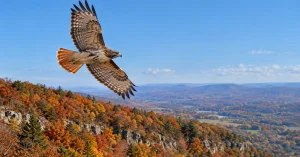
Learning how to identify hawks starts with a simple shift: stop looking for colors and start looking at shapes. A hawk a quarter mile up is a silhouette against bright sky, and the field marks in your guide are often invisible. Wing shape, tail length and the way the bird flies tell you far more, and they work at distances where plumage does not. Fall is the best time to practice, because thousands of raptors funnel south along ridges and coastlines from September into November.
This guide covers the main groups, the species most North American birders see, where and when to watch, and the habits that make identification faster. If you are new to birding in general, start with our birdwatching for beginners guide and come back when you have a pair of binoculars and a few trips behind you.
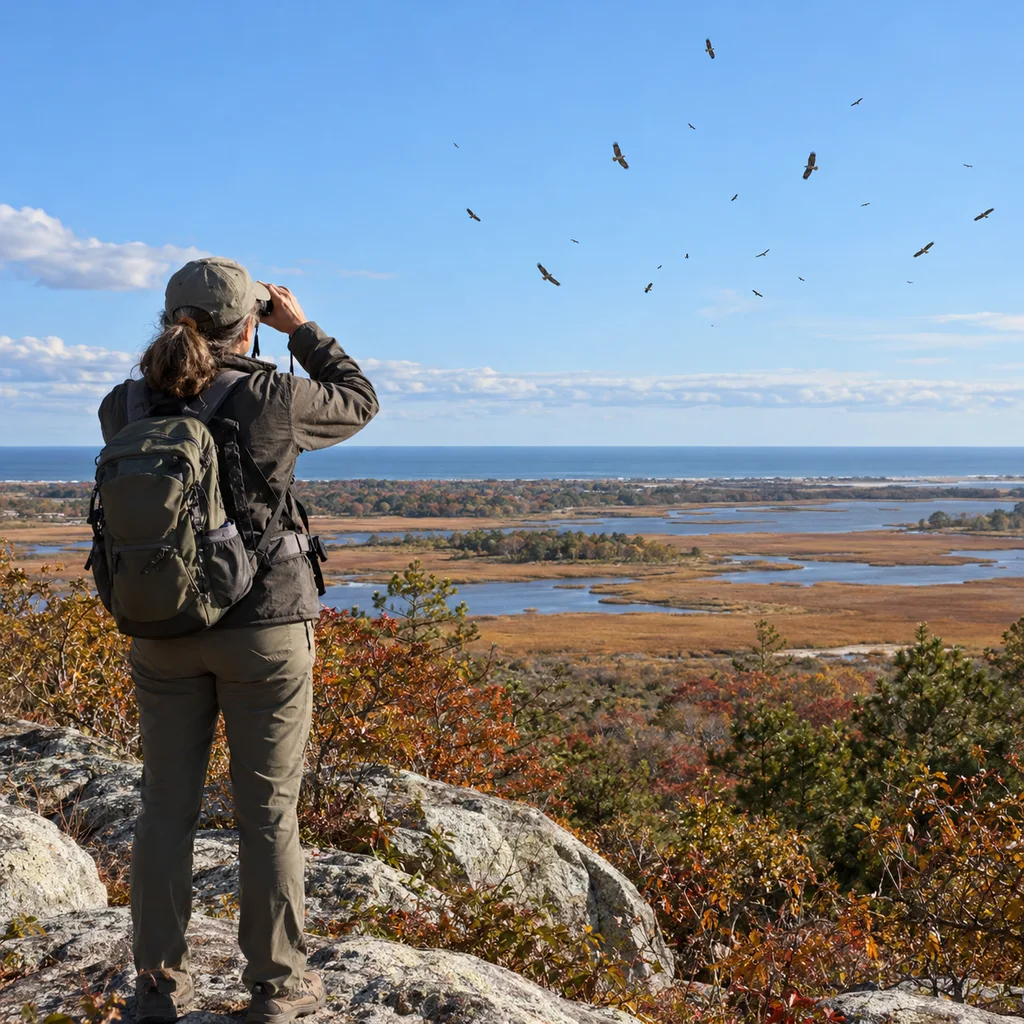
Table of Contents
Start With Shape: The Three Main Groups
Before you try to name a species, put the bird in a group. Almost every diurnal raptor you see in fall falls into one of three shapes, and getting the group right narrows the possibilities from dozens to a handful.
Buteos: Broad Wings, Short Tails
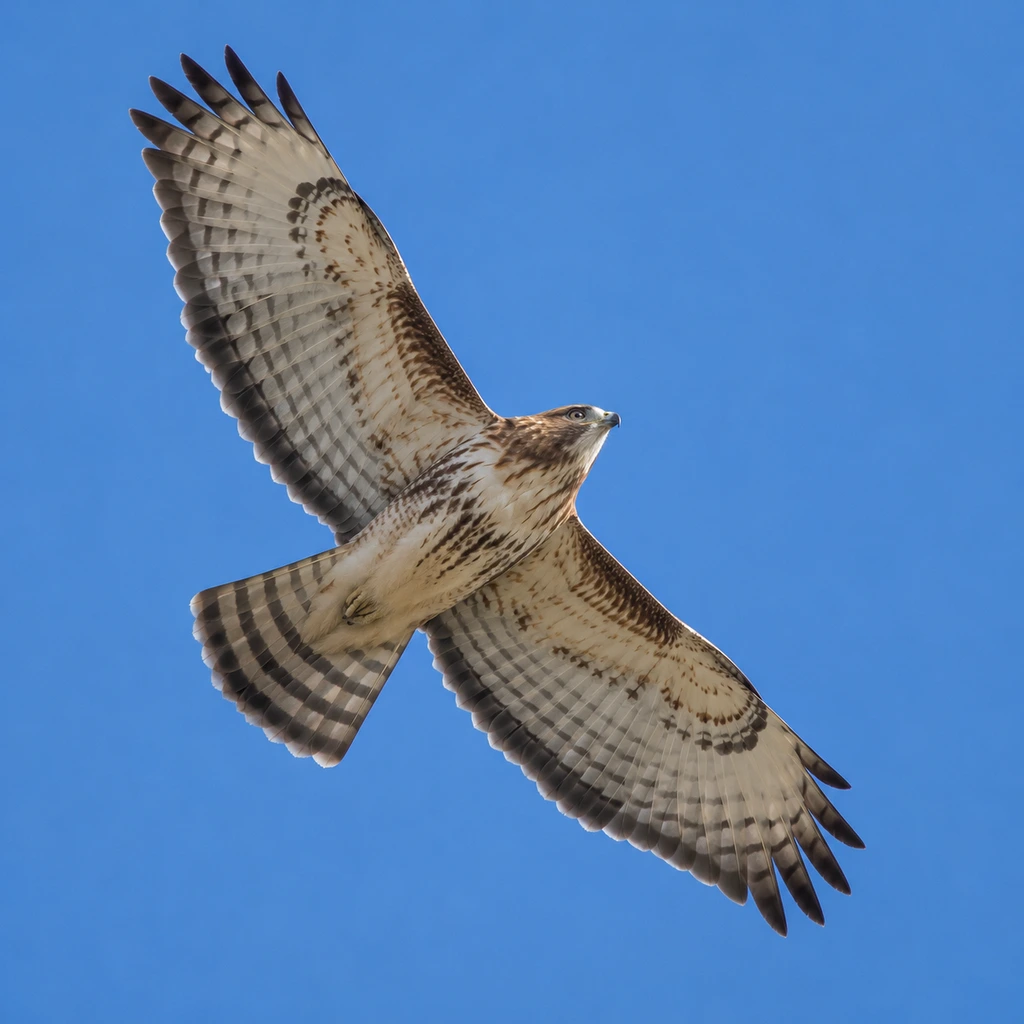
Buteos are the classic soaring hawks. They have long, broad wings with rounded tips and short, fanned tails, and they spend much of their time circling on thermals with very few wingbeats. The red-tailed hawk, red-shouldered hawk, broad-winged hawk and rough-legged hawk are all buteos.
Accipiters: Short Wings, Long Tails
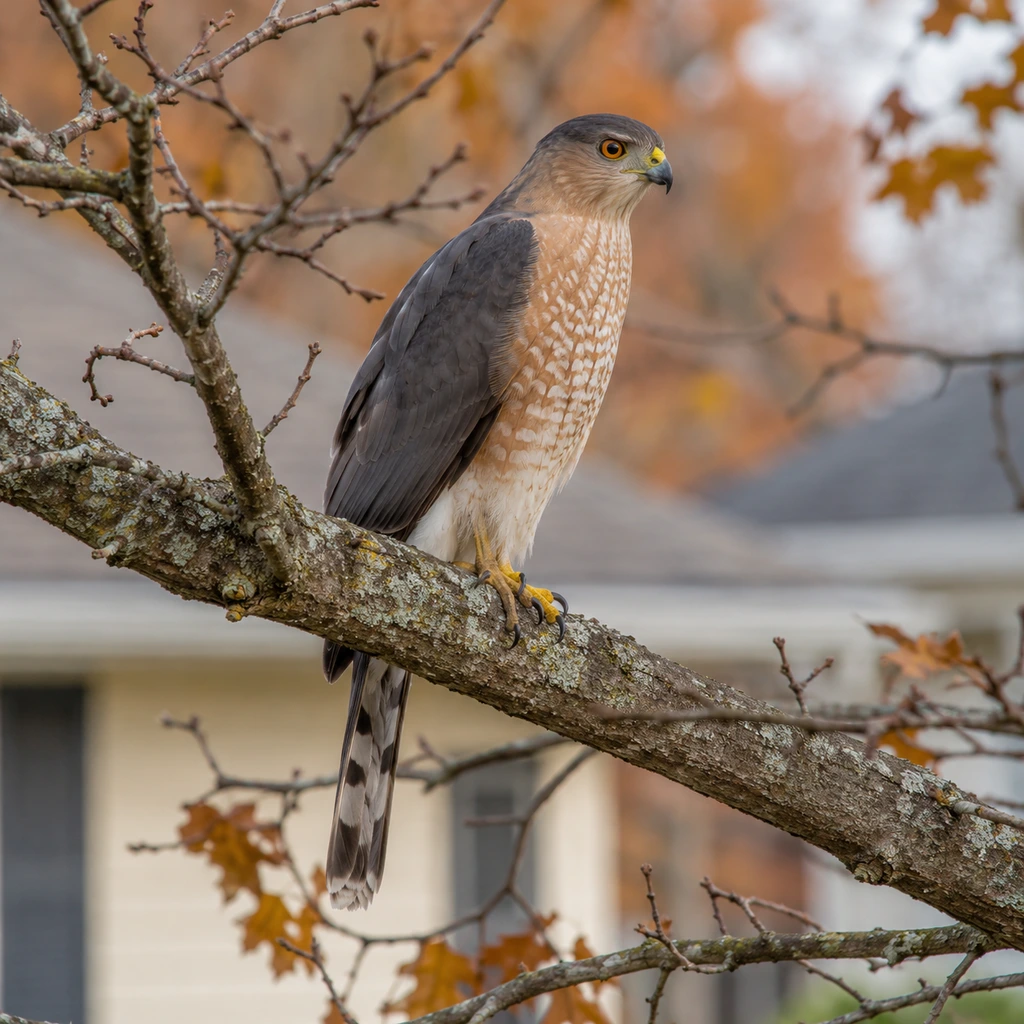
Accipiters are built for chasing birds through trees. Their wings are short and rounded and their tails are long, which gives them a cross-shaped silhouette. Their signature flight is several quick, stiff wingbeats followed by a short glide, often written as flap, flap, flap, glide. Cooper’s hawks and sharp-shinned hawks are the two you will see most.
Falcons: Pointed Wings, Fast Flight
Falcons are not hawks in the strict sense, but they share the same migration routes and get mixed in constantly. Look for long, pointed wings and powerful, steady wingbeats. American kestrels, merlins and peregrine falcons are the common three. If the wingtips are sharply pointed, it is almost certainly a falcon.
Harriers: The Odd One Out
The northern harrier fits none of the groups neatly. It is long winged and long tailed, flies low over fields and marshes, and holds its wings in a shallow V, called a dihedral, as it tilts from side to side. A white patch at the base of the tail shows from a long way off.
How to Identify Hawks by Flight and GISS
Experienced hawk watchers often name a bird before they can see a single feather, using what birders call GISS, short for general impression of size and shape. It sounds mysterious, but it is just pattern recognition built from watching a lot of birds.
Watch the Wingbeats
Buteos soar and flap slowly. Accipiters flap quickly in bursts and glide. Falcons flap steadily and powerfully and rarely circle for long. Harriers flap loosely and tilt. Counting the rhythm of the wings is often enough to place a distant bird in its group.
Note How It Holds Its Wings
Flat wings, slightly raised wings or wings bent at the wrist all mean something. Red-tailed hawks soar on fairly flat wings. Harriers and turkey vultures hold a V. Accipiters gliding in a crosswind often push their wrists forward.
Judge Size Carefully
Size is hard to judge against an empty sky, so compare birds when you can. A sharp-shinned hawk is roughly the size of a jay, a Cooper’s hawk closer to a crow, and a red-tailed hawk noticeably bigger and bulkier than either.
Once you have the group, field marks confirm the species: a rusty tail, a dark belly band, bold tail bands, a white rump. Work from shape to marks, never the other way round, and you will make far fewer mistakes.
The Hawks You Will See Most in Fall
Red-tailed Hawk
The red-tailed hawk is the most widespread large hawk in North America and the one to learn first. Adults show a brick red tail from above and a pale, rusty-washed tail from below. Most have a dark belly band across a pale chest and a dark bar on the leading edge of the underwing, called the patagial mark, which is one of the most reliable marks on a soaring bird. Look for it perched on poles and fence posts along highways.
Red-shouldered Hawk
Smaller and slimmer than the red-tail, with a longer tail. Adults have rich orange barring on the underparts, a black and white checkered look on the wings, and boldly banded black and white tails. In flight, look for pale crescents near the wingtips, called windows, which glow when the bird is backlit. Red-shoulders favor wet woods and river bottoms.
Broad-winged Hawk
A small, compact buteo and the star of September hawk watches. Broad-winged hawks migrate in huge flocks that spiral up on thermals in groups called kettles, sometimes thousands of birds at once, before streaming south. Adults have pale underwings with a dark trailing edge and a tail with one broad white band between black bands. Peak movement is usually mid September.
Rough-legged Hawk
A winter visitor from the Arctic that arrives in late fall. It often hovers over open fields, which few other large hawks do. Look for dark patches at the wrists on the underwing, a dark belly in many birds, and a white tail with a dark band near the tip.
Accipiters: Cooper’s Hawk Against Sharp-shinned Hawk
These two look almost identical in plumage and are the most common identification puzzle at any hawk watch or backyard feeder. Size overlaps, because females of both species are larger than males, so use several features together.
Head Projection
A Cooper’s hawk has a larger head that projects well past the leading edge of the wings in flight, giving it a flying cross look. A sharp-shinned hawk has a small head that barely sticks out, so the wings look pushed forward.
Tail Shape
Cooper’s hawks usually show a rounded tail tip with a broad white terminal band. Sharp-shinned hawks tend to show a squared or notched tail tip with a thin white edge. Tail shape changes when the tail is fanned, so check it when the tail is closed.
Flight Style
Sharp-shins flap with quick, choppy, almost frantic wingbeats. Cooper’s hawks have slightly slower, stiffer, more powerful beats. Both use the flap and glide rhythm. Watchers who see thousands a year still let some go as accipiter species, and that is perfectly acceptable. If one is hunting at your feeders, our guide on attracting birds to your yard explains how to give songbirds safer cover, and well-placed bird feeders and bird baths near shrubs help too.
Quick Hawk ID Comparison
Use this as a field cheat sheet. It covers the birds that make up most sightings at North American hawk watches in fall.
| Bird | Group | Key Mark | Flight | Peak Fall Timing |
|---|---|---|---|---|
| Red-tailed hawk | Buteo | Rusty tail, belly band, patagial mark | Slow soaring, flat wings | October to November |
| Red-shouldered hawk | Buteo | Pale wing windows, banded tail | Soars, quick wingbeats | October to November |
| Broad-winged hawk | Buteo | Broad white tail band, dark trailing edge | Kettles on thermals | Mid September |
| Rough-legged hawk | Buteo | Dark wrist patches, white tail base | Hovers over fields | Late fall into winter |
| Cooper’s hawk | Accipiter | Big head, rounded tail | Flap, flap, glide | Late September to October |
| Sharp-shinned hawk | Accipiter | Small head, square tail | Quick choppy wingbeats | Late September to October |
| Northern harrier | Harrier | White rump patch | Low, tilting, wings in a V | September to November |
Where and When to Watch Fall Migration
Raptors avoid crossing large bodies of water and ride rising air where they can, so migration concentrates along ridges, lakeshores and coastal points. Count sites staffed by volunteers report daily totals, and many welcome visitors. Our overview of fall bird migration explains the bigger picture, and many ridge sites double as great walks, so pair a hawk watch with the tips in our fall hiking guide.
Hawk Mountain, Pennsylvania
Hawk Mountain Sanctuary on the Kittatinny Ridge is the most famous hawk watch in the country and the world’s first refuge for birds of prey. Northwest winds after a cold front push birds along the ridge, and the North Lookout gives views for miles.
Cape May, New Jersey
Cape May Point sits at the tip of a peninsula where southbound birds pause before crossing Delaware Bay. Accipiters and falcons are the specialty, often at close range from the hawk watch platform.
Hawk Ridge, Minnesota
Above Duluth, Hawk Ridge catches birds that follow the Lake Superior shoreline rather than cross it. Broad-winged hawk flights in mid September can be enormous.
Corpus Christi, Texas
Along the Texas coast, the hawk watch near Corpus Christi records some of the largest broad-winged hawk numbers in North America in late September, when kettles stack up over the coastal plain on their way to Mexico.
Gear and Habits That Make ID Easier
Binoculars for Raptors
An 8×42 binocular is the best all-round choice: bright, steady and with a wide field of view for tracking a moving bird. The Celestron Nature DX 8×42 is an easy starting point, and the Vortex Crossfire HD 8×42 adds an excellent warranty. For open country, a 10x such as the Bushnell Engage X 10×42 pulls distant birds closer. Our full list of the best binoculars for birdwatching compares them in detail.
A Scope for Hawk Watches
At ridge sites, a spotting scope helps with distant perched birds and with sorting kettles. Our picks for the best spotting scopes cover budget and premium options. A tripod and a chair make long days on a lookout far more comfortable.
Use eBird and Your Notes
Log sightings in eBird to see what others are reporting nearby and when species peak in your area. Sketching or jotting a few words about shape and flight, not just the name, trains your eye faster than any app.
Dress for a Day on the Lookout
Hawk watching means standing still in wind, often on an exposed ridge, on exactly the cold, clear days after a front when birds move best. Bring more layers than you think and a pack with room for food and water, like the ones in our best hiking daypacks list; our guide on how to layer for hiking applies, and a warm hat matters.
Hawk Watching Ethics
Give perched raptors space and never flush a bird for a better look or a photograph. At busy count sites, keep voices down, leave the front of the lookout to the official counters and ask before setting up a scope in a shared spot. On the trail, the usual trail etiquette applies. Raptors are protected under the Migratory Bird Treaty Act, so disturbing nests or birds is not just bad form.
Frequently Asked Questions
What is the easiest way to learn how to identify hawks?
Learn the shape groups first, then the red-tailed hawk, then add species one at a time. Visiting a staffed hawk watch, where counters call out birds as they pass, speeds this up enormously.
What is the most common hawk in North America?
The red-tailed hawk. It lives across most of the continent year round and is the large hawk you usually see perched along roads and fields.
When is the best time to see migrating hawks?
From mid September through November. Broad-winged hawks peak in mid September, accipiters and falcons in late September and October, and red-tailed hawks in late October and November. Clear days after a cold front with northwest winds are best in the East.