

This post may contain affiliate links. If you buy through them, we may earn a small commission at no extra cost to you.
The best bird feeders solve one problem before any other: keeping the seed for the birds. Squirrels will empty an unprotected feeder in an afternoon, and most people who give up on feeding birds gave up over that, not over the birds. Everything else, capacity, port count, material, matters after that is settled.
Below are six that are genuinely stocked on Amazon right now, each chosen for a different garden and a different kind of bird rather than ranked one to six. Ratings and specifications were checked at the time of writing. If you are new to the hobby entirely, start with our complete guide to birdwatching for beginners, which covers what to do once the birds arrive.
Table of Contents
What Separates the Best Bird Feeders
Four things decide whether a feeder gets used or quietly retired to the shed, and price predicts only one of them.
- Squirrel defence that actually works. Weight-activated shrouds are the only mechanism that reliably works, because they close the ports under a squirrel and reopen under a bird. Baffles and cages help; cayenne pepper and greased poles do not.
- Chew-proof materials. A squirrel that cannot get in will try to gnaw in. Metal ports and UV-stabilised, chew-resistant plastic are the difference between one season and ten.
- How easily it comes apart. Dirty feeders spread disease between birds, so you need to clean it every couple of weeks. If that needs tools, it will not happen.
- The food it is built for. Seed, nectar and mealworms need completely different feeders, and the food you choose decides which species turn up far more than the feeder does.
Placement matters as much as hardware. Feeders need cover within a short flight, roughly ten feet, so birds have somewhere to escape to, but not so close that squirrels can jump across. Logging what turns up on the free eBird platform is the easiest way to see whether a change of placement actually worked. The Cornell Lab All About Birds guide is the best free reference for working out which species you can realistically expect, and our companion guide to attracting birds to your yard covers water, cover and placement in detail.
The Best Bird Feeders at a Glance
Rule four of them out here, then read the two that are left. The first question is what you want to feed, and the second is whether squirrels are a problem where you live. A feeder pairs naturally with a pair of binoculars chosen for birding, though a window feeder needs neither.
| Feeder | Food | Squirrel defence | Capacity | Best for |
|---|---|---|---|---|
| Squirrel Buster Plus | Seed | Weight-activated shroud | 5.1 lb | Best overall |
| Perky-Pet Squirrel-Be-Gone | Seed | Weight-activated ports | 2 lb | Best budget |
| Kingsyard Glass Hummingbird | Nectar | Not needed | 16 oz | Hummingbirds |
| Clear Window Feeder | Seed | Window mounted | Small tray | Close up viewing |
| Squirrel Buster Mini | Seed | Weight-activated shroud | 1 lb | Small gardens and balconies |
| Smart Feeder with Camera | Seed | Not included | Spill proof tub | Identifying your visitors |
The Six Best Bird Feeders in Detail
Squirrel Buster Plus: Best Overall
This is the feeder to buy if you want the problem solved and no further thought. Brome’s shroud mechanism is the one everything else imitates: openings in the outer sleeve line up with the feeding ports, and when a squirrel puts its weight on the feeder the sleeve slides down and closes the ports completely. The squirrel is not hurt, it is simply served nothing.
What lifts the Plus above the rest of the range is the weight-adjustable spring. You can tune exactly how much weight closes the shroud, which lets you admit cardinals and grackles while excluding squirrels, or tighten it down to smaller birds only. The cardinal ring gives larger birds somewhere to perch, which most tube feeders do not.
At 28 inches tall it holds 5.1 pounds of seed, so refills are occasional rather than constant, and every exposed part is UV-stabilised, chew-proof material. Brome backs it with what they call Lifetime Care. At 4.7 stars across more than ten thousand ratings, it is the most consistently recommended seed feeder on Amazon.
Specs That Matter
- 5.1 lb seed capacity, 28 inches tall
- Weight-activated shroud closes the ports under a squirrel
- Adjustable spring sets the closing weight
- Cardinal ring plus 6 feeding ports
- UV-stabilised chew-proof construction, pole mountable
Who It Is For
Anyone with a real squirrel problem who wants to buy once and stop thinking about it.
Perky-Pet Squirrel-Be-Gone: Best Budget
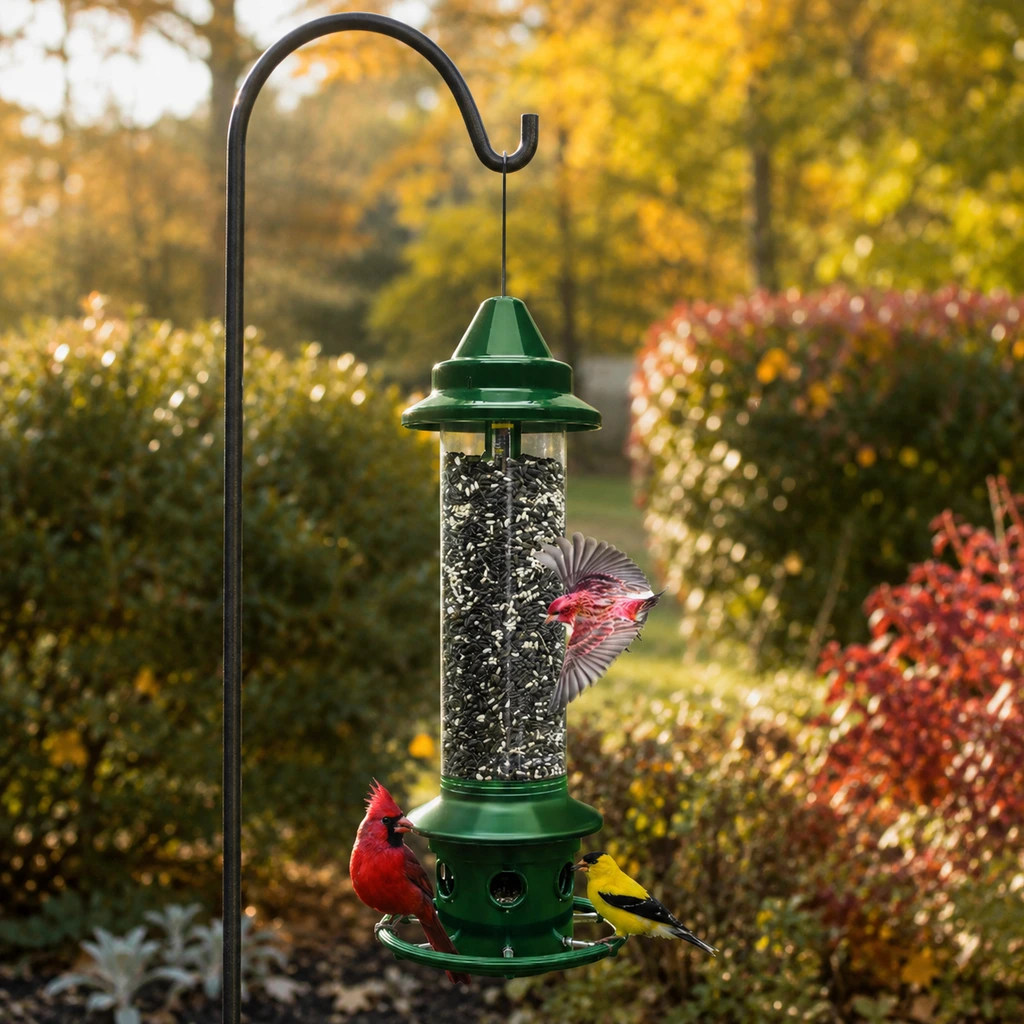
With more than twenty thousand ratings this is the most bought feeder here by a distance, and it delivers the important mechanism, weight-activated port closure, at a fraction of the price of the premium options. Put weight on the perch ring or the metal frame and the feeding ports shut.
The body is powder-coated metal rather than plastic, which gives it a rustic look and genuine rust resistance, and metal is inherently chew-proof in a way that budget plastic feeders are not. The U-shaped perches suit the perching birds most gardens actually get.
The clear seed reservoir is a small thing that matters daily, because you can see at a glance whether it needs filling rather than opening it. At 2 pounds capacity it needs refilling more often than the Squirrel Buster Plus, and its 4.0 star average is the lowest here, reflecting a mechanism that is effective but less refined than Brome’s.
Specs That Matter
- 2 lb seed capacity in a clear reservoir
- Weight-activated ports close under a squirrel
- Powder-coated metal body, rust resistant
- U-shaped perches suited to perching birds
- Hanging design for a tree, hook or bracket
Who It Is For
First time feeders and anyone who wants working squirrel defence without paying premium prices.
Kingsyard Glass Hummingbird Feeder: Best for Hummingbirds
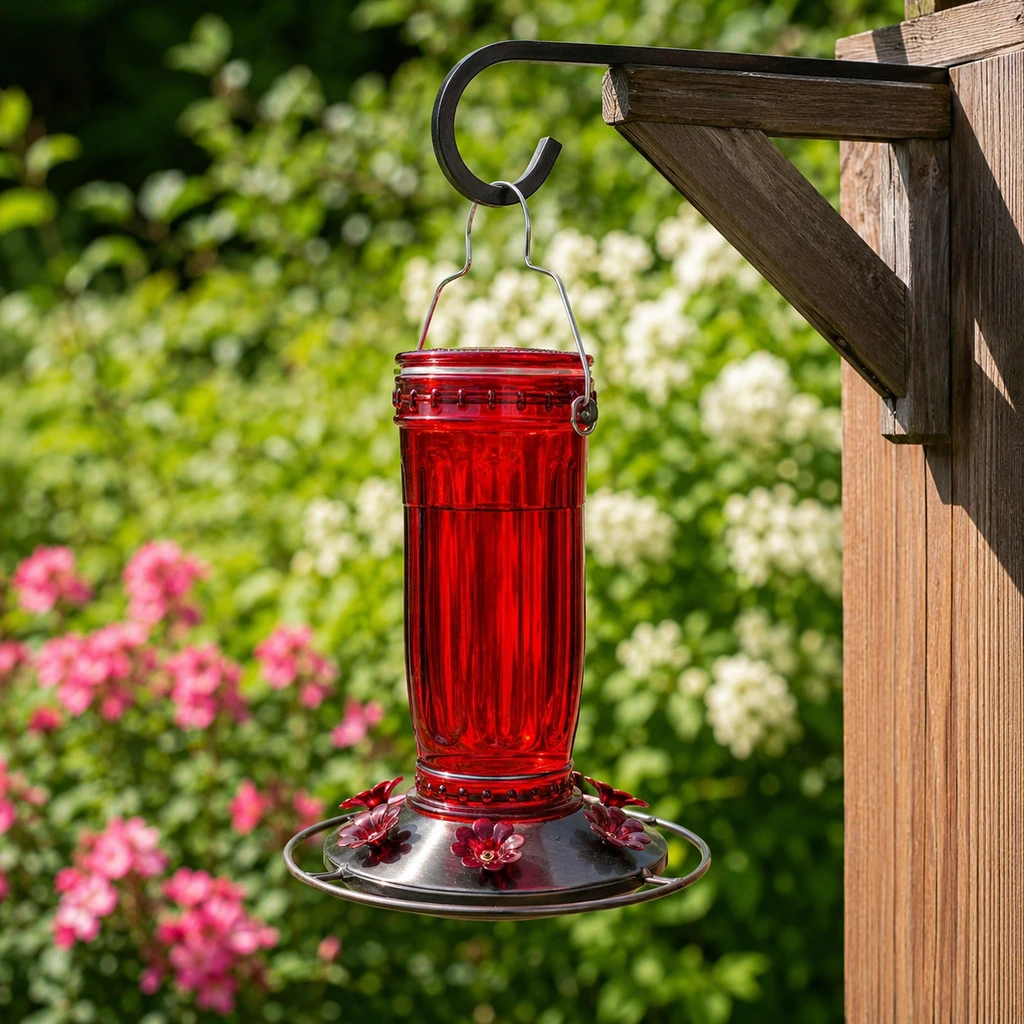
Hummingbirds need nectar, not seed, so this is a different instrument entirely and worth owning alongside a seed feeder rather than instead of one. Six flower-shaped ports around a 16 ounce glass reservoir let several birds feed at once, which matters because hummingbirds are territorial and a single-port feeder gets monopolised.
Two design details do the real work. The built-in gasket makes the base-to-bottle seal genuinely leakproof, which matters more than it sounds because dripping nectar is what attracts ants and wasps in the first place. The included ant moat, a small water reservoir above the feeder, stops the ants that get there anyway.
Glass rather than plastic is the right call for nectar, because it does not cloud, scratch or hold sugar residue in the way plastic does, and the wide-mouth bottle plus fully disassembling base makes cleaning practical. Nectar feeders need washing every few days in warm weather, so that matters.
Specs That Matter
- 16 oz glass reservoir with 6 flower-shaped ports
- Built-in gasket for a leakproof base seal
- Large-capacity ant moat with stainless steel hook
- Wide-mouth bottle, fully disassembles for cleaning
- Glass construction resists clouding and residue
Who It Is For
Anyone in hummingbird territory, and gardeners who want colour and activity rather than volume.
Clear Window Bird Feeder: Best for Close-Up Viewing
This is the feeder that converts people into birdwatchers. It suction-cups to the outside of a window, so the birds feed inches from your face with a pane of glass between you, and you get a view no pair of binoculars will match. For anyone without a garden, it is often the only option.
Five heavy-duty suction cups hold it through weather and through several birds landing at once, which is the point where cheaper window feeders fail. The seed tray lifts out for cleaning and refilling without unmounting the whole thing, and the sloping roof plus drainage holes keep the seed dry in rain and snow.
The acrylic is clear on all sides, and the corners are rounded rather than sharp so there is nothing for a bird to catch itself on. It is a favourite for children and for anyone with limited mobility, since the birds come to the window rather than the other way round. Expect small birds rather than the full range a pole feeder attracts.
Specs That Matter
- Mounts to any window with 5 heavy-duty suction cups
- Lift-out seed tray for easy cleaning and refilling
- Sloping roof and drainage holes keep seed dry
- Clear acrylic on all sides for an unobstructed view
- Rounded corners with no sharp edges
Who It Is For
Apartment dwellers, families with children, and anyone who wants birds at arm’s length.