
This post may contain affiliate links. If you buy through them, we may earn a small commission at no extra cost to you.
The best spotting scopes do the one thing binoculars cannot: hold a steady, magnified image of something a long way off, for as long as you want to look at it. Ducks on the far side of a lake, a raptor on a distant pylon, a wader flock on a mudflat. At that range binoculars show you a shape and a scope shows you a species.
We compared six scopes from a 60mm budget kit to an 85mm HD glass, all checked on their listings for stock, rating and real specifications. Two candidates were dropped along the way: one 5.0 star scope resting on three reviews, and a second Gosky listing that shared its review count with the one below, meaning it was a variant rather than an independent product. If you are still deciding whether you need a scope at all, our birdwatching guide starts with binoculars.
Table of Contents
What Separates the Best Spotting Scopes
Three numbers and one accessory decide almost everything.
The objective lens diameter, the second number in a name like 20-60×80, is how much light the scope gathers. Eighty millimetres is the practical standard for birding; sixty is noticeably dimmer at dusk and dawn, which is when birds are most active. Bigger glass costs weight as well as money, which is why 80mm rather than 100mm is the sweet spot.
The magnification range, the first number, matters less than people expect. Nearly all useful viewing happens between 20x and 40x, because beyond that heat shimmer and hand tremor destroy the image faster than magnification improves it. A 25-75x scope is not better than a 20-60x scope, it just has more numbers you will rarely use. Specification inflation runs through outdoor gear, from lumen claims on headlamps to bearing counts on reels.
Then the tripod, which is not an accessory but half the instrument. A good scope on a flimsy tripod is worse than a modest scope on a solid one, because at 40x a breath of wind is a visible wobble. Any scope sold with a tabletop tripod needs a proper one eventually, the same way poles only help once they are the right length.
The Best Spotting Scopes at a Glance
| Scope | Magnification | Objective | Sealing | Best For |
|---|---|---|---|---|
| Vortex Diamondback HD | 20-60x | 85 mm | Argon purged, waterproof | Best overall |
| Celestron Ultima 80 | 20-60x | 80 mm | Multi coated | Best value |
| Gosky Flagship DiamondEdge | 20-60x | 80 mm | Nitrogen filled | Most complete kit |
| Athlon Talos | 20-60x | 80 mm | Nitrogen purged | Best mid range glass |
| SVBONY SV28 | 25-75x | 70 mm | Waterproof | Best budget |
| NWDEY 25-75×60 | 25-75x | 60 mm | Multi coated | Cheapest full tripod kit |
The Six Best Spotting Scopes in Detail
Vortex Diamondback HD 20-60×85: Best Overall
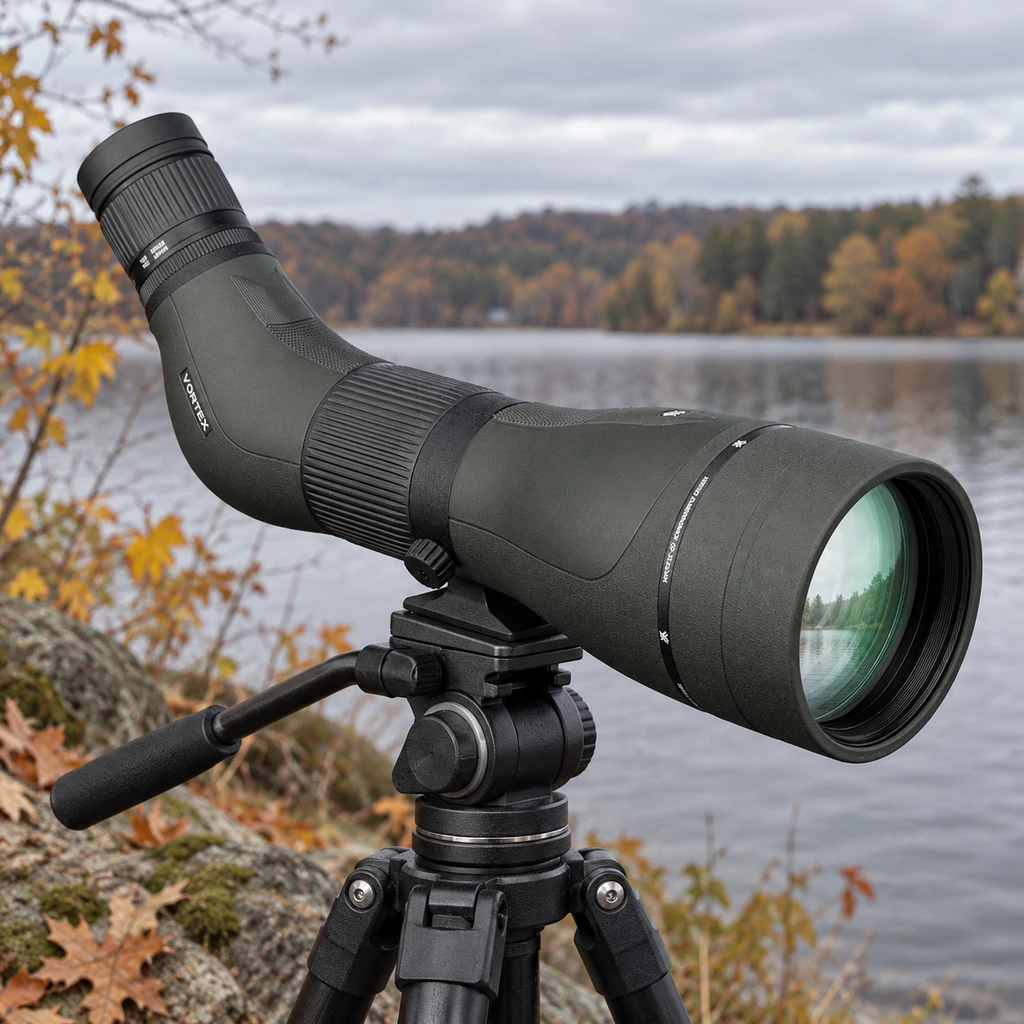
The Diamondback HD is where the optics stop being the limiting factor and your tripod and the weather take over. An 85mm HD optical system cuts chromatic aberration, which in practice means the dark edges of a bird against a bright sky stay black rather than fringing purple, and it holds resolution right to the edge of the field rather than only in the centre.
It is built for the worst conditions you will use it in. O-ring sealed and argon purged for genuine waterproof and fogproof performance, Armortek coatings on the lenses to shrug off oil and scratches, rubber armour on the body, and a built in sunshade that also keeps rain off the objective. Adjustable twist up eyecups mean it works with or without glasses.
The mounting detail matters more than it sounds: it is Arca-Swiss compatible, so it goes straight onto a decent tripod head without an adapter plate, and it takes a car window mount for roadside viewing. Low light performance is the real reason to buy it, and low light is when birding happens.
Specs That Matter
- Optics: 85mm HD system, cuts chromatic aberration, edge to edge sharpness
- Sealing: O-ring sealed and argon purged, waterproof and fogproof
- Protection: Armortek lens coatings, rubber armour, built in sunshade
- Mounting: tripod adaptable, Arca-Swiss compatible, car window mount capable
- Rating: 4.6 stars across 455 reviews
Who It Is For
Anyone who watches birds at distance regularly and wants the glass to outlast their interest in upgrading.
Celestron Ultima 80 20-60×80: Best Value
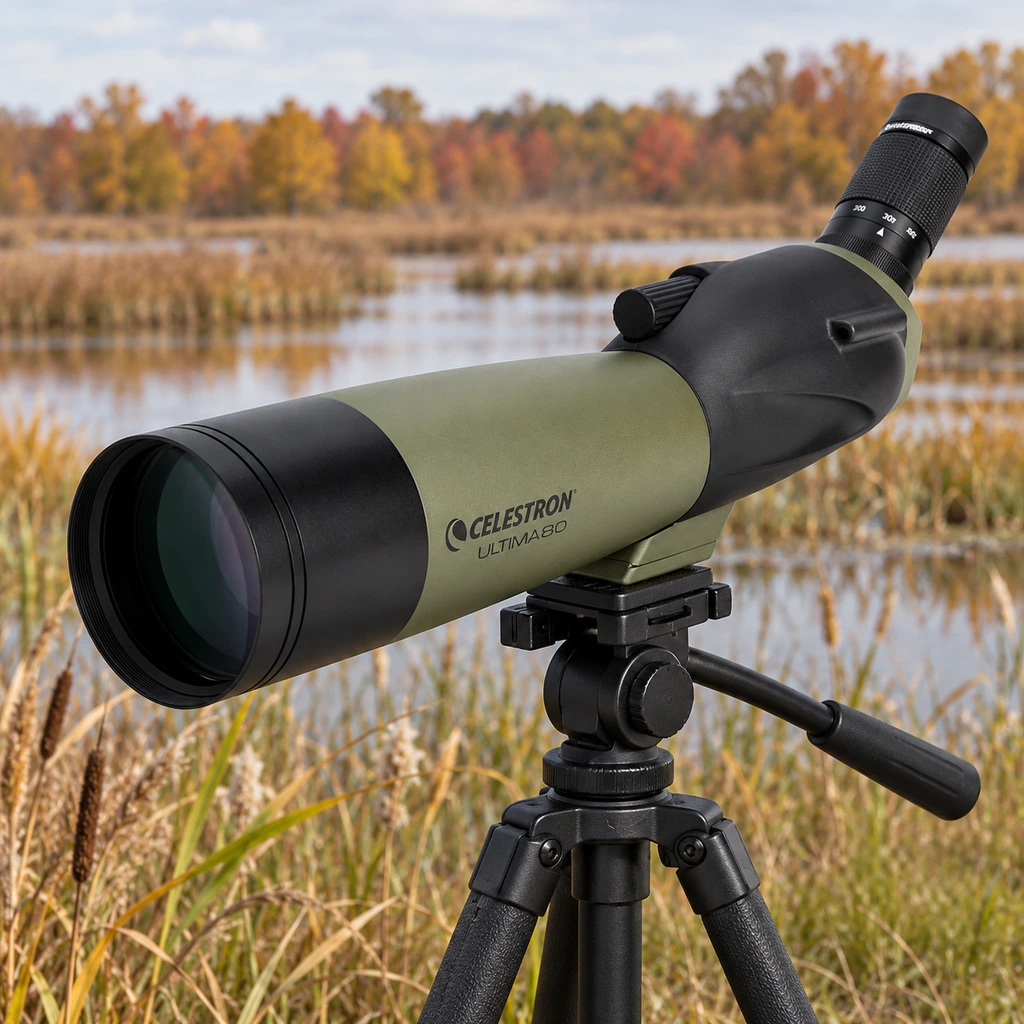
This is the scope most serious beginners should buy. An 80mm objective and 20-60x zoom at a fraction of the premium price, from a brand that has been making optics since 1960 and backs it with a limited lifetime warranty.
The 45 degree angled eyepiece is the right choice for birding, whatever hunting listings suggest. Angled is more comfortable for long sessions, far easier to share with someone shorter, and much better for looking upward at a bird in a tree, which is most of what woodland birding involves.
Every lens surface carries multiple anti reflective coatings, and it arrives with the things you would otherwise buy separately: a soft carrying case, an extended tripod mounting plate and the zoom eyepiece. The large focus dial is the underrated feature, because a bird moves and a small stiff dial loses it.
Specs That Matter
- Optics: 80mm objective, 20-60x zoom, fully multi coated surfaces
- Eyepiece: 45 degree angled, better for upward viewing and sharing
- Included: soft carrying case, extended tripod mounting plate, zoom eyepiece
- Support: Celestron limited lifetime warranty
- Rating: 4.4 stars across 1,350 reviews
Who It Is For
Beginners buying their first scope who want brand support and glass they will not immediately outgrow.
Gosky Flagship DiamondEdge 20-60×80: Most Complete Kit
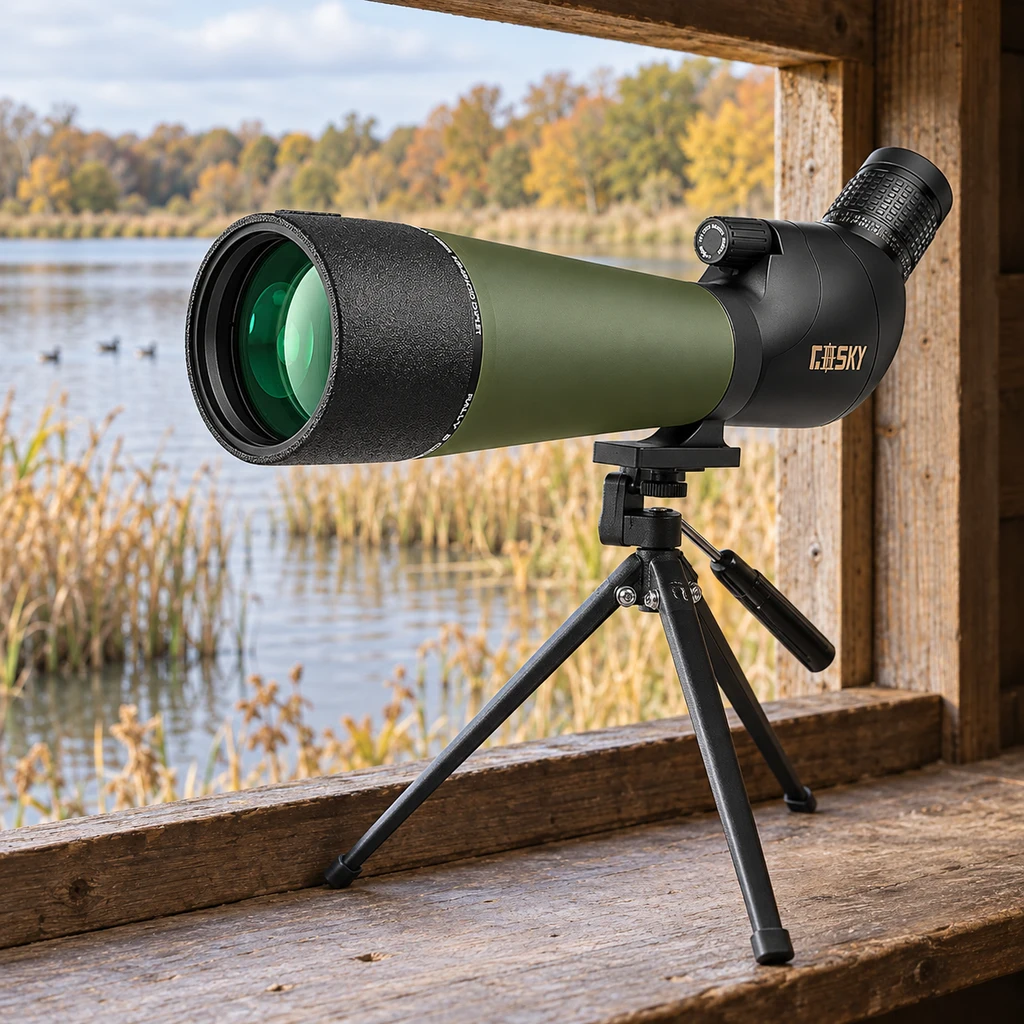
More than five thousand reviews at 4.4 stars makes this the most tested scope in the round up, and it arrives with more in the box than anything else here. An 80mm fully multi coated green film objective gives a field of view running from 82.9 feet down to 48 feet at 1000 yards across the zoom range.
It is nitrogen filled and sealed, so it is genuinely waterproof and fogproof rather than merely water resistant, which matters if your birding happens in autumn and winter weather rather than on clear afternoons.
The kit is the selling point. A full metal tabletop tripod and mount, a carrying case, and a smartphone adapter for digiscoping, which is how most people end up sharing what they see. The tabletop tripod is fine for a hide window or a car bonnet and will want replacing for standing use.
Specs That Matter
- Optics: 80mm fully multi coated green film objective, 20-60x zoom
- Field of view: 82.9 to 48 ft at 1000 yards across the zoom range
- Sealing: nitrogen filled, waterproof and fogproof
- Included: full metal tabletop tripod, carrying case, smartphone adapter
- Rating: 4.4 stars across 5,523 reviews
Who It Is For
Anyone who wants everything in one box, and anyone planning to photograph through the scope with a phone.
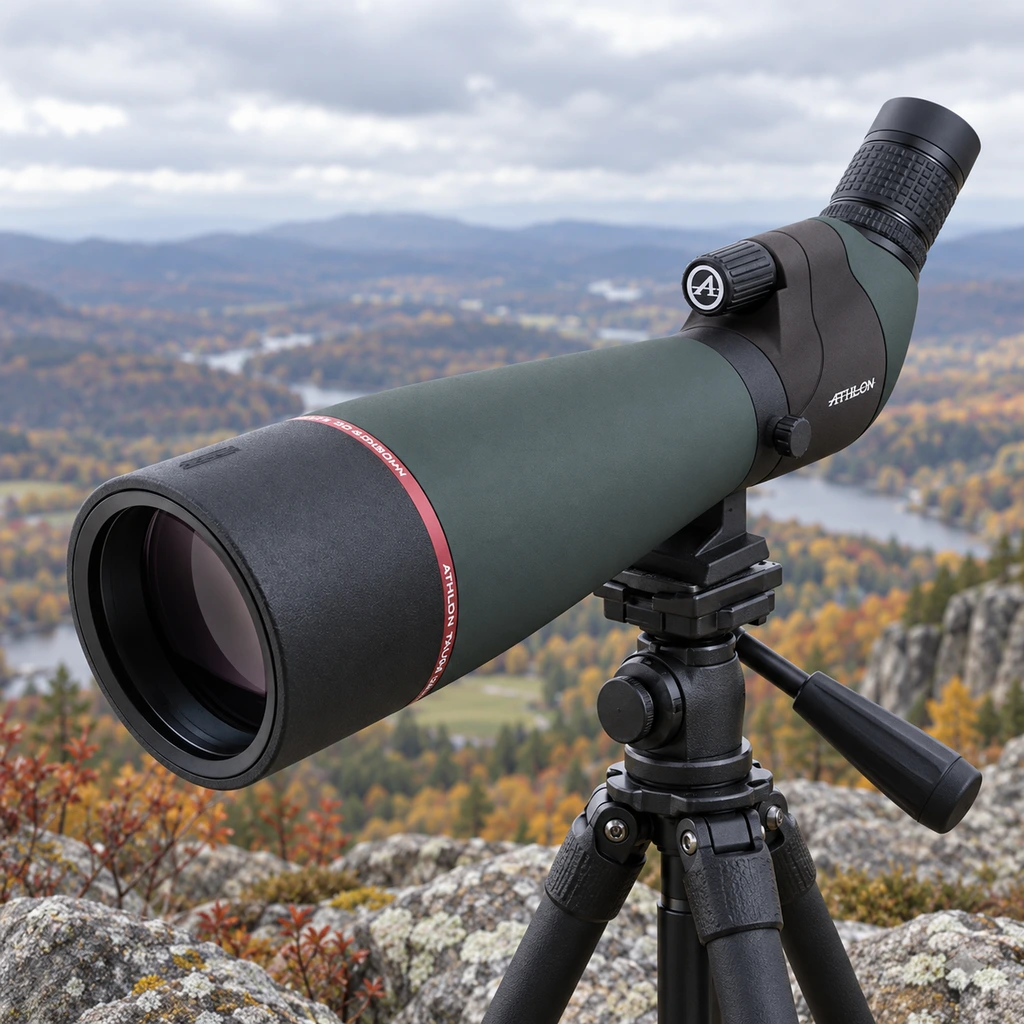
Athlon Talos 20-60×80: Best Mid Range Glass
The Talos sits between the budget kits and the premium glass, and the money goes into the optical path rather than the accessories. K9 glass prisms with silver coating reflect more light to your eye than the aluminium coatings common at this price, and every lens is fully multi coated.
Nitrogen purging does two jobs: it keeps moisture out for waterproofing, and it improves thermal stability, which is why the image does not fog internally when you carry a cold scope into a warm hide or the reverse. It is waterproof to the point of surviving accidental submersion.
The rotating tripod ring is the feature you will use every session. It lets you turn the scope body around the mounting ring so the eyepiece sits at a comfortable angle whatever the tripod is doing, which matters on a slope or when viewing steeply upward. It ships with a tripod and a carrying case.
Specs That Matter
- Prisms: K9 glass with silver coating for higher light transmission
- Lenses: fully multi coated throughout
- Sealing: nitrogen purged for waterproofing and thermal stability
- Handling: rotating tripod ring, ships with tripod and carrying case
- Rating: 4.4 stars across 265 reviews
Who It Is For
Birders who care more about the view than the accessory list, and anyone who watches in cold or wet conditions.
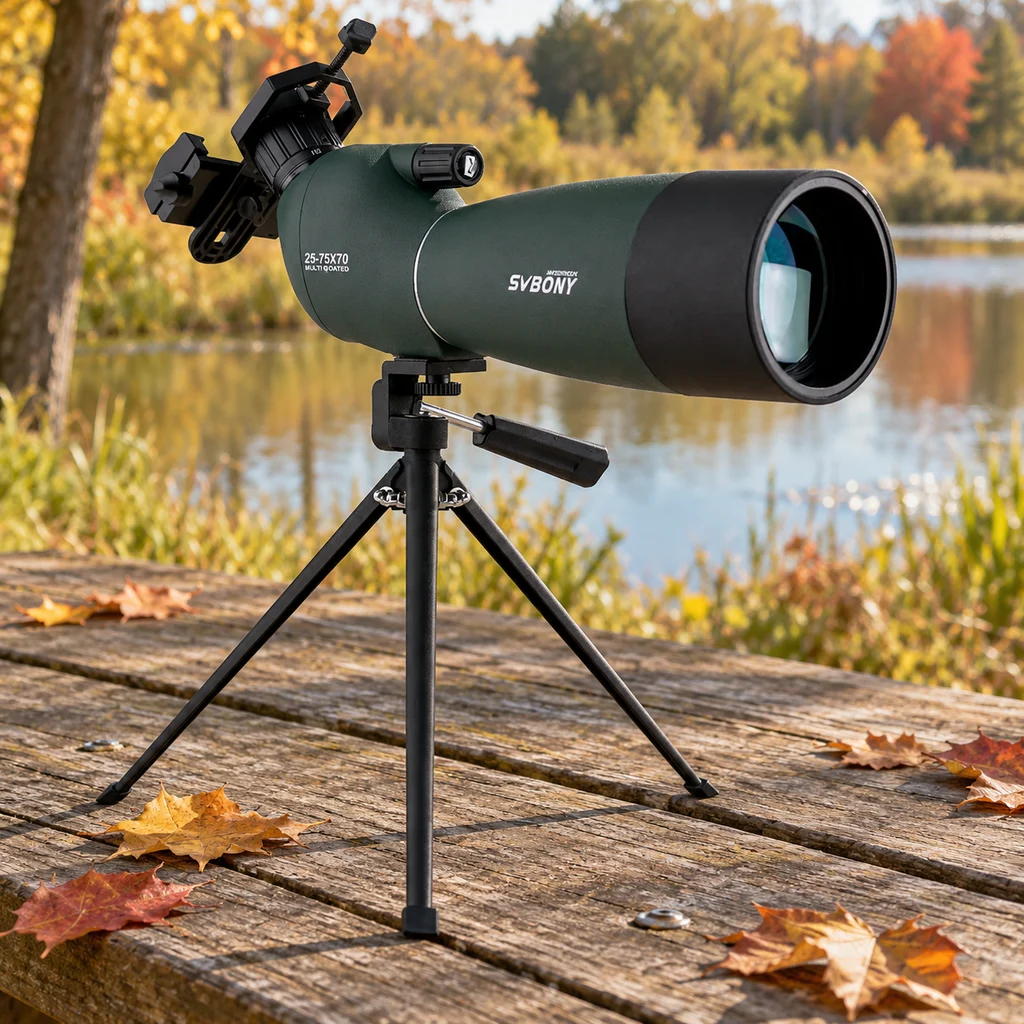
SVBONY SV28 25-75×70: Best Budget
Three thousand reviews at 4.4 stars at this price is why the SV28 keeps appearing in beginner recommendations. A 70mm objective and 25-75x zoom, waterproof, with a non slip seamless finish that does not feel like the cheap plastic the price suggests.
Seventy millimetres gathers less light than the 80mm scopes above, and you will notice it at dusk. In good daylight the difference is much smaller than the price gap, which is the honest trade you are making. The extendable sunshade helps with glare on bright water.
It comes with a phone adapter and a desktop tripod, and it is light enough to leave in the car, which in practice is the feature that gets a scope used. Set it up on a car window or a picnic table at a lake and it earns its keep immediately.
Specs That Matter
- Optics: 70mm objective, 25-75x zoom, extendable sunshade
- Weather: waterproof body with a non slip seamless finish
- Included: phone adapter and portable desktop tripod
- Portability: light enough to keep in the car permanently
- Rating: 4.4 stars across 3,326 reviews
Who It Is For
First scopes, garden and pond watching, and anyone who wants distance viewing without a real budget.
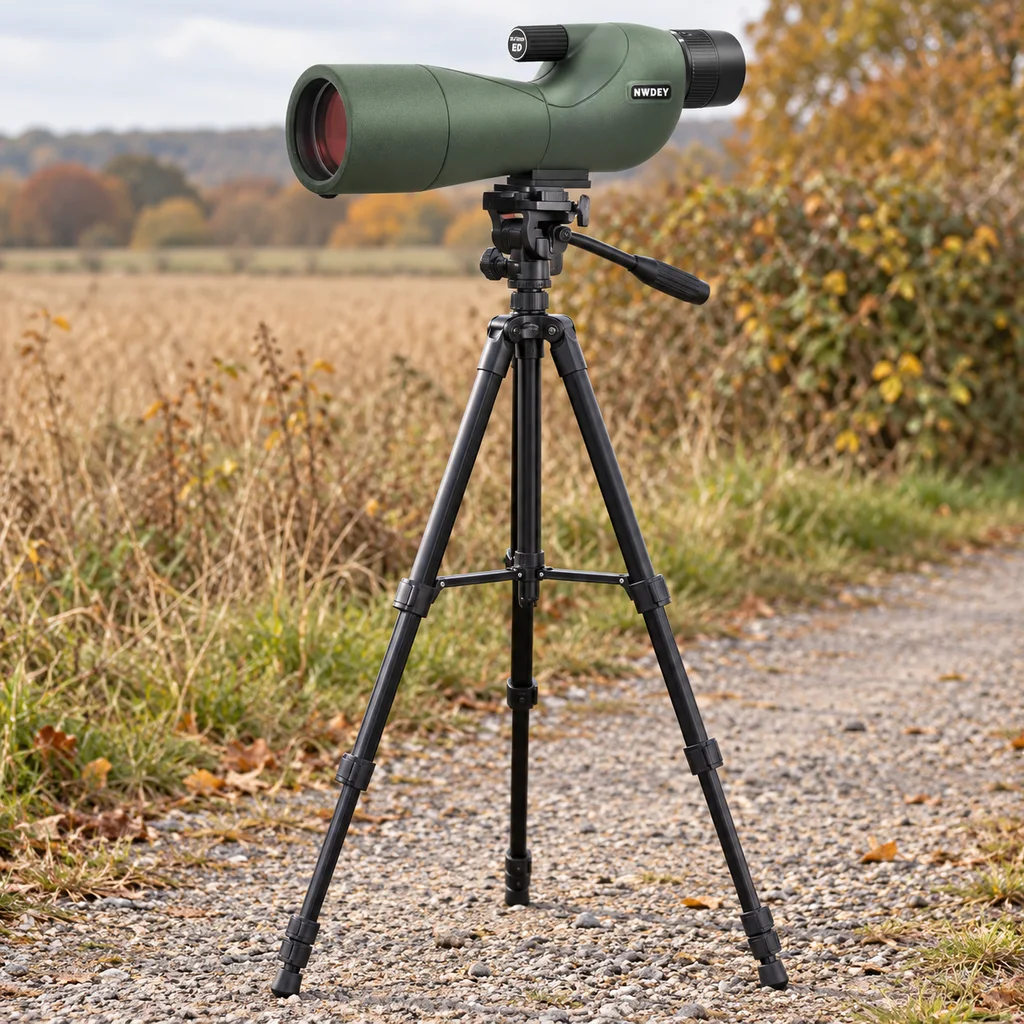
NWDEY 25-75×60: Cheapest Full Tripod Kit
This is the only pick here that arrives with a full height tripod rather than a tabletop one, and that is the entire reason it is on the list. A 60 inch adjustable tripod with three way angle adjustment and a quick release plate means you can stand and watch comfortably on day one without a second purchase.
Be clear about the compromise. The 60mm objective is the smallest here and it is dimmer at dawn and dusk than any of the 80mm scopes, and at 4.1 stars across 140 reviews it is also the lowest rated pick in this round up. The BAK4 prism and fully multi coated 60mm lens do a reasonable job in daylight and no more.
The listing is unusually honest about how to use it: start at 25x to find your target, then zoom in gradually, and start low for digiscoping with the included phone adapter. That is correct advice for any scope and most listings do not give it.
Specs That Matter
- Optics: 60mm fully multi coated objective with BAK4 prism, 25-75x
- Tripod: 60 inch adjustable, three way angle adjustment, quick release plate
- Included: universal smartphone adapter for casual digiscoping
- Caveat: smallest objective here and the lowest rated at 4.1 stars
- Rating: 4.1 stars across 140 reviews
Who It Is For
Anyone whose budget has to cover the tripod too, and who will mostly watch in good daylight.
How to Choose Between Them
One Scope You Will Keep
The Vortex Diamondback HD. The 85mm HD glass is the only one here that performs properly in the low light at either end of the day, which is exactly when birds are active, and when migrants are moving.
First Scope, Sensible Money
The Celestron Ultima 80. An 80mm angled scope with a lifetime warranty is the standard beginner answer for good reason, and the angled eyepiece suits woodland birding far better than a straight one, and woodland is where most people start.
Everything in One Box
The Gosky Flagship. Tripod, case and phone adapter included, five thousand reviews behind it, and nitrogen sealing for the weather you will actually be out in during autumn migration.
Best View Per Pound Spent
The Athlon Talos. Silver coated K9 prisms put the budget into light transmission instead of accessories, which is the right priority once you own a tripod. Put the savings toward getting birds closer to you instead.
Watching From the Car or the Garden
The SVBONY SV28 or the NWDEY kit. Both are light, both include a phone adapter, and the SVBONY is the better optic while the NWDEY includes the taller tripod. Either pairs well with a feeder setup within view of a window.
Magnification, Objectives and Angled Bodies: What the Specs Mean
The Second Number Is the Important One
In 20-60×80, the 80 is the objective diameter in millimetres and it sets how much light the scope collects. Eighty is the birding standard, seventy is a compromise, sixty is a daylight only instrument. Light gathering is what gives you detail at dawn and dusk, and no amount of magnification substitutes for it. Dawn is also the best hour for learning bird song, so the two skills reward the same early start.
High Magnification Is Mostly Marketing
Useful viewing lives between 20x and 40x. Above that, atmospheric shimmer on a warm day and the smallest tripod vibration are magnified along with the bird, so the image gets bigger and worse at the same time. Treat 75x as a number on a box rather than a setting you will use. The same restraint applies to gear generally, as in cutting a pack down to what you use.
Angled Versus Straight
Angled eyepieces are better for birding: more comfortable over long sessions, easier to share with people of different heights, and much better for looking up into trees. Straight bodies are easier to aim quickly and better from inside a car. For general birdwatching, buy angled. If your watching happens from a hide or a car at a quiet dispersed campsite, straight has its place.
Nitrogen and Argon Purging Are Not Marketing
Filling the tube with an inert gas keeps moisture out, so the scope does not fog internally when the temperature changes. That is the difference between a scope that works when you carry it from a cold car into a warm hide and one that is useless for twenty minutes. Any scope you will use in autumn and winter should have it, for the same reason a properly sealed shell beats a water resistant one.
Using It Well and Making It Last
Find the bird at the lowest magnification, then zoom. Everyone does the opposite once and spends a minute hunting an empty grey field at 60x. Get the subject centred at 20x, then zoom in and refocus, which takes about two seconds with practice. Bring something warm: standing still at a lake edge in autumn is colder than walking in the same weather.
Spend on the tripod before you spend on the scope. At 40x, a tripod that flexes turns a sharp image into a soft wobbling one, and no glass fixes that. If your scope came with a tabletop tripod, treat it as a temporary measure for hide windows and car bonnets.
Never wipe the objective with your shirt. Blow the grit off, use a lens brush, then a proper lens cloth if it still needs it, because a single dragged sand grain leaves a permanent scratch. Keep the caps on in transit and store it dry, the same discipline as storing camping gear.
For digiscoping with a phone adapter, start at the lowest magnification, brace the tripod, and use a timer or the volume button rather than tapping the screen. Every tap is a vibration and every vibration is magnified as much as the bird is. A scope also makes a good excuse for a slow morning on an autumn walk or beside a garden water source.
Frequently Asked Questions
Do I need a spotting scope for birdwatching?
Not to start. Binoculars cover woodland, gardens and most trails. A scope earns its place when you regularly watch open water, estuaries, mudflats or distant perched raptors, where binoculars show a shape rather than a species. Until then, ears do more than optics, as our bird song guide explains.
What magnification is best for birding?
Twenty to forty times covers nearly everything. Higher magnifications are limited by air shimmer and vibration rather than by the optics, so a 20-60x scope with good glass beats a 25-75x scope with lesser glass every time.
Angled or straight spotting scope?
Angled for birding. It is more comfortable for long watching, easier to share, and much better for looking upward into trees. Straight bodies suit shooting and viewing from inside a vehicle.
Is a 60mm scope good enough?
In good daylight, yes, and it is a real saving in weight and money. At dawn and dusk, which is when birds are most active, the difference against an 80mm is obvious. If you can only watch early or late, save for the bigger objective.
How important is the tripod?
It is half the instrument. A modest scope on a rigid tripod outperforms an excellent scope on a flimsy one at any magnification above about 25x. Budget for it from the start rather than treating it as an accessory, the same way you would not buy boots and skip the socks.
If you want one scope and no second thoughts, the Vortex Diamondback HD is the pick, and if this is your first, the Celestron Ultima 80 is the sensible answer with a lifetime warranty behind it. Whatever you buy, put a solid tripod under it. Our guide to identifying birds by song covers the half of birding a scope cannot help with, and our binocular picks cover the nights when the scope points upward.
Discover more from Maive Verse
Subscribe to get the latest posts sent to your email.