

This post may contain affiliate links. If you buy through them, we may earn a small commission at no extra cost to you.
Learning how to find the Andromeda Galaxy is one of the best first projects in stargazing, because the payoff is real: a faint gray glow that left its source about 2.5 million years ago, visible from a dark backyard with nothing but your eyes. The Andromeda Galaxy, also called M31, is the most distant object most people will ever see without a telescope, and fall evenings are when it rides highest over the United States.
This guide covers when and where to look, how to prepare your eyes, two reliable star-hops that lead you straight to it, and what it honestly looks like through binoculars and a small telescope. If you are completely new to the night sky, start with our stargazing for beginners guide and come back once you can pick out a few constellations.
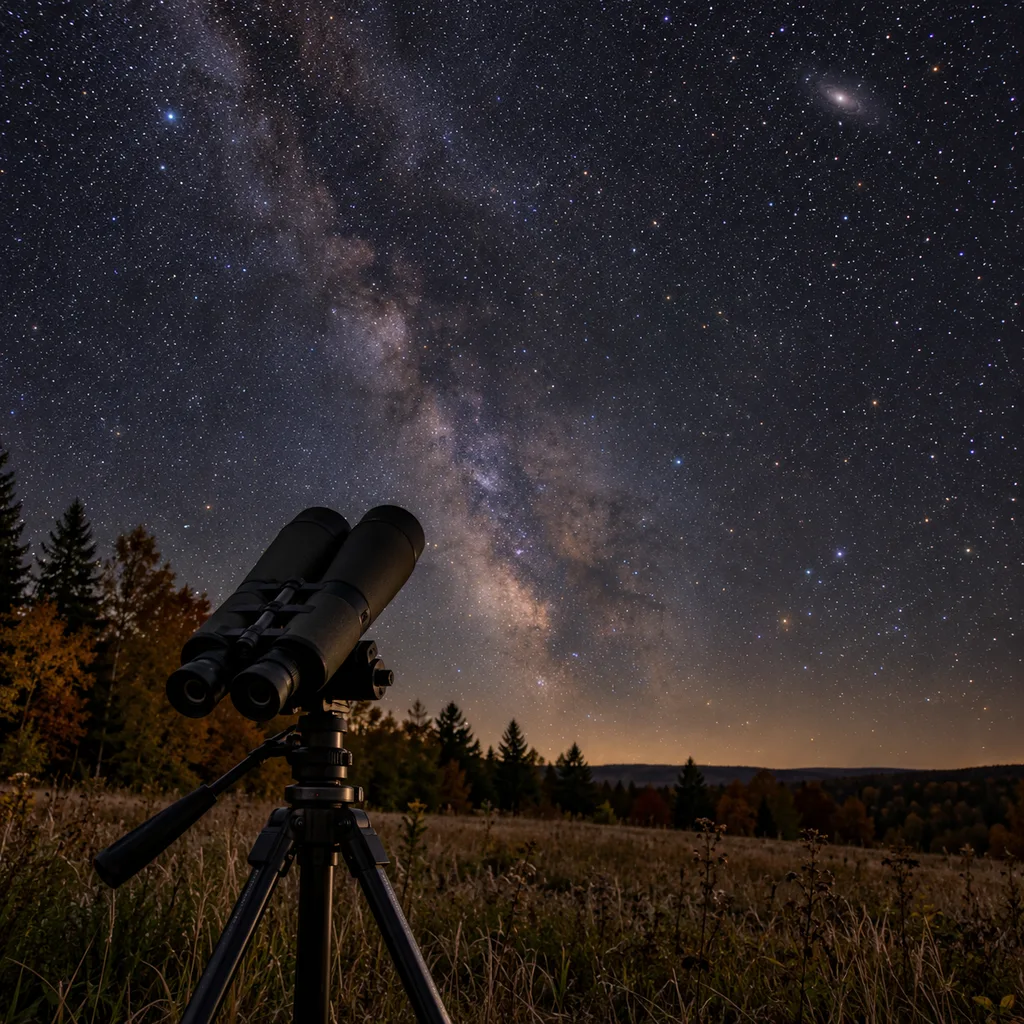
Table of Contents
What the Andromeda Galaxy Actually Is
A Galaxy You Can See Without a Telescope
Andromeda is a spiral galaxy, larger than our own Milky Way, and the nearest big galaxy to us. Together with the Milky Way and the smaller Triangulum Galaxy it anchors the Local Group, the small cluster of galaxies we live in. It shines at about magnitude 3.4, which is bright enough to see with the naked eye from a reasonably dark site, even though the light you are seeing set out long before modern humans existed.
Why It Looks Like a Smudge, Not a Photo
Long-exposure photographs show Andromeda as a huge glowing spiral several times the width of the full Moon. Your eye cannot collect light over minutes the way a camera can, so in real time you mostly see the bright central core: a soft, elongated gray oval, brighter in the middle and fading at the edges. That is normal. Knowing it in advance is the difference between being thrilled and thinking you have the wrong object.
Its Two Small Companions
Andromeda has two satellite galaxies within easy reach of a small telescope. M32 is a small, fairly bright fuzzy dot just off the edge of the core, and M110 is a larger, fainter oval a little farther out on the other side. Under dark skies, good binoculars can sometimes show M32 as a starlike point, but a telescope makes both obvious.
When and Where to Look
Best Months From the United States
September through December is prime time for evening viewing. In early October, Andromeda is already well up in the east and northeast once full darkness falls, and it climbs toward nearly overhead later in the night from most of the continental United States. By late fall it is high in the sky as soon as it gets dark, which makes it a great target for an early evening session.
Which Direction to Face
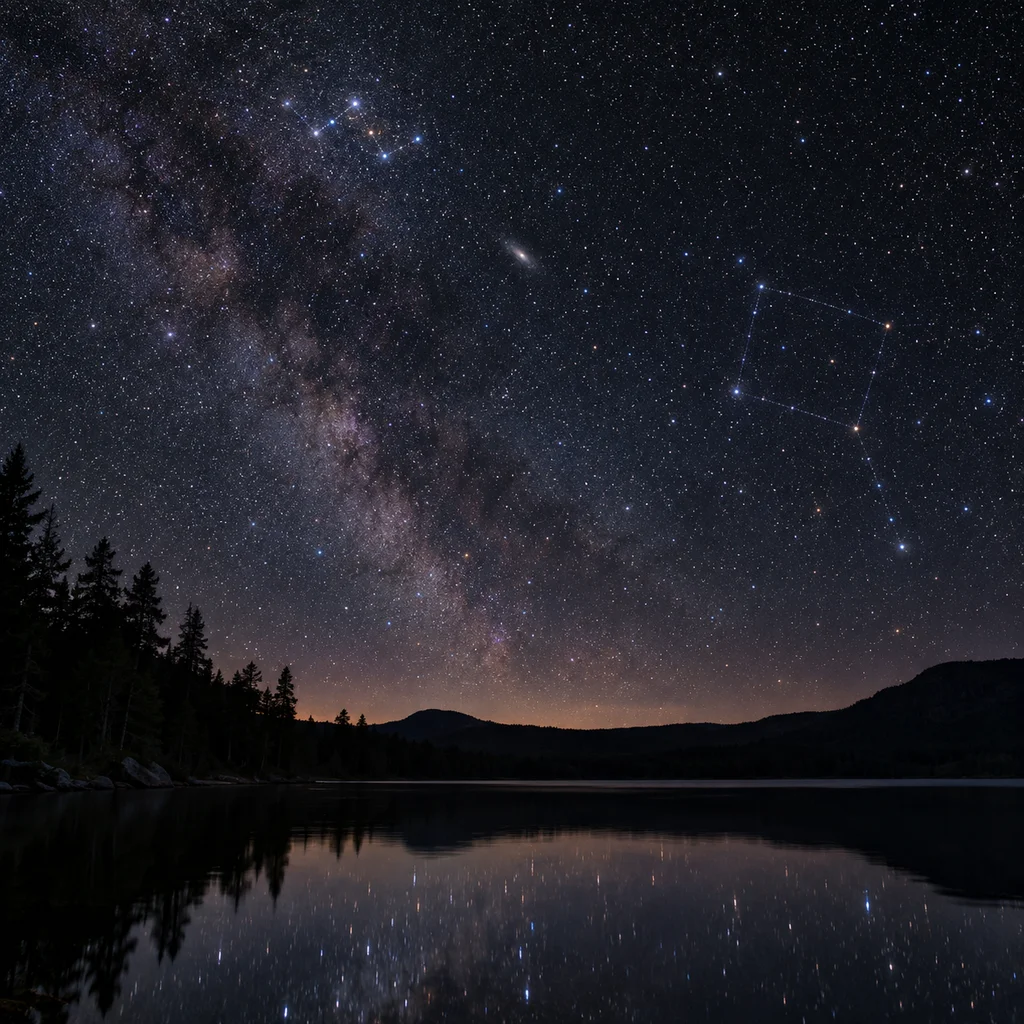
Face northeast to east in the early evening and look roughly halfway up the sky, then higher as the night goes on. The two constellations you will use as signposts, the W of Cassiopeia and the Great Square of Pegasus, sit on either side of Andromeda in that part of the sky, which is exactly why they make such good starting points.
Moon Phase Matters More Than Anything Else
A bright Moon washes out faint objects, and Andromeda is a faint object. Check a moon phase calendar and plan for the nights around new Moon, or for evenings after the Moon has set. A thin crescent low in the west is fine; a gibbous Moon high in the sky makes the galaxy very hard to pick out with the naked eye.
Find a Darker Sky
The Bortle scale rates sky darkness from 1, the darkest, to 9, an inner city. Andromeda is usually a naked eye object at Bortle 4 or darker, a struggle at 5 or 6, and a binocular-only target from a bright suburb. Even a short drive away from town light pollution makes a dramatic difference, and a state park or a campsite is often ideal. Our fall camping essentials list will help you turn a stargazing trip into an overnight.
Before You Start: Prepare Your Eyes
Give Your Eyes 20 to 30 Minutes
Your pupils open within a minute or two of going dark, but the deeper chemical process of dark adaptation takes 20 to 30 minutes. Faint objects that were invisible when you stepped outside slowly appear. A single glance at a bright phone screen resets the clock, so set up, then sit and let the sky come to you.
Use Red Light Only
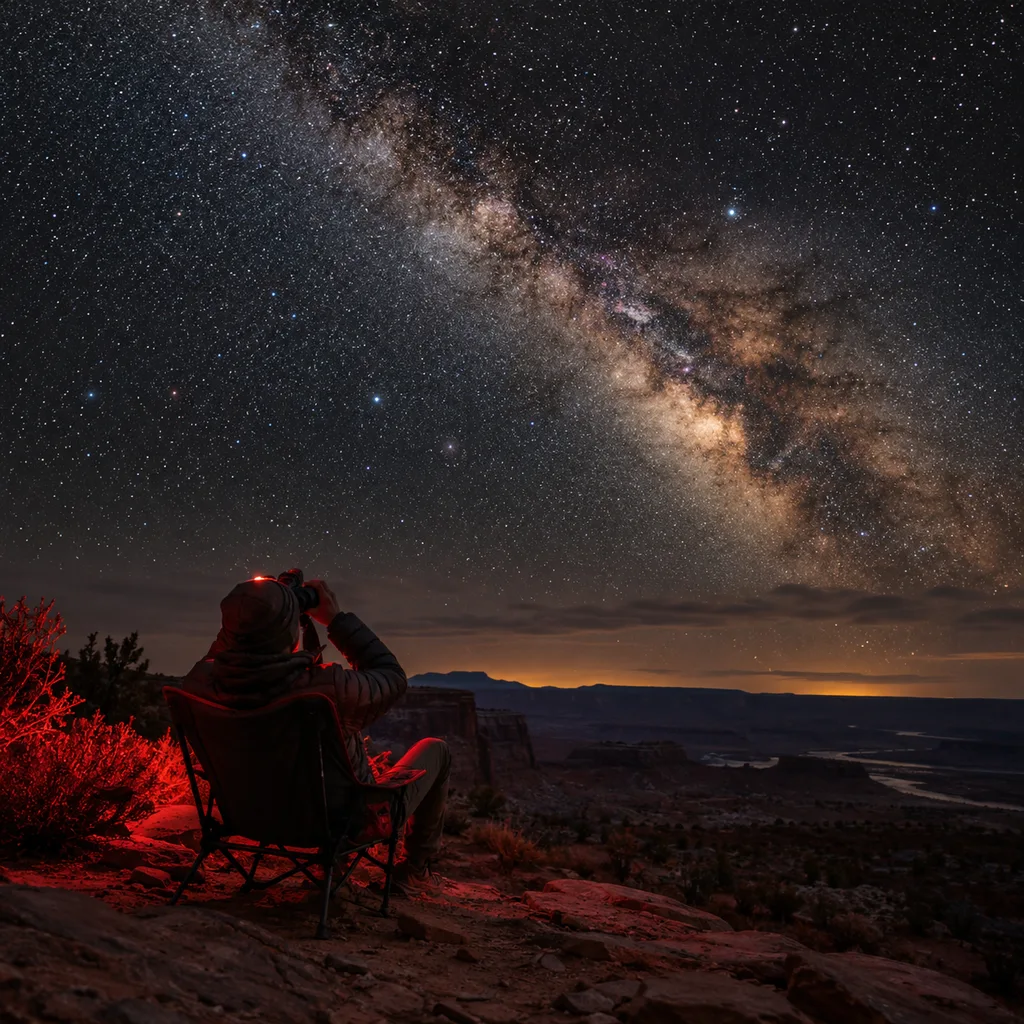
Red light protects your night vision far better than white light. A headlamp with a red mode is the easiest option, and our guide to how many lumens you need in a headlamp explains why the lowest setting is the one you will actually use. Set your phone to its darkest red-tinted mode if you use a star chart app, or better, print a chart before you leave.
Learn Averted Vision
The center of your eye is packed with color-sensitive cells that are poor in low light. The light-sensitive rod cells sit off to the side. With averted vision, you look slightly to one side of a faint object rather than straight at it, and it suddenly appears brighter and larger. It feels odd at first, and it is the single most useful trick for seeing Andromeda.
Pack a Simple Kit
You do not need much, and keeping it simple is part of the appeal. Bring a reclining camp chair or a foam pad so you can look up without straining your neck, a red-light headlamp from our list of the best headlamps for camping, a printed star chart, warm layers, a hat and something hot to drink. Binoculars are optional on your first night but make the search far easier. If the drive to dark skies is long, turning it into an overnight is easy; our camping for beginners guide covers the basics, and a short backpacking trip can take you somewhere properly dark.
Plan for at least an hour outside. The first half hour goes to dark adaptation and finding your bearings; the second is where the fun starts. Anyone learning how to find the Andromeda Galaxy for the first time should expect a few false starts on faint stars and small star clusters before the real thing jumps out, so give yourself that time rather than rushing.
How to Find the Andromeda Galaxy: Two Star-Hops
Star-hopping means starting from bright, easy stars and moving step by step to a fainter target. Use whichever of these two routes is higher in your sky, or try both and confirm one with the other.
Method 1: From the W of Cassiopeia
Find Cassiopeia, the bright W or M shape in the northeast. The W is made of two Vs, one noticeably deeper than the other. Treat the deeper V as an arrowhead and follow the direction its point aims, roughly three times the width of the V. That line lands you in the area of Andromeda. Sweep slowly there with averted vision or binoculars for a soft oval glow among the fainter stars.
Method 2: From the Great Square of Pegasus
Find the Great Square of Pegasus, four moderately bright stars forming a large box in the eastern sky. The corner star nearest Cassiopeia is Alpheratz, which actually belongs to the constellation Andromeda. From Alpheratz, follow the chain of stars leading away from the Square: count two stars along to Mirach, a fairly bright orange star. At Mirach, turn and hop toward Cassiopeia through two fainter stars, Mu and then Nu Andromedae. The galaxy sits just beyond Nu, about the same distance again.
Confirm What You Are Seeing
A star stays a sharp point no matter how you look at it. Andromeda does not: it is fuzzy, it is longer in one direction than the other, and it brightens toward the middle. If you think you have it, check from both routes. When both star-hops land on the same smudge, you have found it. Knowing how to find the Andromeda Galaxy from two directions also means you can still get there when one constellation is behind a tree or a cloud.
What You Will See by Instrument and Sky
Expectations matter as much as technique. This is roughly what each combination shows from mid-northern latitudes on a moonless night.
| Instrument | Suburban Sky (Bortle 5 to 6) | Dark Sky (Bortle 1 to 3) |
|---|---|---|
| Naked eye | Hard; maybe a faint patch with averted vision | Obvious elongated glow, easy to point out |
| 7×50 or 10×50 binoculars | Small, clear gray oval with a brighter core | Long oval stretching across much of the view |
| 15×70 binoculars on a tripod | Larger oval, M32 possible as a fuzzy dot | Big, detailed glow, M32 and sometimes M110 |
| Small telescope, low power | Bright core, M32 easy, M110 faint | Core, both companions and hints of dust lanes |
With the Naked Eye
From a truly dark site Andromeda looks like a small, faint cloud that does not move. Most people need averted vision the first time. Once you have seen it, you will find it again easily on every clear fall night after.
Through Binoculars
Binoculars are the sweet spot. Their wide field of view makes star-hopping easy, and they show the oval shape clearly even from a suburban yard. A classic 10×50 like the Nikon Aculon A211 10×50 is ideal for handheld sweeping, and our round-up of the best binoculars for stargazing compares the options.
Through a Small Telescope
A telescope at low magnification shows a brighter core and makes both companions easy. High magnification is the wrong choice here: Andromeda is huge and faint, so more power simply spreads the light out. Use your lowest power eyepiece. Our guide to the best telescopes for beginners covers scopes that do this well.
Binoculars or Telescope?
Why Binoculars Win First
For a first look, binoculars beat a telescope. They show a right-side-up view, they are quick to point, and their wide field holds the whole star-hop at once. The Celestron Cometron 7×50 is an inexpensive way to start, with a wide, bright view that suits beginners.
When a Telescope Helps
A telescope earns its place once you can find Andromeda reliably and want more: the companions, the shape of the core, and on very dark nights a hint of the dark dust lanes. It is also far better for the rest of the sky, from the Moon and planets to star clusters.
Steadying the View
Big astronomy binoculars like the Celestron SkyMaster 15×70 show much more, but they are too heavy to hold steady for long. Mount them on a tripod with an adapter, or brace your elbows on a car roof or a chair. A tripod also helps if you want to photograph the galaxy; see our picks for the best tripods for astrophotography and our guide on how to photograph the night sky.
Common Mistakes
- Looking on a night with a bright Moon high in the sky.
- Checking a phone screen and losing your dark adaptation.
- Expecting the spiral from photographs instead of a soft gray oval.
- Using a telescope at high magnification, which dims the view.
- Looking straight at the galaxy instead of using averted vision.
- Giving up after five minutes rather than letting your eyes adapt.
- Searching too low in the sky early in the evening, where haze is thickest.
Most of these are fixed with patience and planning. Dress warmer than you think you need to, because standing still on a fall night gets cold fast; our tips for staying warm on cold nights outside apply just as well to a long stargazing session. If you are heading out after dark on a trail, read our night hiking safety guide first.
Frequently Asked Questions
Can you see the Andromeda Galaxy with the naked eye?
Yes, from a dark site on a moonless night. It appears as a faint, elongated glow. From a bright suburb you will usually need binoculars.
What time of year is best to see Andromeda?
September through December evenings are best from the United States, when the galaxy is high in the east and northeast after dark and rides nearly overhead later at night.
Which direction is the Andromeda Galaxy?
In f