


This post may contain affiliate links. If you buy through them, we may earn a small commission at no extra cost to you.
The best binoculars for stargazing are almost never the most powerful ones. Magnification amplifies your heartbeat along with the starlight, so a 25x pair held in the hands shows you a shaking blur while a steady 7x pair shows you Jupiter and four of its moons. Aperture and stability decide what you actually see; the magnification number decides how much of it you can hold still.
That trade off is the whole decision. A 50mm handheld pair is the right first purchase for nearly everyone. A 70mm or 80mm pair gathers far more light and will show you genuinely faint objects, but it needs a tripod, and a tripod turns a spontaneous ten minutes in the garden into a small expedition.
Below are six pairs genuinely stocked on Amazon right now, chosen for different jobs rather than ranked one to six. Ratings and specifications were checked at the time of writing. If you are new to the night sky, our guide to stargazing for beginners covers the technique that matters more than the glass does.
Table of Contents
What Makes the Best Binoculars for Stargazing
Four numbers, and they interact more than the marketing suggests.
- Aperture. The second number, in millimetres, is the diameter of the front lenses. It decides how much light reaches your eye, and light is the entire game at night. 50mm is the practical handheld maximum for most people; 70mm and 80mm see much more but need support.
- Magnification. The first number. Above roughly 10x, hand shake becomes the limiting factor rather than the optics. High magnification also narrows the field of view, which makes finding anything harder.
- Exit pupil. Aperture divided by magnification. A 7×50 gives 7.1mm, about as wide as a young dark-adapted pupil, which is why 7×50 is the classic night glass. A 12×25 gives 2.1mm and is noticeably dimmer after dark.
- Prism type and coatings. BaK-4 prisms and fully multi-coated optics pass more light and keep the edges of the field sharp. On a cheap pair this is usually where the cost was cut.
Weight belongs on the list too, because it decides whether you keep using them. The same principle drives our advice on daypack fit: the item you actually carry beats the better one you leave at home. And no optic beats a clear sky, so check the forecast first; the satellite-app approach in our guide to predicting trail weather works just as well for cloud cover at night.
The Best Binoculars for Stargazing at a Glance
| Binocular | Aperture | Magnification | Tripod needed | Best for |
|---|---|---|---|---|
| Celestron SkyMaster 15×70 | 70mm | 15x | Recommended | Best overall |
| Celestron Cometron 7×50 | 50mm | 7x | No | Beginners and wide views |
| Nikon Aculon A211 10×50 | 50mm | 10x | No | Best handheld all-rounder |
| Celestron SkyMaster 25×70 | 70mm | 25x | Yes | High magnification |
| Celestron SkyMaster 20×80 | 80mm | 20x | Yes | Deep sky and faint objects |
| Occer 12×25 Compact | 25mm | 12x | No | Best budget and travel |
The Six Best Binoculars for Stargazing in Detail
Celestron SkyMaster 15×70: Best Overall
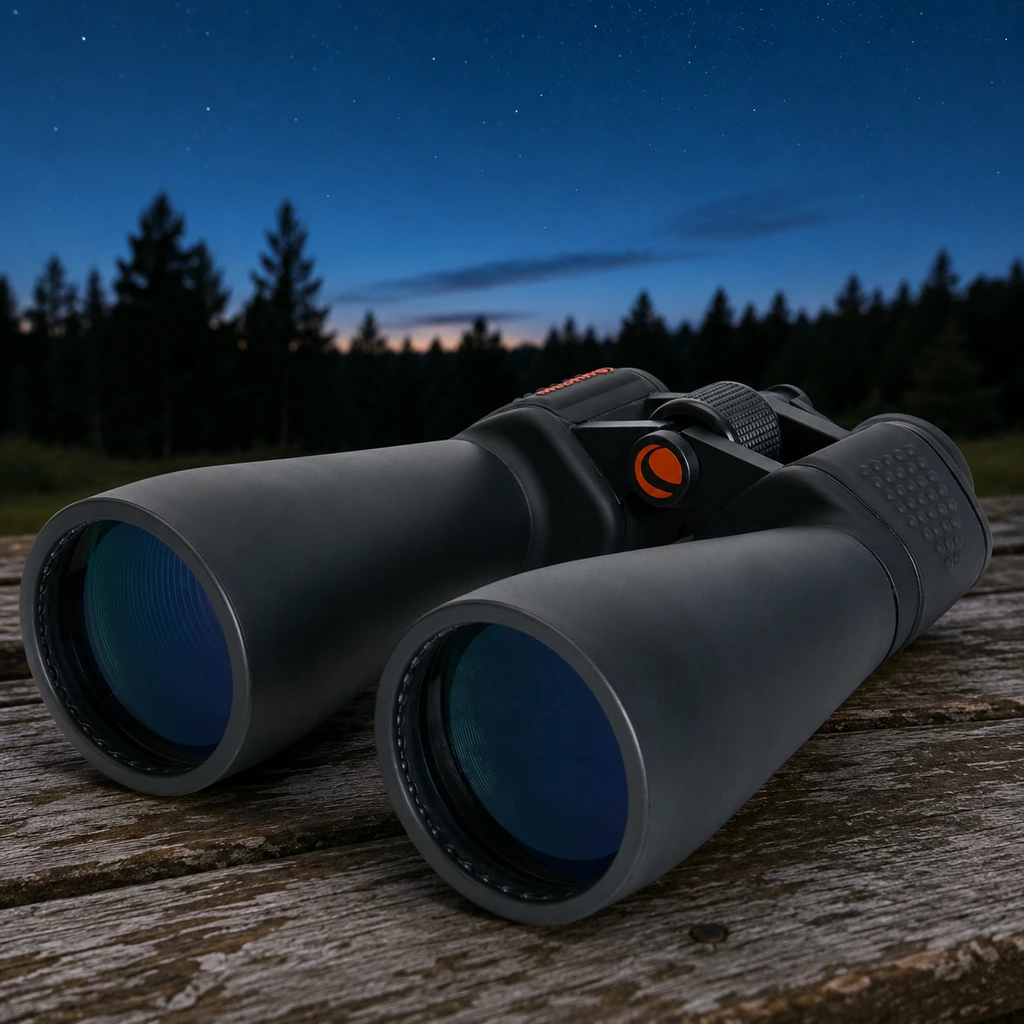
If you buy one pair specifically for the night sky, this is the one that gives you the most for the money. Seventy millimetre objectives gather roughly twice the light of a 50mm pair, and at 15x the image is still wide enough to find things without a chart. That combination is why the SkyMaster 15×70 has been the default recommendation in astronomy circles for years.
BaK-4 prisms do the optical work, and Celestron pitch these squarely at people observing in dim conditions near dawn and dusk or at night. The housing is rubber-armoured and water-resistant, which matters more than it sounds: dew is the standard hazard of a still, clear night, and these shrug it off.
Be honest with yourself about the tripod. Celestron themselves note that most owners mount SkyMasters on a photo tripod because of the size and weight, and there is a quarter-twenty adapter built in for exactly that. Handheld they are usable in short bursts; on a tripod they are transformed. At 4.4 stars across more than eight thousand five hundred ratings, this is the most consistently recommended astronomy binocular on Amazon.
Specs That Matter
- 70mm objective lenses with 15x magnification
- BaK-4 prisms tuned for low light observing
- Built-in quarter-twenty adapter for a standard photo tripod
- Rubber-armoured, water-resistant housing
- 4.4 stars from over 8,500 ratings
Who It Is For
Anyone who wants serious light-gathering without moving to a telescope, and is willing to use a tripod for the best of it.
Celestron Cometron 7×50: Best for Beginners
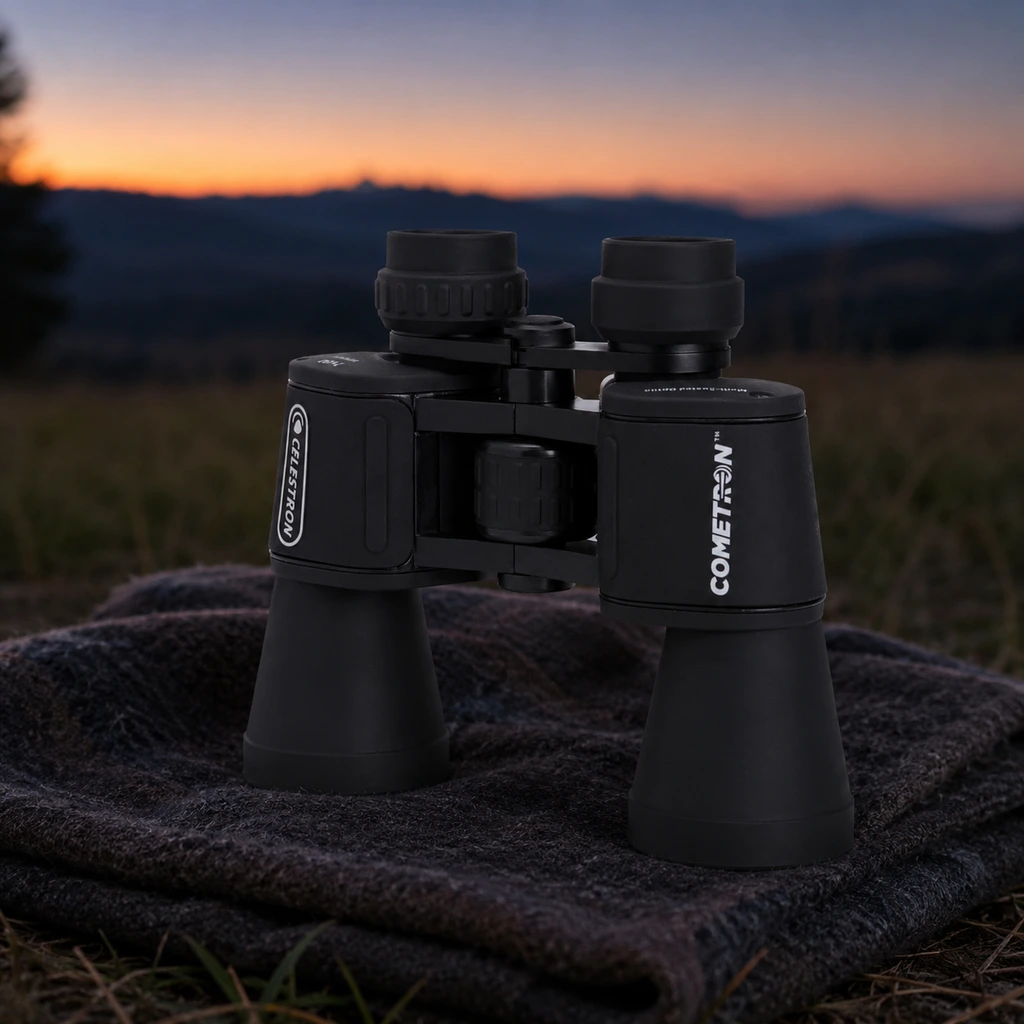
Seven power sounds low until you use it in the dark. The wide 6.6 degree field means you can sweep along the Milky Way and actually keep track of where you are, and at 7x you can hold them steady with no support at all. For a first pair this matters far more than reach.
Fifty millimetre objectives with multi-coated optics give an exit pupil of about seven millimetres, which is close to the widest a dark-adapted eye can use, so essentially all the light these collect reaches your retina. Celestron position them as an easy, affordable way to learn the night sky, and that is exactly what they are.
They are not night-only. Close focus is 26.2 feet, which makes them perfectly good for birds and scenery by day, and there is a tripod adapter socket if you later want shake-free views of the moon. At 4.5 stars from over four thousand ratings, they are the safest first purchase here.
Specs That Matter
- 50mm objectives with multi-coated optics
- 7x magnification with a wide 6.6 degree field of view
- Roughly 7mm exit pupil, matched to a dark-adapted eye
- Close focus of 26.2 feet, so they double for daytime use
- 4.5 stars from over 4,000 ratings
Who It Is For
A first pair, anyone observing without a tripod, and sweeping the Milky Way and large star clusters.
Nikon Aculon A211 10×50: Best Handheld All-Rounder
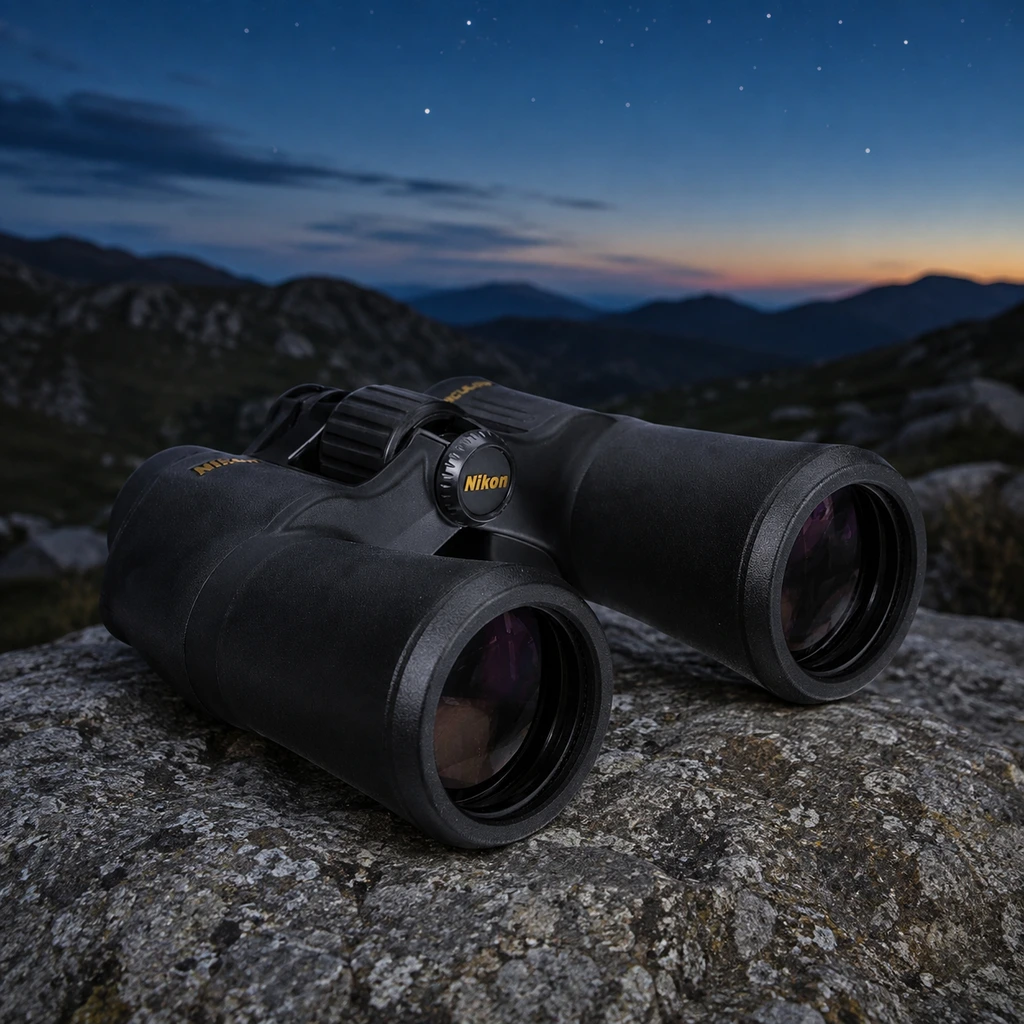
Ten by fifty is the classic compromise, and Nikon build the most comfortable version of it at this price. You keep the 50mm aperture that makes a binocular useful after dark, gain a little reach over a 7×50, and stay just inside the magnification where most people can hold an image steady.
The details are what separate it. Turn-and-slide rubber eyecups let spectacle wearers get their eyes to the right distance, which is the usual reason people find binoculars uncomfortable. Aspherical multicoated Eco-Glass lenses keep the image bright, the central focus knob is smooth enough to work in gloves, and the rubber armour grips even when everything is wet with dew.
It is a Porro prism design, which is why it looks old-fashioned and why it performs above its price: Porro prisms deliver more depth and better light transmission per pound than a roof prism of similar cost. At 4.6 stars this is the highest rated pair on the list, and it is tripod adaptable when you want it to be.
Specs That Matter
- 50mm objectives at 10x, the classic handheld compromise
- Porro prism design with aspherical multicoated Eco-Glass lenses
- Turn-and-slide rubber eyecups suited to spectacle wearers
- Rubber-armoured non-slip body, tripod adaptable
- 4.6 stars, the highest rated pair here
Who It Is For
One pair for astronomy and wildlife both, spectacle wearers, and anyone who wants to observe without carrying a tripod.
Celestron SkyMaster 25×70: Best High Magnification
Same 70mm aperture as the 15×70, considerably more reach. Twenty five power pulls in lunar craters, the phases of Venus and the disc of Jupiter at a scale the lower-powered pairs cannot manage, and on a tripod the view of the moon along the terminator is genuinely startling.
The cost is stability and field of view. At 25x every tremor is magnified with the image, so these are a tripod instrument and Celestron say as much, pointing to the size, weight and high magnification as the reason. The quarter-twenty adapter is built in. The narrower field also makes finding a target harder, so it helps to locate things with the naked eye first and then look.
BaK-4 prisms and the same rubber-armoured, water-resistant housing as the rest of the SkyMaster line. With over nine thousand ratings at 4.3 stars, it is the most reviewed pair here, and the reviews that pull the average down are almost always from people who tried to hold them.
Specs That Matter
- 70mm objectives with 25x magnification
- BaK-4 prisms, the same optical platform as the 15×70