


This post may contain affiliate links. If you buy through them, we may earn a small commission at no extra cost to you.
Trail running for beginners is less about fitness than most people expect and more about learning to move over ground that keeps changing. If you can run two or three miles on pavement without stopping, you already have the engine. What you do not have yet is the footwork, the pacing instinct and the habit of looking well ahead, and those three things are what make a first trail run feel either brilliant or miserable.
The good news is that all three arrive quickly. Most road runners feel competent on easy singletrack within a month of consistent outings. This guide covers the nine things that matter in that first month, the small amount of kit you genuinely need, and the mistakes that send people back to the sidewalk.
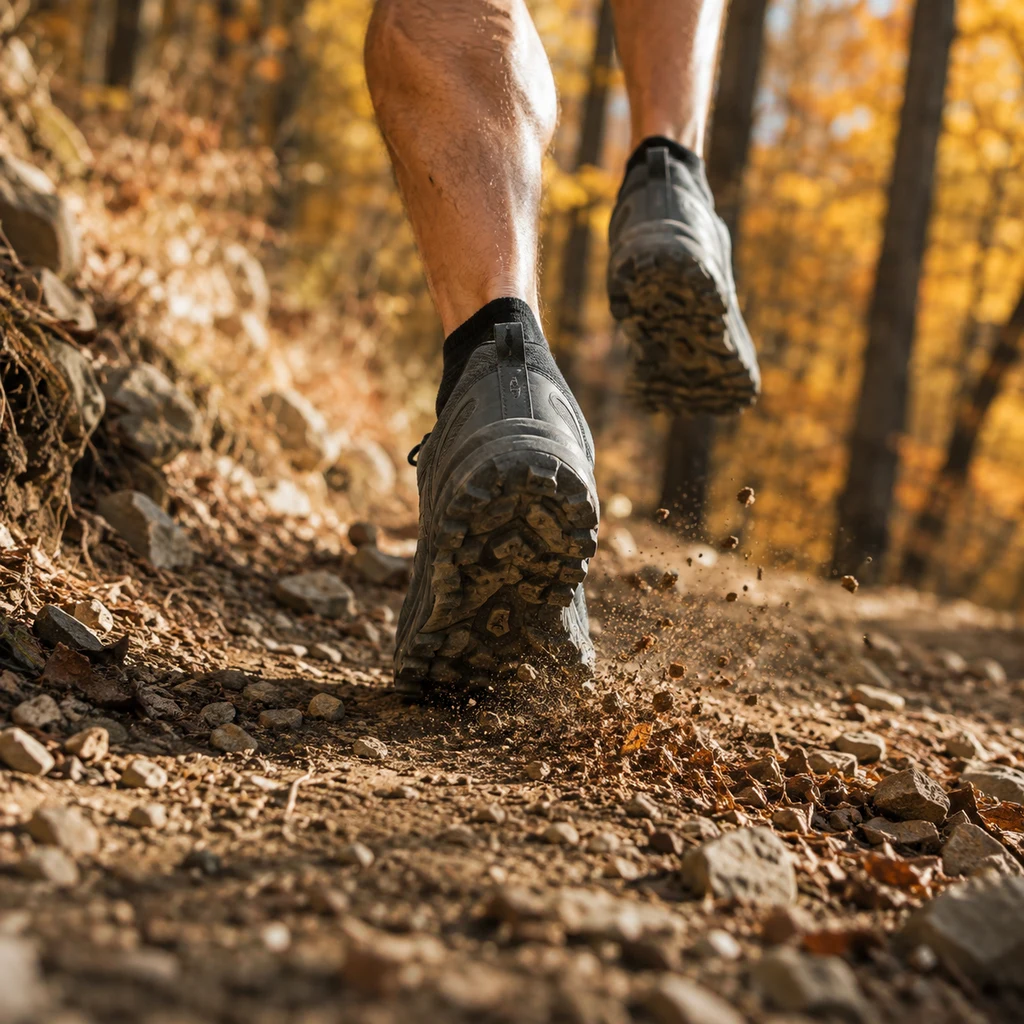
Table of Contents
How Trail Running Differs From Road Running
The obvious difference is the surface. The more important one is that your pace stops meaning anything. On a road you can hold a steady number for an hour. On a trail your speed changes every few strides as the ground tilts, softens or throws a root at you, and a mile with six hundred feet of climb can take twice as long as a flat one.
Two other changes catch people out. Your heart rate climbs far earlier than it would on a road hill, because the ground is uneven and your stabilising muscles are working alongside everything else. And your feet land differently every stride, which is tiring in a way that flat repetition is not. Expect to finish a shorter distance feeling like you ran further. You did, in every way except the number on the watch.
If you already hike, you are further along than you think. Route finding, footing and layering all carry across, and our complete guide for beginner hikers covers the ground skills that trail running simply performs at a higher speed.
Trail Running for Beginners: The 9 Steps
1. Pick a Trail That Is Shorter Than You Think
Halve whatever distance you would run on the road, then choose the flattest, most obvious trail you can find. A three mile road runner should look for a mile and a half of wide, well used path with very little elevation. This is not caution for its own sake. Finishing a short first run tired but pleased is what makes you go back, and a nine mile mountain loop on day one usually does the opposite.
Wide paths, sometimes called doubletrack, are the right place to start because you can lift your eyes without immediately standing on something. Save narrow singletrack for your third or fourth outing.
2. Run by Effort, Not by Pace
Cover the watch face if you have to. On the trail the only useful gauge is your breathing, and the target for every early run is conversational: you should be able to speak a full sentence without gasping. On a climb that will mean slowing to a shuffle. On a smooth flat section it might mean running faster than your road pace. Both are correct.
Runners who chase their road pace uphill blow up in the first mile, every time. Let the trail set the speed and you will finish stronger and enjoy far more of it.
3. Shorten Your Stride and Lift Your Feet
A shorter, quicker stride is the single biggest technique change. It puts your foot down underneath your body rather than out in front, which buys you a fraction of a second to react when the ground is not where you expected it. Aim for light, frequent steps rather than long, committed ones.
Lifting your feet slightly higher than feels necessary is the other half. Most trail falls are toe catches on roots and rocks that half an inch of extra clearance would have missed entirely. It feels exaggerated for the first mile, then becomes automatic.
4. Look Five Steps Ahead, Not at Your Shoes
Your eyes should be scanning the ground roughly five to fifteen feet in front of you. Your brain is remarkably good at remembering where the obstacles were and placing your feet without direct supervision, but only if you gave it the information a second earlier.
Watching your shoes has the opposite effect: by the time you see a rock you are already standing on it. If you want to look at the view, stop. Nobody has ever regretted ten seconds on a ridge.
5. Walk the Steep Climbs on Purpose
Hiking the steep sections is technique, not failure. Above a certain gradient, walking with your hands on your thighs is barely slower than running and costs a great deal less energy. Experienced trail runners walk climbs that would embarrass a beginner into jogging.
The rough rule is that if running the hill pushes your breathing past conversational, walk it, and start running again as soon as the ground eases. On sustained mountain gradients a pair of poles makes that walk considerably more efficient, and our guide to using trekking poles covers the arm timing that makes them worth carrying.
6. Brake Less on the Descents
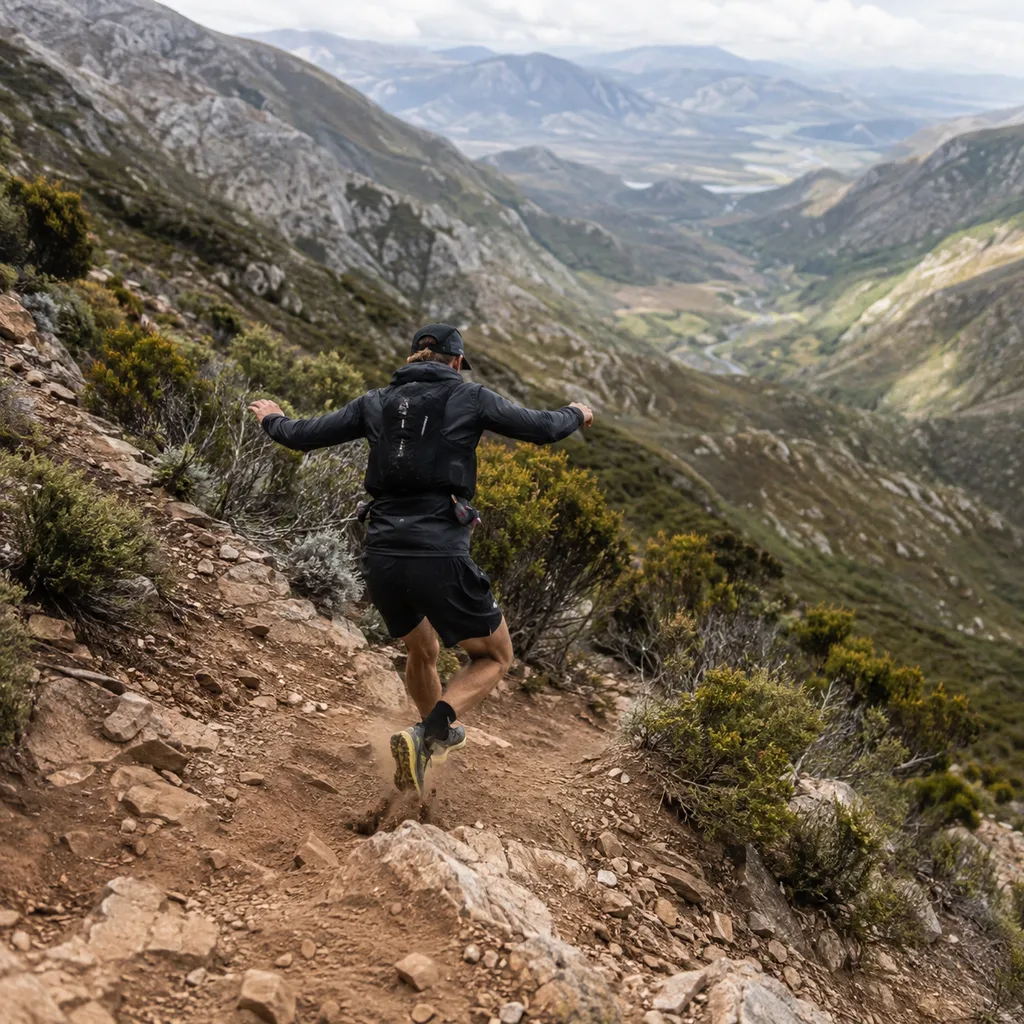
Downhill is where beginners are slowest and sorest. The instinct is to lean back and land heel first, which is precisely the braking action that wrecks your quadriceps. Instead lean very slightly forward from the ankles, let your stride quicken, and use short steps to steer rather than long ones to slow.
Keep your arms wide for balance and pick a line a few steps ahead. Start on gentle descents on good surfaces. Confidence going down arrives faster than you would expect, and it is the most enjoyable part of the sport once it does.
7. Carry Water and a Light
Anything over about forty five minutes deserves water, and on a trail there is no shop to duck into. A soft flask in a waist belt covers short runs, and a proper vest makes sense once you are out for more than an hour. The Nathan TrailMix 7L running vest is a common first choice because it takes a two litre bladder and still weighs seven ounces empty.
A small headlamp lives in that vest from September onwards. Light disappears under tree cover far earlier than it does in open ground, and a run that started in daylight can finish in the dark surprisingly quickly. A compact rechargeable such as the Black Diamond Spot 400 weighs almost nothing and turns a stressful walk out into a non event. Our round up of the best headlamps compares the options in detail.
8. Tell Someone Where You Are Going
Trail running takes you out of phone signal quickly and away from other people almost as fast. Before you leave, tell someone the trailhead, the rough loop and when you expect to be back. It costs one message.
Download the map for offline use as well. AllTrails and Gaia GPS both cache maps on the phone, which matters because the moment you most need a map is usually the moment you have no bars. On federal land, the National Park Service trail pages are worth a look for closures before you drive out.
9. Build Volume Slowly
Trail running loads your ankles, calves and the small stabilising muscles far harder than road running does, and those tissues adapt more slowly than your lungs do. The classic beginner injury is not a dramatic fall. It is an achilles or a peroneal tendon that got twice its usual work in a fortnight.
Two trail runs a week for the first month is plenty, and keep one of them very easy. If you already run on roads, swap two road runs across rather than adding trail miles on top of a full week.
What You Actually Need to Start
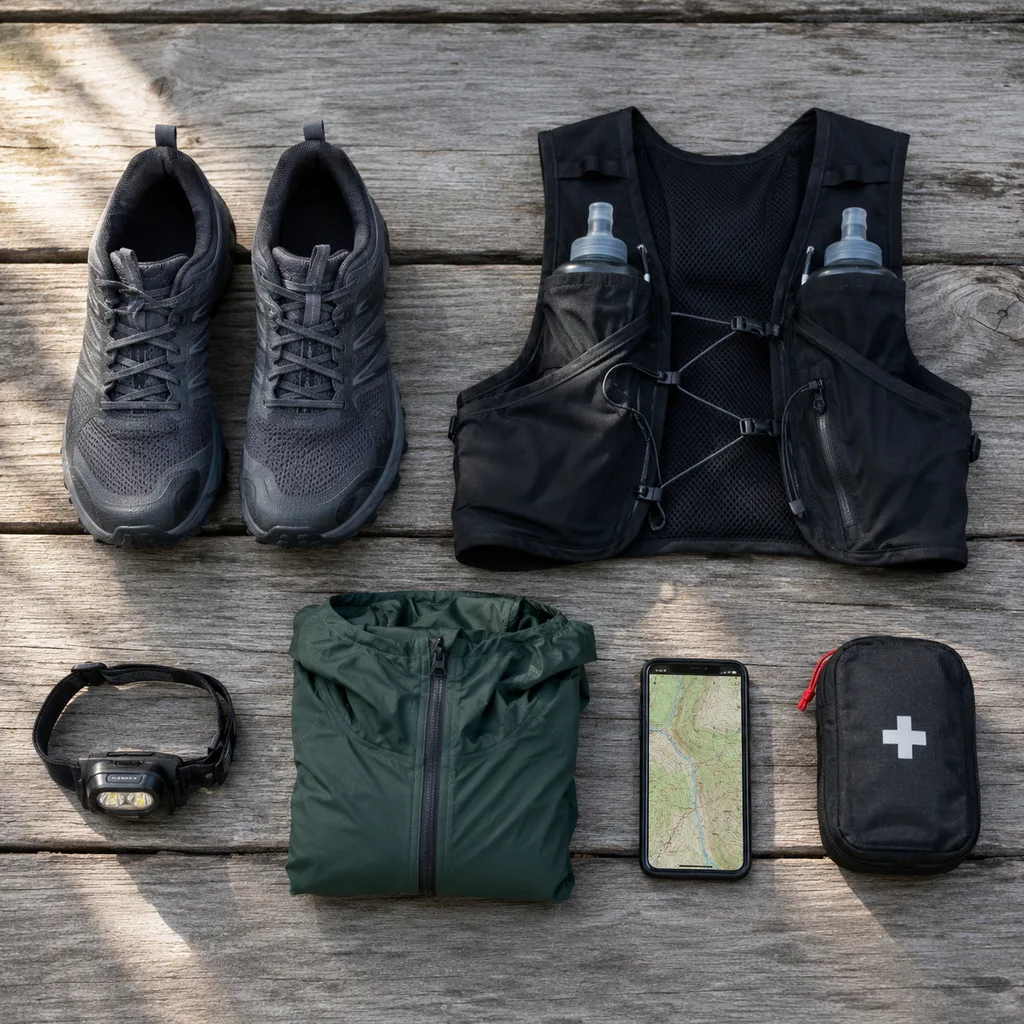
Very little, which is one of the better features of the sport. The list below is genuinely everything for a first season on marked trails in daylight.
Shoes Come First
Road shoes work on smooth dirt and stop working the moment the surface turns loose, wet or off camber. Trail shoes differ in three ways that matter: rubber lugs that bite into soft ground, a firmer and more protective sole so sharp rock does not bruise the foot, and a more secure upper that holds the foot when the ground tilts sideways.
You do not need to spend heavily to start. Something like the ASICS Gel-Venture 11 handles dry and moderately technical trail perfectly well, and you can move to a specialist shoe once you know what your local ground is actually like. For the full comparison, our guide to the best trail running shoes breaks down six options by terrain. If you are coming from hiking, the sizing logic in how to choose hiking boots applies here too.
Water and Fuel
Under forty five minutes you can usually go without. Beyond that, carry water, and beyond about ninety minutes carry something to eat. Trail effort burns through energy faster than the same clock time on the road because of the climbing.
Soft flasks beat hard bottles because they collapse as they empty and stop sloshing against your back. Whatever you carry, practise drinking on the move during an easy run rather than discovering the technique on a long one. Our hydration guide covers how much you actually need per hour, and our trail nutrition guide covers what to eat once the runs get long.
Layers, Light and the Small Stuff
- A wind shell that packs down to the size of a fist, for ridgelines and stops
- A headlamp from early autumn onward, even on runs that start in daylight
- A phone with offline maps downloaded before you leave the house
- A small first aid kit with tape and a bandage, for you or for someone else
- Gaiters if your local trails are sandy or full of grit
Cotton is the one genuine mistake. It holds water, chills you the moment you stop moving, and takes hours to dry. If you are carrying more than a vest will hold, the fit advice in our guide to hiking daypacks translates directly to running packs.
Common Beginner Mistakes
- Running the same effort uphill as on the flat, which empties the tank inside the first mile
- Leaning back on descents, which brakes with the quadriceps and leaves them wrecked the next day
- Watching your feet instead of the ground five to fifteen feet ahead
- Starting on narrow technical singletrack instead of a wide, easy path
- Adding trail miles on top of a full road week rather than swapping some across
- Heading out in autumn without a light, then finishing the last mile in the dark
The other quiet mistake is treating an aborted run as a failure. Turning round at the halfway point because the weather closed in or your legs were flat is a good decision, not a bad one. One more worth naming: arriving on a busy shared path without knowing the trail etiquette that keeps runners, walkers and cyclists out of each other’s way.
A Simple First Month on the Trails
Four weeks, two runs a week, and no pace targets at all. Week one is two easy outings of twenty to thirty minutes on the flattest wide trail you can find, walking whenever you feel like it. Week two repeats that with one run extended to forty minutes.
Week three introduces a genuine climb, walked on the way up and run gently on the way down. Week four adds a first section of narrow singletrack on the shorter run. By the end of it most people can run an hour on rolling trail comfortably, and the technique from the nine steps has stopped being conscious.
From there the natural progressions are a longer weekend run, a local trail race, or simply a bigger loop. Autumn is the best time of year to start, because the ground is firm and the temperature is right, and our guide to fall hiking covers the seasonal conditions you will be running through. Trail Runner magazine is a reasonable place to find a first race once you want one.
Frequently Asked Questions
Do I need trail running shoes to start?
Not for the first run or two on smooth, dry dirt path. As soon as the ground turns loose, wet or rocky, road shoes lose grip and offer no protection underfoot, and that is the point at which trail shoes stop being optional. Most people buy a pair within the first month.
How fit do I need to be for trail running?
If you can run two to three miles on the road without stopping, you can start on easy trails today. Trail running for beginners rewards patience far more than fitness, because walking the steep sections is normal at every level of the sport.
Why is my trail pace so much slower than my road pace?
Because it should be. Uneven ground, climbing and descending all cost time, and a minute or two per mile slower is completely normal on easy trail. On steep or technical ground the gap can be much larger, which is exactly why effort rather than pace is the right gauge.
Is trail running harder on your knees?
Generally the opposite. Soft, varied ground spreads the load across different tissues instead of repeating an identical impact thousands of times, and most runners report less knee irritation on trail than on pavement. Descending badly is the exception, which is why braking less matters so much.
How do I stop rolling an ankle?
Shorten your stride, lift your feet and look ahead rather than down. Beyond that, ankles get stronger with exposure, so consistent short runs on easy trail build more resilience than occasional long ones on rough ground. A shoe with a secure upper helps, which is one reason the boot fit principles we use for hiking apply to running shoes too.
Pick a wide, flat trail near you, halve your usual distance and go and get it slightly wrong a few times. The footwork arrives faster than the fitness does, and the first time a descent clicks you will understand why people give up pavement for this.
Discover more from Maive Verse
Subscribe to get the latest posts sent to your email.