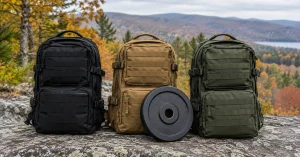
The best rucking backpacks lined up on a granite ledge with a weight plate

Best Rucking Backpacks: 6 Top Picks for 2026

This post may contain affiliate links. If you buy through them, we may earn a small commission at no extra cost to you.

The best rucking backpacks hold weight high against your spine, spread it across straps wide enough not to bite, and stay put when you walk. Almost nothing else about a pack matters once there is 30 pounds of cast iron in it. We compared six packs that people actually ruck in, from a 20 litre purpose built rucker to a 30 litre assault pack that costs less than a pair of boots.

Every pick below is in stock, currently rated 4.2 stars or better, and chosen for how it carries a plate rather than how it looks on a shelf. If you are new to loaded walking, start with our beginner guide to rucking and come back when you know what weight you actually want to carry. Autumn is the season it becomes pleasant, the same shift that makes fall day hikes worth planning around.
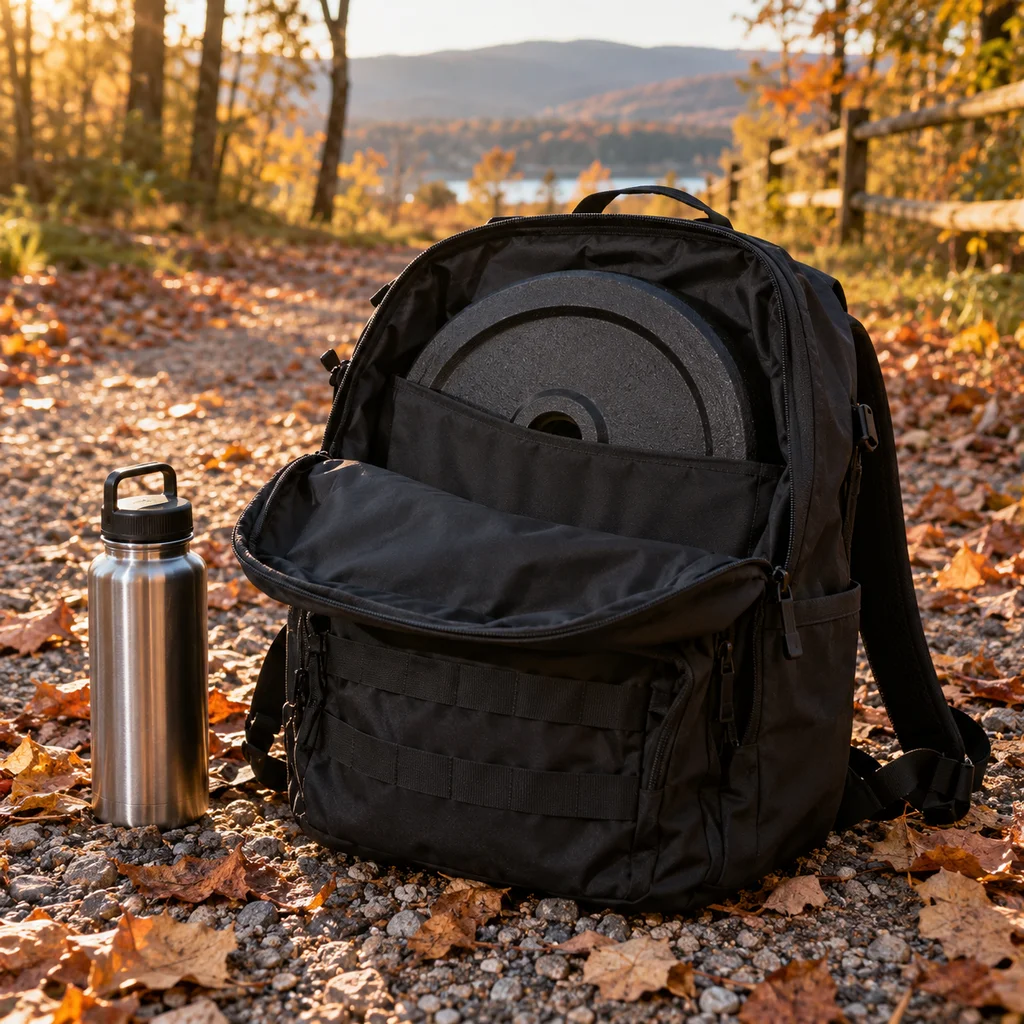
One of the best rucking backpacks open on a gravel path with a weight plate

What Separates the Best Rucking Backpacks

A hiking daypack and a rucking pack look similar and fail in different places. The daypack is built to carry a light, bulky load low and close. A rucking pack is built to carry a dense, heavy load high and tight, which is a different engineering problem.

Three things decide it. First, a sleeve or pocket that pins the weight between your shoulder blades so it cannot sag or swing. Second, shoulder straps thick enough to spread 30 pounds across the top of your shoulders instead of concentrating it on two narrow lines. Third, fabric and stitching that survive metal being dropped into the bag several hundred times. None of that overlaps with what makes a good trail shoe or a good shell work, so do not assume your usual brands transfer.

Capacity matters less than people expect. Most rucking happens between 10 and 30 pounds, which occupies very little volume, so a 20 litre pack is plenty unless you are also carrying gear for the day. That is the opposite of how you would choose a backpacking pack, where volume is the first number you look at.

The Best Rucking Backpacks at a Glance

PackCapacityFabricPlate PocketBest For
GORUCK Rucker 4.020L1000D CORDURAElevated, dedicatedBest overall
Ruckercise Ridge21L1000D CORDURATwo sizesBest plate fit
RuckBuddy RuckPack25LReinforced nylonLong and short sleeveHeavy loads
GORUCK Ruck Plate Carrier 3.0Plate only1000D CORDURA10, 20 or 30 lb platesMinimalist training
Hannibal Tactical30L600D polyesterNone, use gearBest budget
Mardingtop Tactical30L600D polyesterNone, use gearLightest option
The six best rucking backpacks compared on the specs that decide comfort under load.

The Six Best Rucking Backpacks in Detail

GORUCK Rucker 4.0: Best Overall

The Rucker is the pack the whole category grew out of, and after four revisions it does the fundamentals better than anything else here. The plate pocket sits high and is sewn in place, so a 20 pound plate rides between your shoulder blades from minute one to minute ninety without a millimetre of sag.

The straps are the other half of the story. They are wide, heavily padded and reinforced where they meet the body of the pack, which is the exact point where cheaper packs start cutting into the top of your shoulders. Raised lumbar padding along the bottom edge braces your lower back and stops the load pulling you into a slouch on the back half of a long ruck.

At 20 litres it is compact, and that is deliberate. There is room for a jacket, water, a snack and a plate, and not enough room to fill it with things you do not need. It also passes as an ordinary black backpack, which matters if it doubles as your commute bag.

Specs That Matter

  • Capacity: 20L, enough for a plate plus a jacket, water and food
  • Plate pocket: elevated and dedicated, holds standard ruck plates high on the back
  • Straps: wide, reinforced and extra padded to prevent strap bite under heavy load
  • Back panel: 210D CORDURA lining with raised lumbar padding for spine support
  • Rating: 4.7 stars across 251 reviews

Who It Is For

Anyone who intends to ruck twice a week for years rather than trying it for a month. It is the most expensive pack here and the only one you are unlikely to replace.
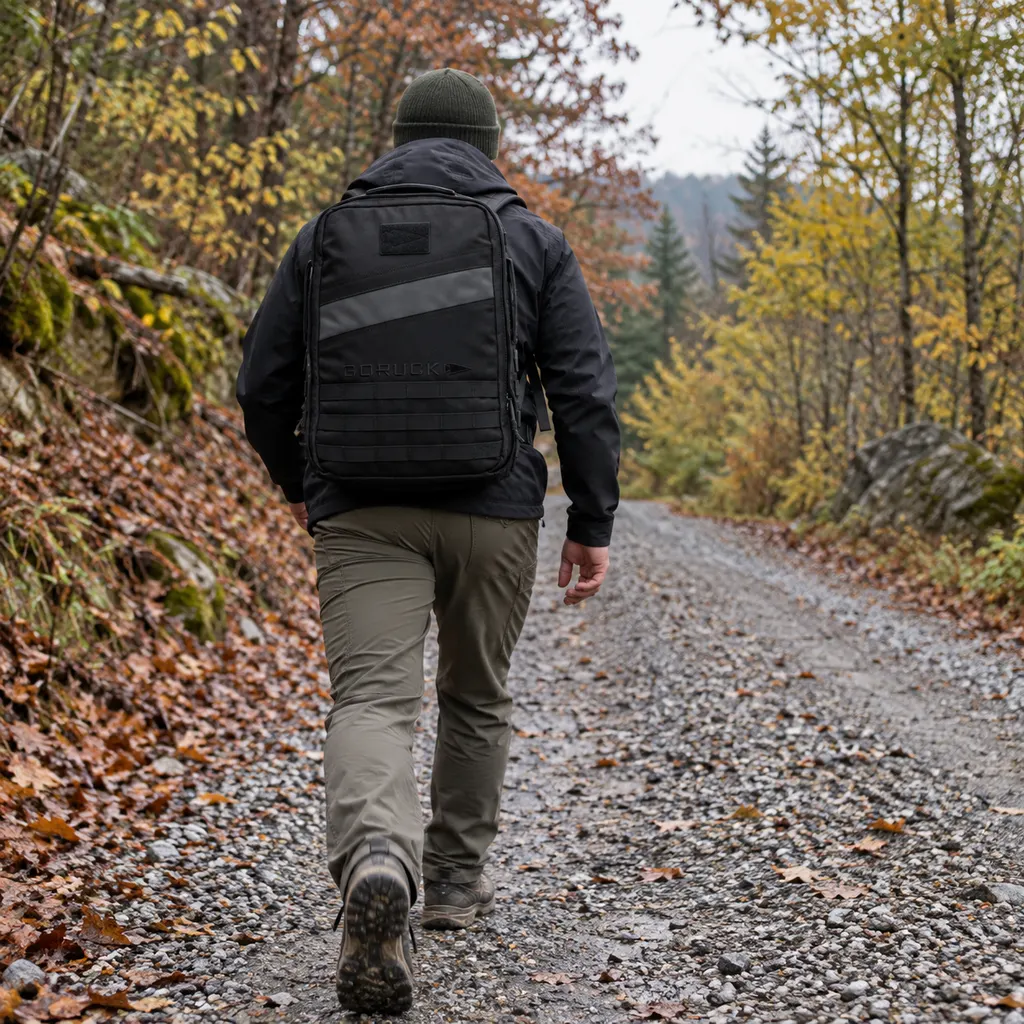
GORUCK Rucker 4.0 rucking backpack worn on a gravel fire road in autumn

Ruckercise Ridge 21L: Best Plate Fit

The Ridge solves the most annoying problem in rucking, which is owning a plate that does not fit the bag. It has two plate pockets in different sizes, a long one at 15.5 by 10.5 inches and a short one at 11 by 8.5 inches, so both common plate formats sit flat and tight instead of rattling around in a main compartment.

Construction is 1000 denier CORDURA nylon, the same class of fabric as the Rucker, and it shrugs off the abrasion of loading and unloading iron. MOLLE webbing across the front lets you add pouches, and there is an internal hydration ring with a hose port if you want a bladder rather than bottles.

At 18 by 13.5 by 4.5 inches it is a narrow pack, which is exactly right for loaded walking. Nothing sticks out past your shoulders and the depth keeps the weight close to your back rather than levering away from it.

Specs That Matter

  • Capacity: 21L in an 18 x 13.5 x 4.5 inch body
  • Plate pockets: two, sized 15.5 x 10.5 in and 11 x 8.5 in
  • Fabric: 1000D CORDURA nylon
  • Extras: MOLLE webbing, hydration ring and hose port
  • Rating: 4.5 stars across 34 reviews

Who It Is For

Anyone who already owns a ruck plate, or who wants the freedom to buy either plate size later without a second bag.
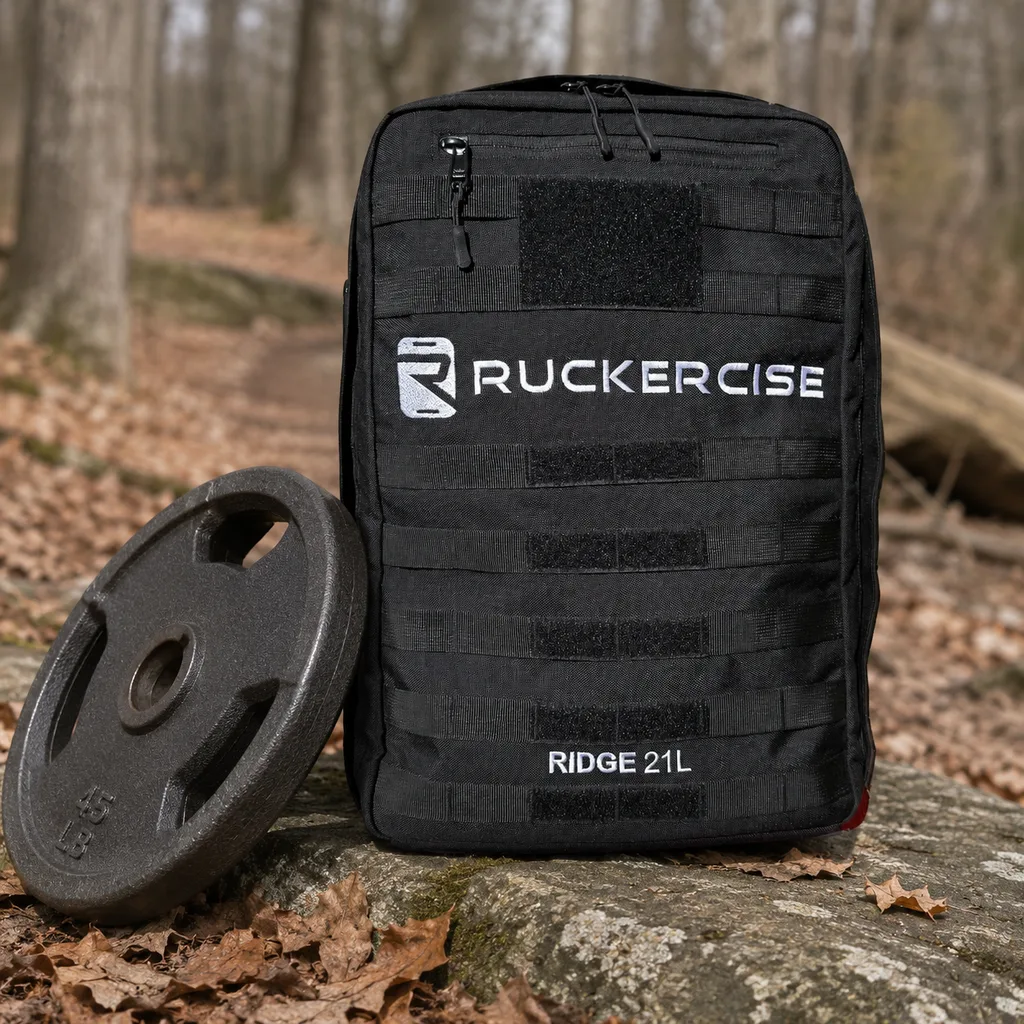
Ruckercise Ridge 21L rucksack on a rock with a cast iron weight plate beside it

RuckBuddy RuckPack 25L: Best for Heavy Loads

Once you are past 30 pounds, shoulders alone stop being enough, and this is the only pack in the round up with a proper removable padded hip belt. Moving even a third of the load onto your hips changes how the last 20 minutes of a heavy ruck feel, and you can strip the belt off entirely for lighter sessions.

The internal sleeve keeps plates high and tight, with a 16 by 12.5 inch long pocket and a smaller short pocket, and the shoulder straps use thick high density foam that resists the strap bite that shows up around the 45 minute mark. The 25 litre main compartment leaves genuine room for shoes and layers, so it works as a gym bag on the way to a session.

Four reinforced grab handles are the unusual touch. They turn the loaded pack into a piece of gym equipment for drags, presses and carries, which is useful if your rucking sits inside a broader strength routine.

Specs That Matter

  • Capacity: 25L, external dimensions 20.9 x 12 x 6.3 in
  • Plate pockets: reinforced internal sleeve, 16 x 12.5 in long pocket
  • Hip belt: removable and padded, for loads above 30 lb
  • Extras: four grab handles, MOLLE front panel, hydration ring and hose port
  • Rating: 4.4 stars across 41 reviews

Who It Is For

Ruckers building toward heavy loads, and anyone who wants one bag that handles the walk and the gym session at either end of it.
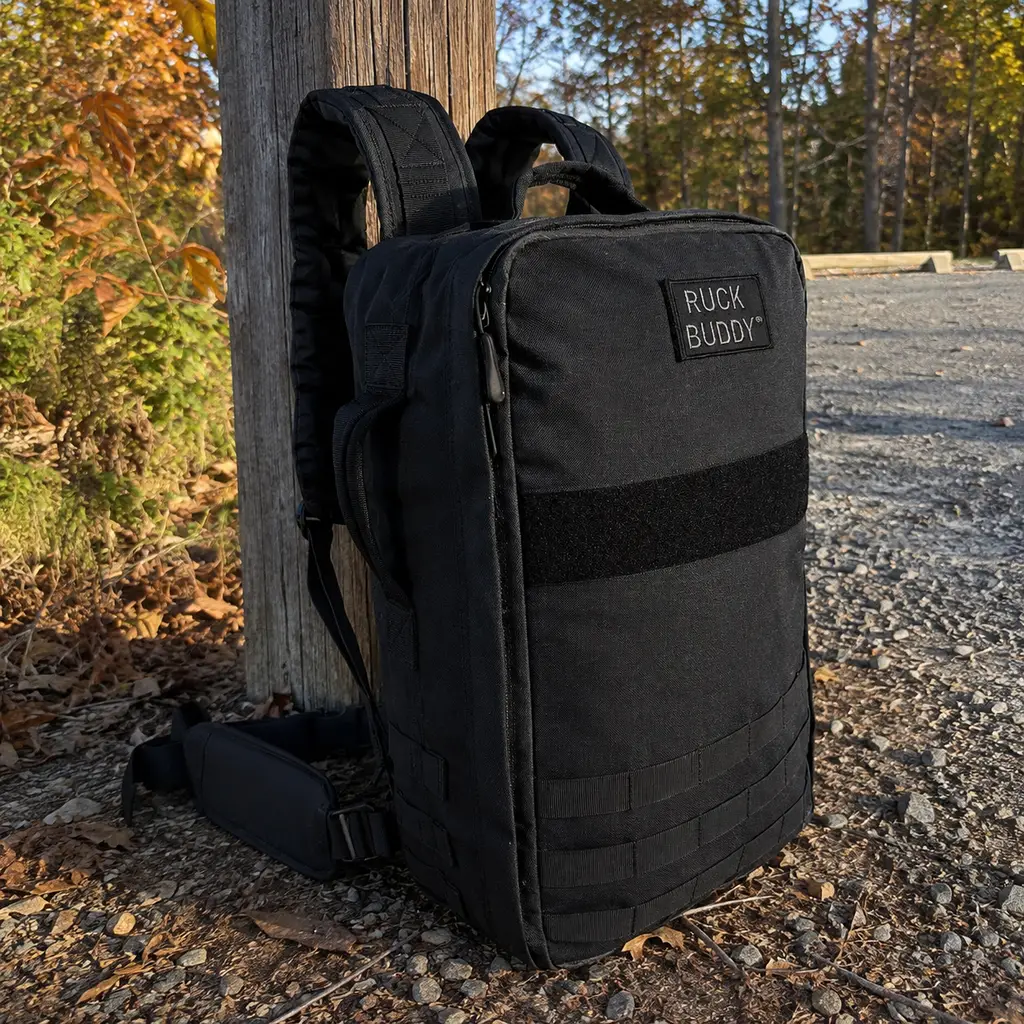
RuckBuddy RuckPack 25L with its padded hip belt against a wooden trailhead post

GORUCK Ruck Plate Carrier 3.0: Best Minimalist

This is a pack stripped to the single job of carrying a plate. There is no main compartment worth the name, just a sleeve sized for 10, 20 or 30 pound standard ruck plates and the structure to hold one high and flat against your back.

What you get in return is the closest thing to weight that disappears. The back panel and the underside of the straps are lined with 210D high tenacity CORDURA that does not chew up merino or cause friction burn, 10mm EVA foam supports the natural curve of your spine, and dual density straps put an inch of padding where the load actually sits.

Unlike a weighted vest it leaves your chest completely open, so you can drop into pushups mid walk or break into a run without anything compressing your ribs. The trade off is obvious: nowhere to put a jacket, a bottle or a phone beyond a small pocket.

Specs That Matter

  • Carries: 10, 20 or 30 lb standard ruck plates, sold separately
  • Fabric: 1000D CORDURA exterior with a 1050D ballistic reinforced bottom panel
  • Padding: 10mm EVA lumbar support, dual density straps with 1 inch top padding
  • Hardware: YKK zippers with silent pulls
  • Rating: 4.2 stars across 199 reviews

Who It Is For

People whose rucking is training rather than travel, especially anyone mixing walking with calisthenics or short runs.

GORUCK Ruck Plate Carrier 3.0 worn on a grassy hill path at golden hour

Hannibal Tactical 30L: Best Budget

If you are not sure rucking will stick, this is the pack to find out with. It is a conventional three day assault pack: 30 litres across two main compartments, water resistant fabric, MOLLE webbing on the front and both sides, and a back compartment sized for a hydration bladder that doubles neatly as a plate sleeve.

There is no dedicated plate pocket, so you pack the weight yourself. Put the plate flat against the back panel in the hydration sleeve, wedge a rolled jacket underneath it so it cannot slide down, and cinch the compression straps. Done properly it carries almost as well as a purpose built sleeve for a fraction of the price.

The padding is honest for the money. Thick mesh on the back panel and adjustable padded straps with an expandable waist belt handle 20 to 25 pounds comfortably, and 575 reviews at 4.7 stars suggest the stitching holds up better than the price implies.

Specs That Matter

  • Capacity: 30L, approximately 9.8 x 15.7 x 10.2 in
  • Compartments: two main, two front, plus a rear hydration sleeve that fits a plate
  • Fabric: water resistant high density polyester with MOLLE on front and sides
  • Comfort: padded adjustable straps, mesh back panel, expandable waist belt
  • Rating: 4.7 stars across 575 reviews

Who It Is For

First time ruckers, and anyone who wants a bag that also works for a day hike or an overnight without a second purchase.

Hannibal Tactical 30L camouflage assault pack resting on a log in a forest

Mardingtop Tactical 30L: Lightest Option

At 1 kilogram empty this is the lightest 30 litre pack here, which matters more than it sounds. Every ounce the bag weighs is an ounce of your load doing nothing useful, so a light shell means more of the weight on your back is training weight.

It is built from 600 denier polyester with YKK zippers and buckles, the components that usually fail first on cheap packs. The body is tall and narrow at 11.8 by 7.8 by 19.3 inches, which keeps a plate high and stops the load swinging out behind you on hills.

A full MOLLE system covers the front, the hydration compartment takes a 2 litre bladder with a top hose port, and the adjustable waist belt plus breathable padded back panel keep it stable. For a pack in this price range the organisation is unusually good, with a large front loading compartment for the things you want without opening the main bag.

Specs That Matter

  • Capacity: 30L in an 11.8 x 7.8 x 19.3 in body
  • Weight: 1.0 kg empty, the lightest pack in this round up
  • Fabric: 600D polyester with YKK zippers and buckles
  • Extras: full MOLLE webbing, 2L hydration compartment with hose port, waist belt
  • Rating: 4.6 stars across 78 reviews

Who It Is For

Ruckers who want the lowest possible empty weight, and anyone doubling the pack up for hiking, fishing or travel.

Mardingtop Tactical 30L coyote tan backpack on a dirt path beside dry grass

How to Choose Between Them

Rucking Three Times a Week, Long Term

Buy the Rucker 4.0. The elevated plate pocket and the strap construction are what you are paying for, and they are the two things that decide whether an hour under load is pleasant or something you talk yourself out of.

You Already Own a Plate

Check the plate’s dimensions first, then buy the Ridge. Its two differently sized pockets cover both common plate formats, which removes the most common mismatch in this category. Measure twice, the way you would before cutting weight out of a daypack.

Working Toward Heavy Loads

The RuckBuddy is the only pick with a removable padded hip belt, and above 30 pounds that belt is the difference between finishing strong and finishing sore. The same logic applies on the trail, which is why daypacks built for real loads all carry one.

Training Rather Than Travelling

The Ruck Plate Carrier 3.0 gives you the cleanest carry and nothing else. If your session is a loop from your door with a bottle in your hand, the missing storage costs you nothing. Carry water separately, because the hydration maths does not change just because the walk is short.

Spending as Little as Possible

The Hannibal 30L at 4.7 stars is the safest cheap pack here, and it will also serve as a weekend bag for dispersed camping if rucking does not stick. Pack the weight yourself and it carries far better than the price suggests.

Capacity, Fabric and Plate Pockets: What the Specs Mean

Litres Are the Least Important Number

A 20 pound plate takes up almost no volume. Twenty litres holds a plate, a shell, a litre of water and food, which covers most sessions. Go bigger only if the pack has a second job, such as the gym, an evening night walk with a headlamp in the lid, or a sub 24 hour overnight.

Denier Tells You How Long It Lasts

Denier measures the thickness of the yarn. 600D polyester is fine for 20 pounds and a few sessions a week. 1000D CORDURA is roughly what military packs use and it is the reason the two premium picks cost what they do. If you drop iron into a bag several times a week, the fabric is where that shows up first. It is the same durability question that sits behind canvas against nylon in a tent.

The Plate Pocket Is the Whole Design

A dedicated sleeve holds the weight at shoulder blade height and stops it sliding. Without one you are relying on your own packing to do the same job, which works, but has to be redone every single time you load the bag. Backpacking for beginners covers the same load order in a bigger pack.

Straps and Lumbar Padding Decide Comfort

Narrow straps concentrate the load onto two lines across the top of your shoulders and go numb around 45 minutes in. Wide, dual density straps spread the same weight over three or four times the area. Lumbar padding braces your lower back so the load does not fold you forward, the same principle behind using poles to unload your legs on steep ground.

Rucking With It Safely and Making It Last

Load the pack on the ground, then lift it onto your back with your legs, not by swinging it up one strap at a time. A 30 pound pack swung onto one shoulder is one of the more common ways people hurt their back doing an activity that is otherwise very gentle on the body. If you are building toward hills, pair the loading habit with elevation training at sea level.

Cinch the shoulder straps until the pack sits against your upper back with no gap, fasten the sternum strap, and check that nothing shifts when you jump on the spot. Anything that moves when you jump will move on every step, and by mile three it will have rubbed a hole in something. Keep your posture tall and your stride short, and read the fundamentals of walking under load if this is all new.

For care, empty the pack after every session rather than leaving iron sitting in wet fabric, brush the grit out of the zippers, and wash it by hand in cold water when it starts to smell. Never machine wash a CORDURA pack with a plate pocket, and never put it in a dryer, which cooks the coating and the foam. The same storage rules as storing your camping gear apply: dry, unloaded and hanging.

Frequently Asked Questions

What backpack should a beginner use for rucking?

For the first month, whatever daypack you already own, packed with water bottles held high against your back. When you buy, the Hannibal Tactical 30L is the lowest risk starting point, and the GORUCK Rucker 4.0 is the one to buy if you are certain rucking will stay in your week.

Can I use a hiking backpack for rucking?

Yes, with two caveats. A hiking pack carries the load lower and looser than a rucking pack, so you have to pack the weight high and cinch every compression strap. Ultralight hiking packs are the exception: their thin fabric and minimal straps are not built for concentrated weight and will wear out fast. Our guide to layering for hiking is a better use of that pack.

What size ruck plate fits most packs?

Standard plates come in two footprints, roughly 11 by 8.5 inches for the short version and 15.5 by 10.5 inches for the long one, in 10, 20 and 30 pound weights. Measure the sleeve in your pack before ordering, because a plate that is an inch too tall will not sit flat and will rock with every step.

Do I need a hip belt for rucking?

Not below about 30 pounds. Above that, a padded hip belt moves a meaningful share of the load onto your pelvis and changes how the final stretch of a long ruck feels. A removable belt gives you both options in one pack.

How long does a rucking backpack last?

A 1000D CORDURA pack rucked three times a week should last years, and the premium options here are usually replaced because someone wanted a different size, not because they failed. A 600D polyester pack under the same use is realistically a two to three year bag, which is still good value at the price. Either one outlasts the shoes you ruck in, which is worth planning for alongside the rest of your walking kit.

If you are buying one pack and want it to be right, the GORUCK Rucker 4.0 is the pick. If you are testing whether rucking fits your week, start with the Hannibal 30L and a couple of water bottles, then upgrade once the habit is real. Either way, our beginner guide covers the first month, and the fall boot round up covers what to put on your feet before you add weight to them.


Discover more from Maive Verse

Subscribe to get the latest posts sent to your email.

Discover more from Maive Verse

Subscribe now to keep reading and get access to the full archive.

Continue reading