


Master the principles of eco-friendly hiking. Discover 11 technical rules to reduce your trail carbon footprint and minimize backcountry environmental impact.

Table of Contents
Introduction: The Carbon Calculus of Backcountry Exploration
Implementing a structured approach to eco-friendly hiking is a technical requirement for preserving the integrity of wilderness ecosystems. While outdoor recreation is often perceived as inherently low-impact, the cumulative atmospheric and physical footprint of backcountry travel is substantial. From the greenhouse gases emitted during trailhead transit to the manufacturing footprint of technical gear, every expedition carries a hidden environmental cost. For those who have already mastered the Bikepacking for Beginners Guide, extending sustainable principles to pedestrian travel is the next phase in wilderness stewardship.
The primary objective of low-impact hiking is the mitigation of both localized trail damage and global atmospheric load. This requires a disciplined understanding of carbon math, sustainable textile lifecycles, and low-waste camp logistics. By treating environmental impact as a measurable variable, the modern navigator can optimize their journey to achieve a net-neutral footprint. This analytical approach mirrors the planning rigor found in our Ultimate Gear List tutorials. This guide outlines 11 rules designed to transition your trail presence into a model of ecological efficiency.
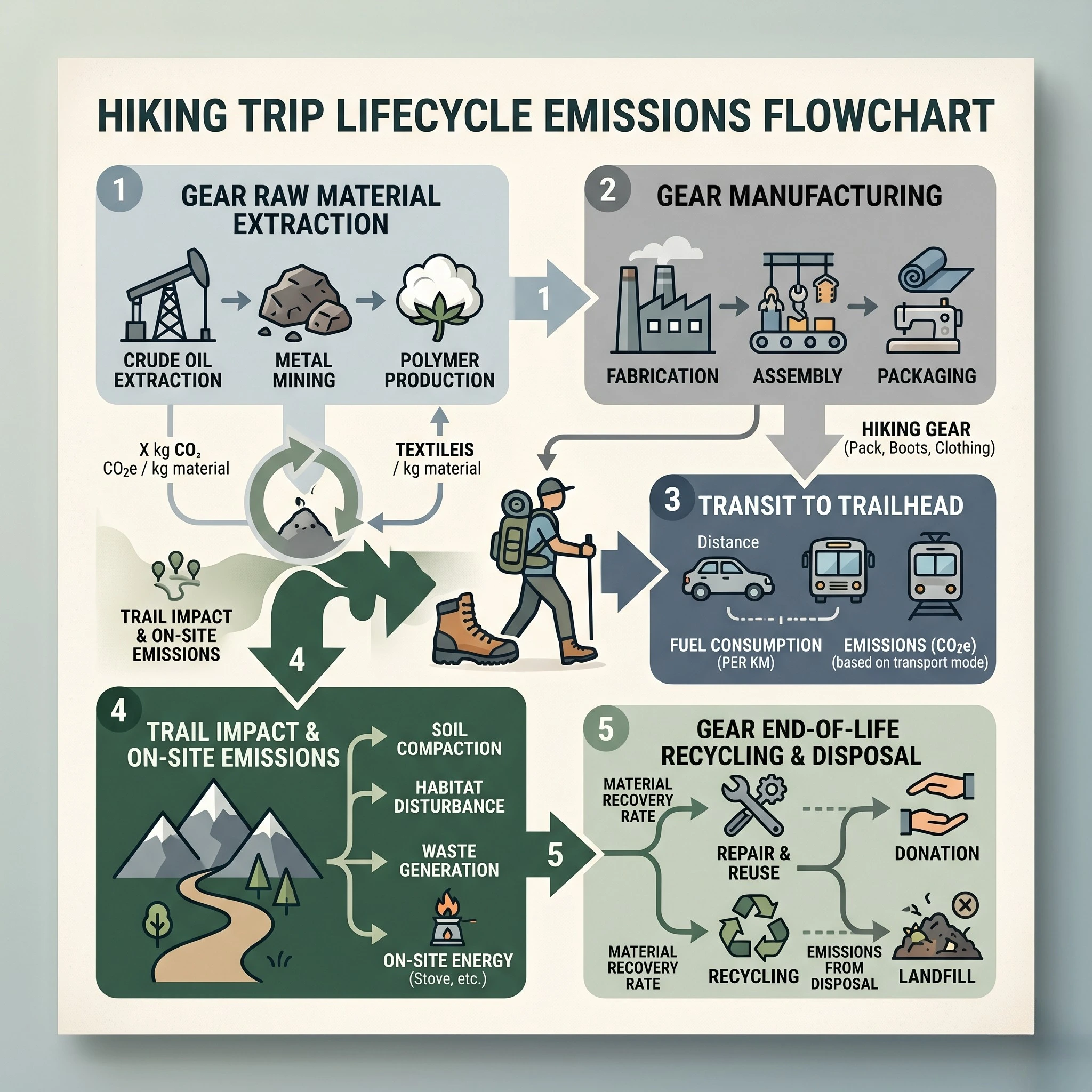
1. Plan Low-Impact Transportation and Group Logistics
The single largest contributor to an individual’s trail carbon footprint is the transportation required to reach the trailhead. Minimizing this variable is the most effective starting point for any eco-friendly hiking protocol.

Calculating Transit Emissions
To quantify the carbon cost of transit, hikers should evaluate the total distance traveled against the vehicle’s specific emission factor. This calculation is expressed by the linear equation:$$C_{\text{transit}} = D \times EF_{\text{vehicle}}$$
Where:
- $C_{\text{transit}}$ is the total carbon emissions in kilograms of $\text{CO}_2$ equivalent ($\text{kg CO}_2\text{e}$).
- $D$ is the round-trip distance in kilometers.
- $EF_{\text{vehicle}}$ is the emission factor of the vehicle ($\text{kg CO}_2\text{e/km}$).
By pooling resources and carpooling with other participants, the per-capita emissions drop exponentially:$$C_{\text{per-capita}} = \frac{C_{\text{transit}}}{N}$$
Where $N$ is the number of passengers. Utilizing public transit, selecting trailheads closer to municipal centers, or planning multi-day trips instead of frequent single-day trips are high-value strategies for optimizing this variable.
Calculating Transit Emissions with Digital Tools
Hikers can utilize the EPA Carbon Footprint Calculator to accurately model and offset their transit emissions before departing. This proactive offset strategy ensures that the travel footprint is neutralized.
2. Transition to Sustainable Trail Gear and Materials
The manufacturing of technical outdoor gear is a resource-intensive process. Eco-friendly hiking requires a shift toward durable, circular, and recycled materials.

Evaluating Circular Lifecycles in Outerwear
When selecting apparel, the hiker must evaluate the material’s circular potential. Traditional synthetic garments rely on virgin petroleum and contain Perfluorochemicals (PFCs) for water repellency. Modern alternatives prioritize recycled polyester, organic cotton, and PFC-free membranes.
To maximize gear lifespan and prevent premature disposal, practicing consistent maintenance is a primary protocol. Extending the utility of existing gear is far superior to purchasing new sustainable alternatives, a principle detailed in our Eco-Friendly Bikepacking framework.
3. Practice Strict Pack-In, Pack-Out Waste Minimization
Waste management on the trail is more than an aesthetic issue; it is a critical safety and chemical hazard.

Micro-Plastic and Organic Waste Protocols
All food must be repackaged into reusable, washable silicone bags before leaving the home base. This eliminates the risk of micro-plastic contamination from commercial wrappers, which can easily escape from pockets in high winds.
Additionally, organic waste like apple cores, banana peels, and nut shells must be packed out. In arid or cold alpine environments, these items do not decompose rapidly and can disrupt the natural diet of local wildlife.
4. Stay on Designated and Durable Trail Surfaces
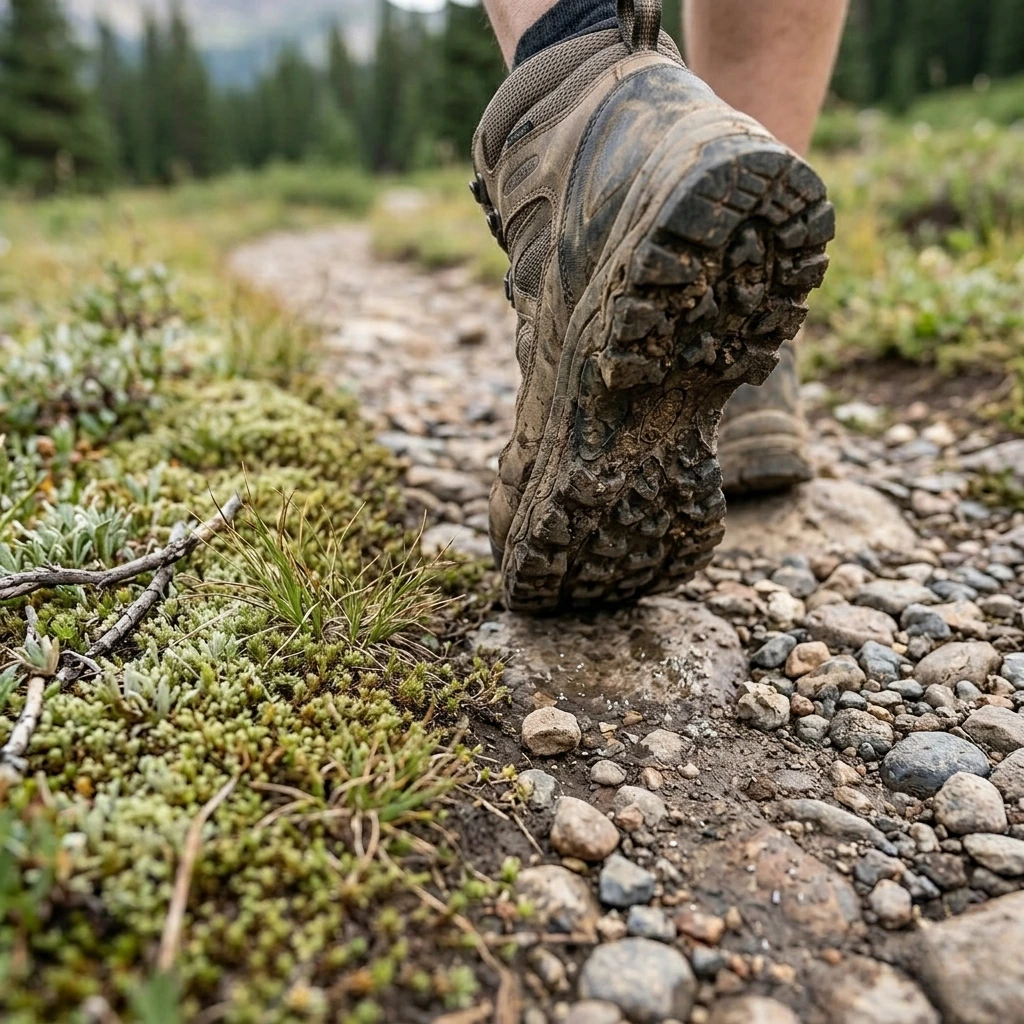
The physical compaction of soil from off-trail travel destroys delicate root systems and accelerates erosion.
The Physics of Trail Erosion
When a hiker steps off the trail, they exert a concentrated force on the soil structure. This force is defined by:$$P = \frac{F}{A}$$
Where:
- $P$ is the pressure exerted on the soil.
- $F$ is the downward force (weight of the hiker and pack).
- $A$ is the contact surface area of the boot sole.
On soft, damp soils, this pressure collapses the macro-pores required for water infiltration and plant root respiration. This trail damage, known as trail braiding, can take decades to recover. Staying in the center of the established path is a non-negotiable protocol advocated by the Leave No Trace Center for Outdoor Ethics. This discipline is identical to the trail etiquette required for Soft Hiking groups.
5. Implement Eco-Friendly Hiking Gear Selections
Enhancing your eco-friendly hiking setup involves choosing products designed specifically to minimize raw material extraction and chemical runoff.

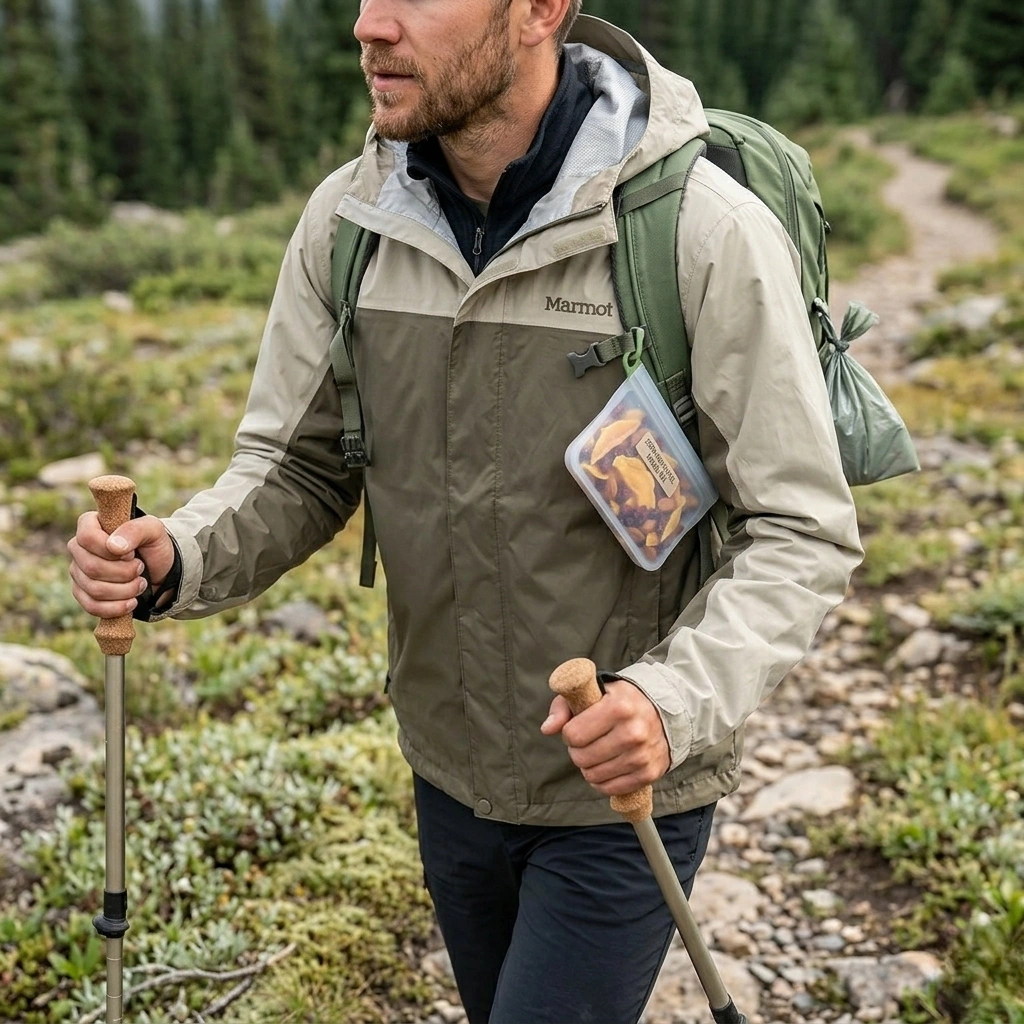
1. Patagonia Torrentshell 3L Rain Jacket
This jacket uses 100% recycled nylon face fabric and a PFC-free waterproof membrane, providing premium protection without the associated chemical footprint.
Key Features
Pros