
Master forest bathing with our technical guide. Learn sensory protocols to reduce stress and improve biological health during mindful hiking in 2026.

Table of Contents
Introduction: The Technical Role of Sensory Immersion
Practicing forest bathing, known in its foundational Japanese context as Shinrin-yoku, is a technical requirement for hikers seeking to mitigate the neurochemical effects of modern digital fatigue. Unlike high-intensity peak bagging, which prioritizes cardiovascular output and elevation gain, mindful hiking focuses on the mechanical regulation of the nervous system through intentional sensory engagement. In 2026, as urban noise and screentime continue to increase biological stress markers, the implementation of forest bathing has become a vital survival protocol for the modern explorer. This practice does not suggest a lack of physical effort; rather, it requires a disciplined shift in the Bikepacking Mindset toward environmental awareness and psychological presence.
The primary objective of this guide is to demystify forest bathing by breaking it down into actionable, technical steps. Success on the trail is redefined here not by the distance covered, but by the depth of the biological and psychological restoration achieved. This approach complements the principles found in our Soft Hiking Guide, where the focus remains on inclusivity and intentionality. By understanding the mechanical relationship between the forest environment and human physiology, any adventurer can transform a standard walk into a high-value clinical exercise in wellness.
The Biological Mechanics of Forest Bathing
To master forest bathing, the practitioner must first understand the chemical and physiological processes involved. Research published by the NIH on Shinrin-yoku confirms that immersion in forest environments significantly reduces salivary cortisol—the body’s primary stress hormone—while simultaneously lowering blood pressure and heart rate variability. These changes are not merely psychological; they are the result of the body’s interaction with “phytoncides.” These are antimicrobial volatile organic compounds (essential oils) emitted by trees, such as cedar and pine, to protect themselves from insects and decay. When inhaled by humans, phytoncides trigger an increase in the activity and number of Natural Killer (NK) cells, which are critical components of the immune system’s response to pathogens and abnormal cell growth.
Furthermore, the “fractal geometry” found in natural landscapes—the complex, repeating patterns in branches, leaves, and clouds—exerts a specific mechanical effect on the human visual system. The brain is evolutionarily optimized to process these patterns, and doing so requires significantly less cognitive load than processing the sharp, linear grids of a city. This reduction in “directed attention” allows the prefrontal cortex to enter a state of “soft fascination,” which is a prerequisite for overcoming the mental fatigue discussed in our endurance guides. Mastering this biological integration requires a commitment to slow, deliberate movement that maximizes the window of exposure to these beneficial environmental factors.
Tactical Protocols for Sensory Engagement on the Trail
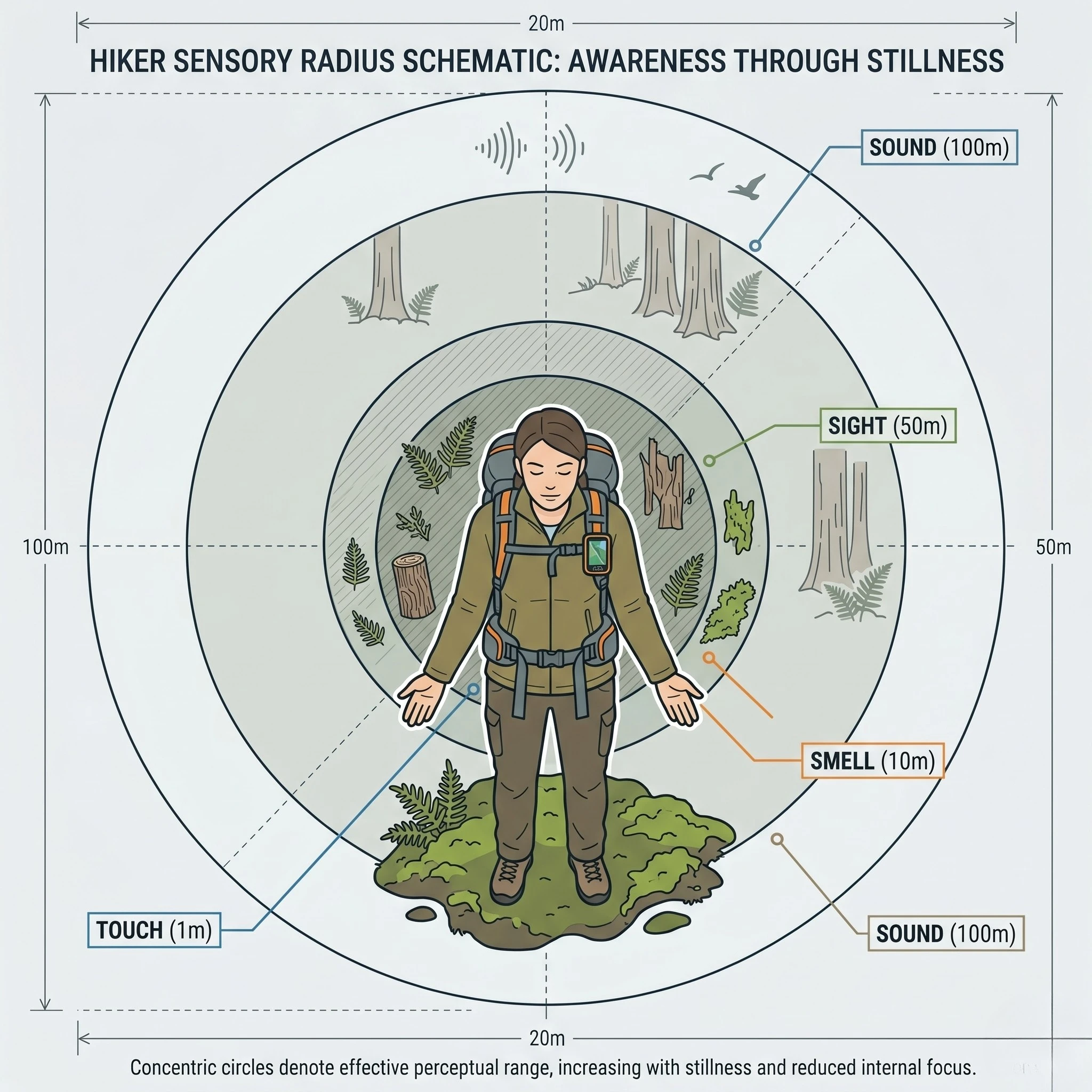
The implementation of forest bathing requires the execution of five distinct sensory protocols. These are designed to anchor the hiker in the present moment and decouple the brain from the “future-oriented” anxiety of reaching a destination.
- Visual Scanning (The Broad Horizon): The hiker must transition from “tunnel vision” (focusing on the trail 5 feet ahead) to “peripheral awareness.” This involves letting the eyes wander without a specific target, observing the movement of light through the canopy and the intricate textures of moss and bark.
- Auditory Isolation (The Soundscape): Periodically, the practitioner should stop and stand in total silence for 60 seconds. The goal is to isolate individual sounds—the distant trickle of a stream, the mechanical rustle of leaves, or the specific call of a bird. This filters out the internal monologue and replaces it with the “white noise” of the ecosystem.
- Olfactory Sampling (Phytoncide Inhalation): Since the benefits of forest bathing are largely chemical, deep, rhythmic breathing is a mechanical necessity. The hiker should focus on the scent of the damp earth, the sharp needles of conifers, and the sweet rot of decaying wood. These scents are the physical evidence of the forest’s active chemistry.
- Tactile Grounding (Surface Texture): Engagement with the physical environment through touch reinforces the connection between the body and the land. This may involve running a hand over the rough ridges of a tree or feeling the cold temperature of a river stone.
- Sit-Spot Implementation: The final protocol involves the “sit spot.” The hiker selects a durable surface away from the trail and remains static for 15–20 minutes. This duration is required for the local wildlife to habituate to the hiker’s presence, allowing the individual to witness the “undisturbed” state of the wilderness.
Logistical Readiness and Environmental Safety Protocols
Maintaining safety and ethical standards is a foundational requirement for forest bathing. Because the practice encourages deep immersion and slow movement, the hiker must be even more vigilant about their surroundings and the impact they leave behind. Disorientation can occur when the mind is relaxed, making the adherence to Solo Safety Protocols mandatory.
- Navigation Redundancy: Even on a “mindful” walk, the hiker must carry a fully charged GPS device and a paper map. The focus on sensory details should never override the mechanical requirement of knowing one’s position relative to the trailhead.
- Environmental Stewardship: Practitioners must strictly follow Leave No Trace Principles. This means remaining on established trails even when seeking a “sit spot” to prevent the compaction of fragile soil and the destruction of insect habitats.
- Wildlife Awareness: Moving slowly and quietly increases the likelihood of a surprise encounter with large mammals. The hiker must maintain situational awareness, as recommended by the National Park Service.
- Physical Readiness: Mindful hiking requires the same attention to gear as high-intensity sports. Carrying adequate water and a small first aid kit ensures that a 2-hour forest bathing session doesn’t turn into an emergency. Training from organizations like NOLS emphasizes that self-reliance is the bedrock of all wilderness engagement.
Conclusion: The Integration of Mindfulness into Wilderness Travel
Mastering the technical art of forest bathing transforms the trail into more than just a path; it becomes a tool for biological and psychological recalibration. By prioritizing sensory immersion (Section 3) and understanding the physiological impact of phytoncides (Section 2), any adventurer can achieve a high-performance state of recovery. The success of a mission is not measured by the miles logged on a watch, but by the cessation of stress and the restoration of focus.
Remember that mindfulness is an iterative skill that develops with consistent practice. Every forest environment—from a local wooded park to a remote alpine glade—offers a unique chemical and visual profile to explore. Keep your Mechanical Readiness – Contextualized for hiking) high and your sensory receptors open. As you progress through your outdoor journey, your ability to integrate these mindful protocols will become your most valuable piece of safety equipment.
The wilderness is waiting, and it does not demand your speed—it only requests your attention. Treat the land with respect, pack with purpose, and embrace the unique liberation of moving slow. The transition from a busy modern life to a grounded, backcountry explorer is a path paved with preparation and a deep passion for the natural world. Step out with a plan, respect your limits, and enjoy the unparalleled freedom of the mindful life.
Discover more from Maive Verse
Subscribe to get the latest posts sent to your email.