
This post may contain affiliate links. If you buy through them, we may earn a small commission at no extra cost to you.
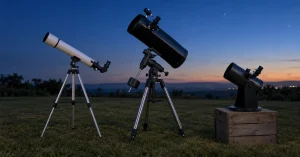
The best telescopes for beginners are the ones that get used, and the thing that stops a first telescope being used is almost never the optics. It is that the owner cannot find anything. A modest scope pointed at Saturn beats an excellent one still pointed at empty sky, which is why aperture, mount and how you locate things matter in that order.
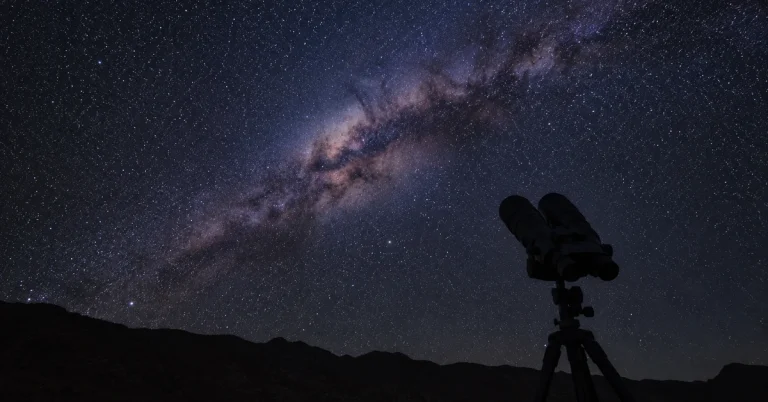
We compared six scopes across the range beginners actually buy, from a 70mm refractor with twenty two thousand reviews to a 130mm reflector on an equatorial mount. All six were checked on their listings for stock, rating and real specifications. One candidate was dropped for having 23 reviews behind a 4.7 rating, and one for a listing that exposed no usable specifications at all. If you have not looked through anything yet, binoculars are the honest first step.
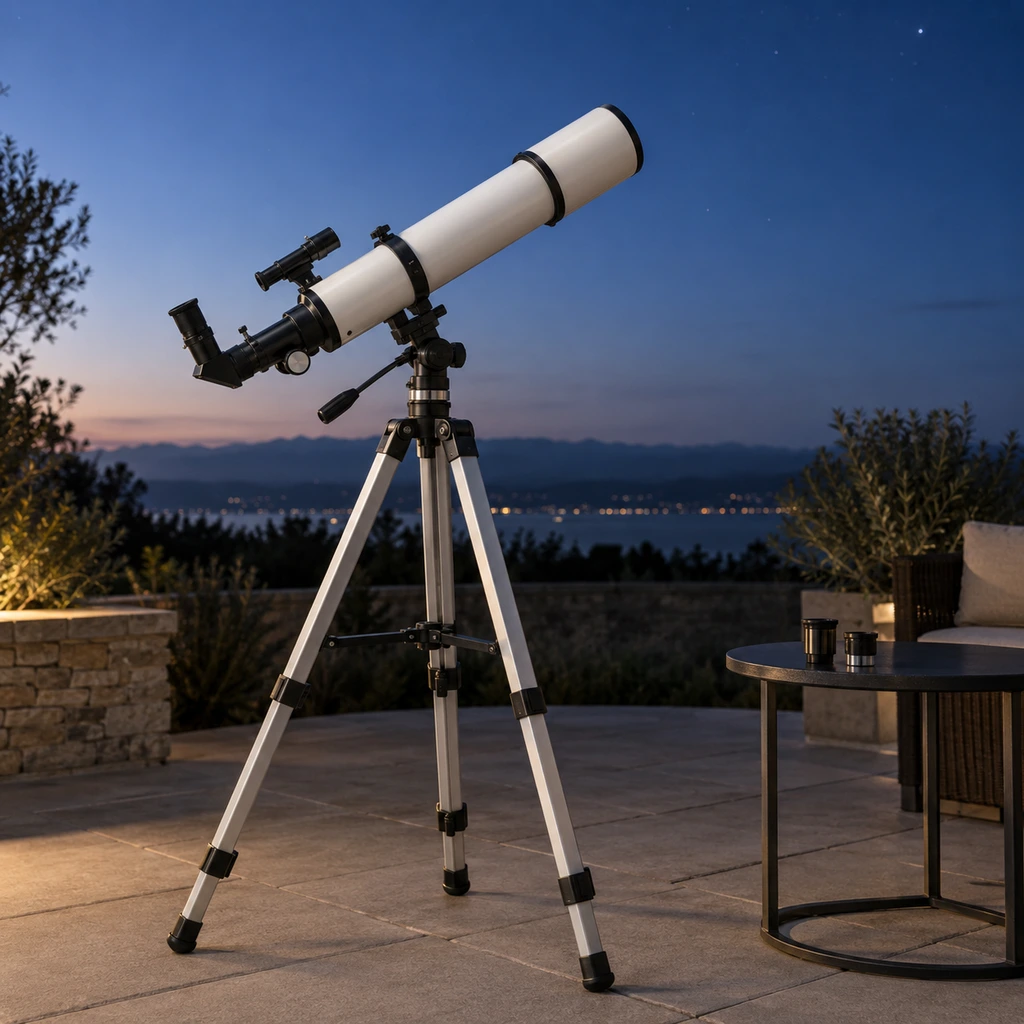
Table of Contents
What Separates the Best Telescopes for Beginners
Aperture first. The diameter of the main lens or mirror sets how much light the scope collects, and light is what turns a faint smudge into a spiral arm. A 130mm reflector gathers roughly three and a half times the light of a 70mm refractor, which is a far bigger difference than any coating or eyepiece upgrade. It is the same logic as objective size in a spotting scope.
Then the mount, which decides whether the view stays still. A wobbly tripod at 100x makes a planet dance out of the field every time you touch the focus knob, and it is the most common reason a cheap telescope gets abandoned. A tabletop Dobsonian base is steadier than a tall spindly tripod, which is why so many astronomers recommend them for first scopes, and why a solid tripod matters as much here as it does for big binoculars.
Then finding things, which is the part nobody warns beginners about. The sky moves, the finderscope shows a tiny patch, and star hopping takes practice. Phone guided systems that use the camera to recognise the star field and walk you to a target have genuinely changed the beginner experience, and they are worth the premium if your patience is limited. Learning the sky the old way still pays, and our beginner guide covers where to start.
Magnification is last and mostly irrelevant. Any scope can be pushed to any magnification with a cheap eyepiece; what limits the useful maximum is aperture and the atmosphere. Listings shouting 675x are describing a blurry, dim, unusable image, the same specification inflation you see in spotting scope magnification claims.
The Best Telescopes for Beginners at a Glance
| Telescope | Aperture | Type | Mount | Best For |
|---|---|---|---|---|
| Celestron AstroMaster 130EQ | 130 mm | Newtonian reflector | Equatorial | Deep sky objects |
| Celestron StarSense Explorer 114AZ | 114 mm | Newtonian reflector | Tabletop Dobsonian | Finding things easily |
| Koolpte 80mm 600mm | 80 mm | Refractor | Altazimuth tripod | Step up refractor |
| Celestron StarSense Explorer LT 80AZ | 80 mm | Refractor | Altazimuth tripod | App guided on a tripod |
| Gskyer 70mm 400mm | 70 mm | Refractor | Altazimuth tripod | Best budget |
| Celestron Travel Scope 70mm | 70 mm | Refractor | Full height tripod | Portability |
The Six Best Telescopes for Beginners in Detail
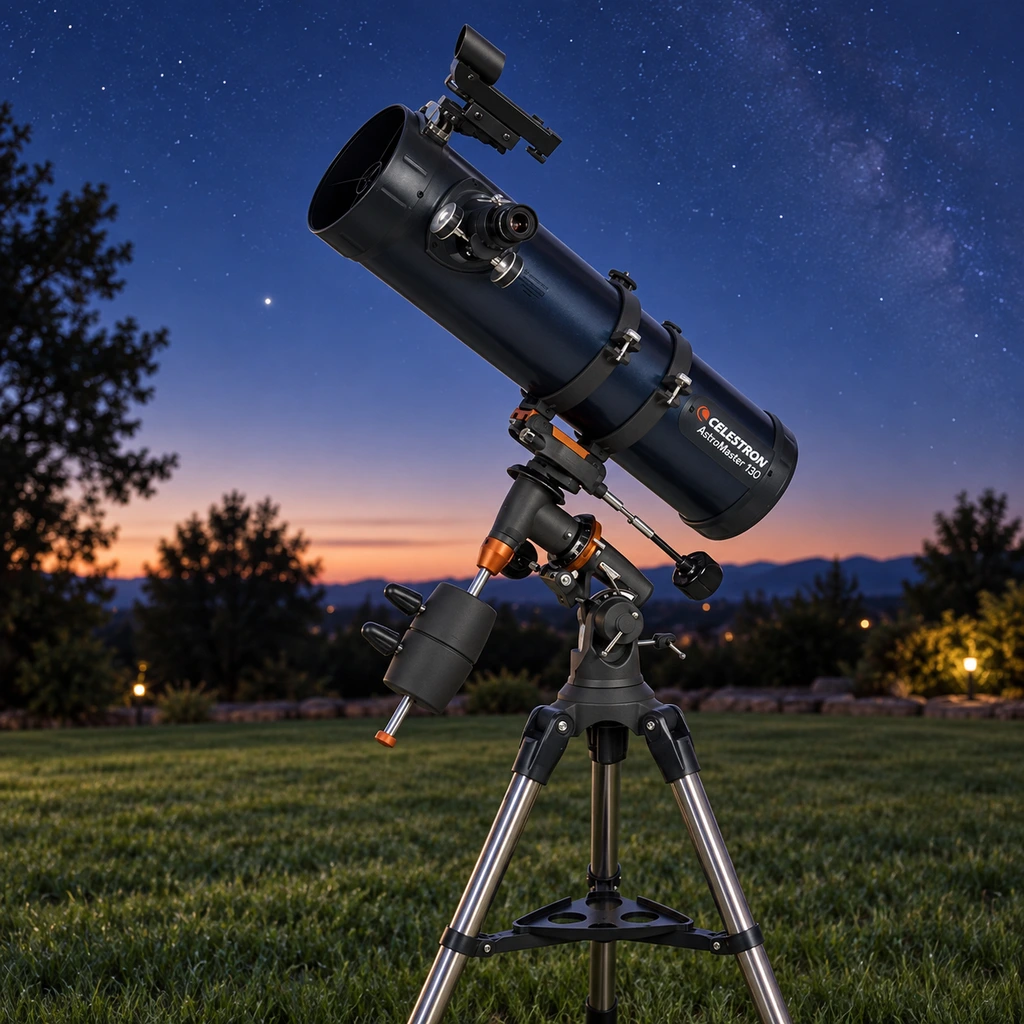
Celestron AstroMaster 130EQ: Best for Deep Sky
This is the most telescope on the list, and the only one with enough aperture to make galaxies and nebulae worth hunting. A 130mm, five inch Newtonian reflector with aluminium and silicon dioxide mirror coatings gathers substantially more light than any of the refractors here, which is the whole game for faint objects.
It sits on an equatorial mount with slow motion control knobs for right ascension and declination. That takes a session to understand and then becomes the reason you keep it: once aligned, following an object as the sky rotates is one smooth knob rather than a constant fight, and at high magnification that difference is enormous.
It assembles in minutes with no tools, and the included accessories are sensible rather than padding: a 20mm eyepiece with a built in erect image corrector so it works for terrestrial viewing too, a 10mm eyepiece for planets, and a StarPointer red dot finderscope, plus a free download of Starry Night software.
Specs That Matter
- Optics: 130mm (5 inch) Newtonian reflector, aluminium and SiO2 coatings
- Mount: equatorial with slow motion knobs for right ascension and declination
- Included: 20mm eyepiece with erect image corrector, 10mm eyepiece, StarPointer red dot finder
- Setup: few parts, no tools, adjustable tripod, plus Starry Night software
- Rating: 4.3 stars across 3,443 reviews
Who It Is For
Anyone whose interest is already real and who wants to see more than the Moon and planets. It is the pick that rewards learning.
Celestron StarSense Explorer 114AZ: Best for Finding Things
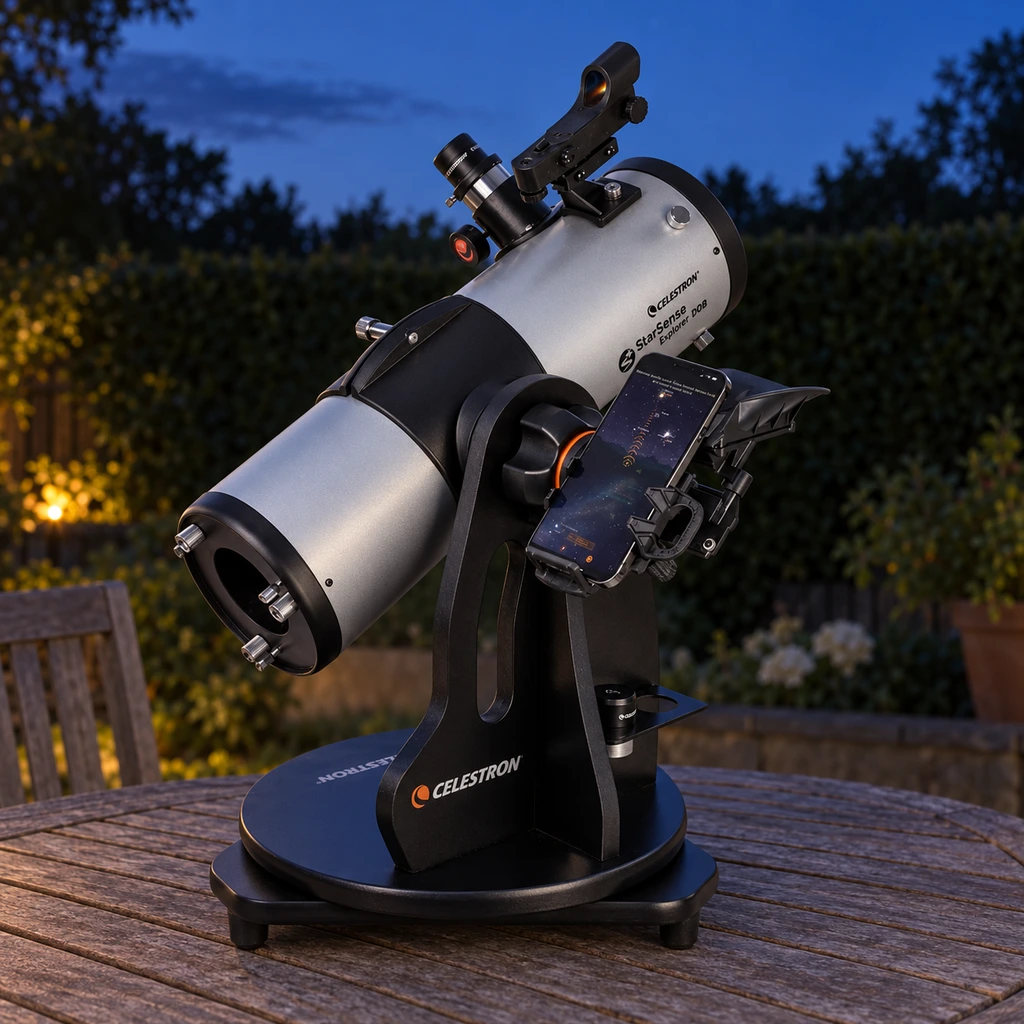
This solves the actual beginner problem. You dock your phone on the scope, open the StarSense Explorer app, and the app uses sky recognition on the phone’s camera to work out exactly where the telescope is pointed, then shows arrows to steer you to a target. When the bullseye turns green, the object is in the eyepiece.
It is not a star chart app; it is a navigation system, and the difference in a beginner’s first month is hard to overstate. It also generates a list of the best objects visible from your location at that moment, which removes the other beginner problem of not knowing what is up there tonight.
The optics are a 114mm, 4.5 inch Newtonian reflector with high reflectivity coatings on a manual altazimuth tabletop Dobsonian base. That base is the steadiest mount here and the reason the views hold still, with the trade off that you need a table, a wall or a crate to stand it on.
Specs That Matter
- Optics: 114mm (4.5 inch) Newtonian reflector with high reflectivity coatings
- Guidance: patented StarSense sky recognition, on screen arrows to each target
- App: generates tonight’s best targets for your time and location
- Mount: manual altazimuth tabletop Dobsonian base, needs a table or platform
- Rating: 4.4 stars across 91 reviews
Who It Is For
Beginners who have been defeated by finderscopes, and anyone buying for someone who will give up if the first night is frustrating.
Koolpte 80mm 600mm: Best Step Up Refractor
Eighty millimetres of aperture at 600mm focal length, f/6.7, is a genuine step up from the 70mm scopes that dominate the budget end. The extra aperture shows on the Moon’s terminator and on Jupiter’s cloud bands, and the longer focal length gives cleaner planetary views than a short fast tube.
The two supplied eyepieces, 25mm and 10mm, give 24x and 60x, which is an honest and useful pair rather than the absurd magnifications some kits advertise. Fully multi coated high transmission optics do the rest.
It sets up with no tools, comes with a phone adapter, a wireless remote for shooting through it, an adjustable aluminium tripod and a carrying bag. Nearly four thousand reviews at 4.3 stars for a scope in this bracket suggests the build holds up.
Specs That Matter
- Optics: 80mm aperture, 600mm focal length, f/6.7, fully multi coated
- Eyepieces: 25mm and 10mm, giving 24x and 60x
- Included: phone adapter, wireless remote, adjustable aluminium tripod, carrying bag
- Setup: no tools required, quick to focus
- Rating: 4.3 stars across 3,969 reviews
Who It Is For
Anyone who wants more than an entry refractor without moving to a reflector and an equatorial mount.
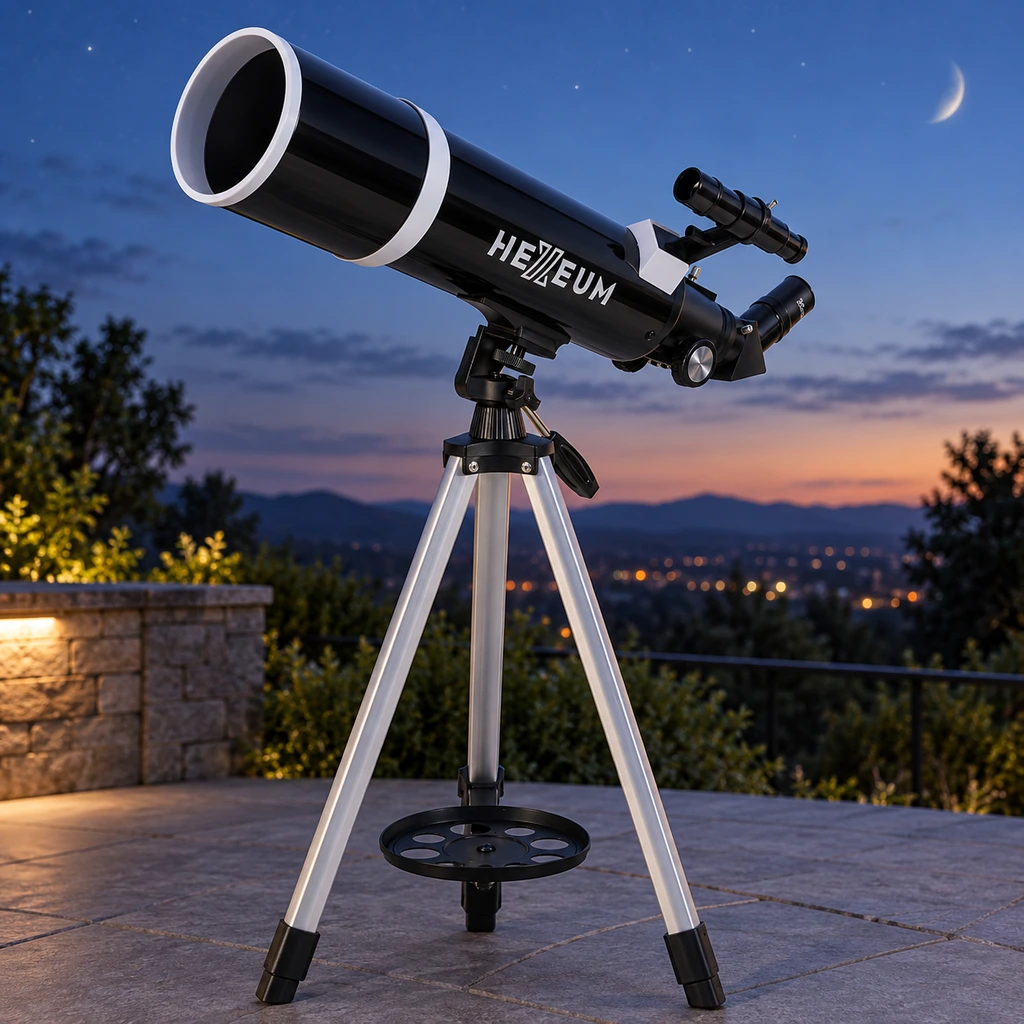
Celestron StarSense Explorer LT 80AZ: App Guided on a Tripod
The same phone guided system as the 114AZ, on a full height tripod with an 80mm refractor instead of a tabletop reflector. If you do not have a convenient table, wall or crate to put a tabletop scope on, this is the version of StarSense to buy.
You get less light than the 114AZ, three inches against four and a half, so faint objects are harder. In exchange you get a refractor, which needs no mirror alignment, holds its collimation permanently and is generally the lower maintenance choice for someone who does not want to fiddle.
The mount is a manual altazimuth with altitude slow motion adjustment on a sliding rod, which gives you finer control for tracking than a bare push to point head. Views of the Moon, Jupiter and Saturn are sharp, and the app finds them for you.
Specs That Matter
- Optics: 80mm (3 inch) refractor with high reflectivity coatings
- Guidance: patented StarSense sky recognition with on screen arrows
- Mount: manual altazimuth, altitude slow motion adjustment via sliding rod
- Advantage: no mirror to collimate, stands on its own tripod
- Rating: 4.3 stars across 582 reviews
Who It Is For
People who want the app guidance but need a free standing tripod, and anyone who would rather not maintain a reflector.
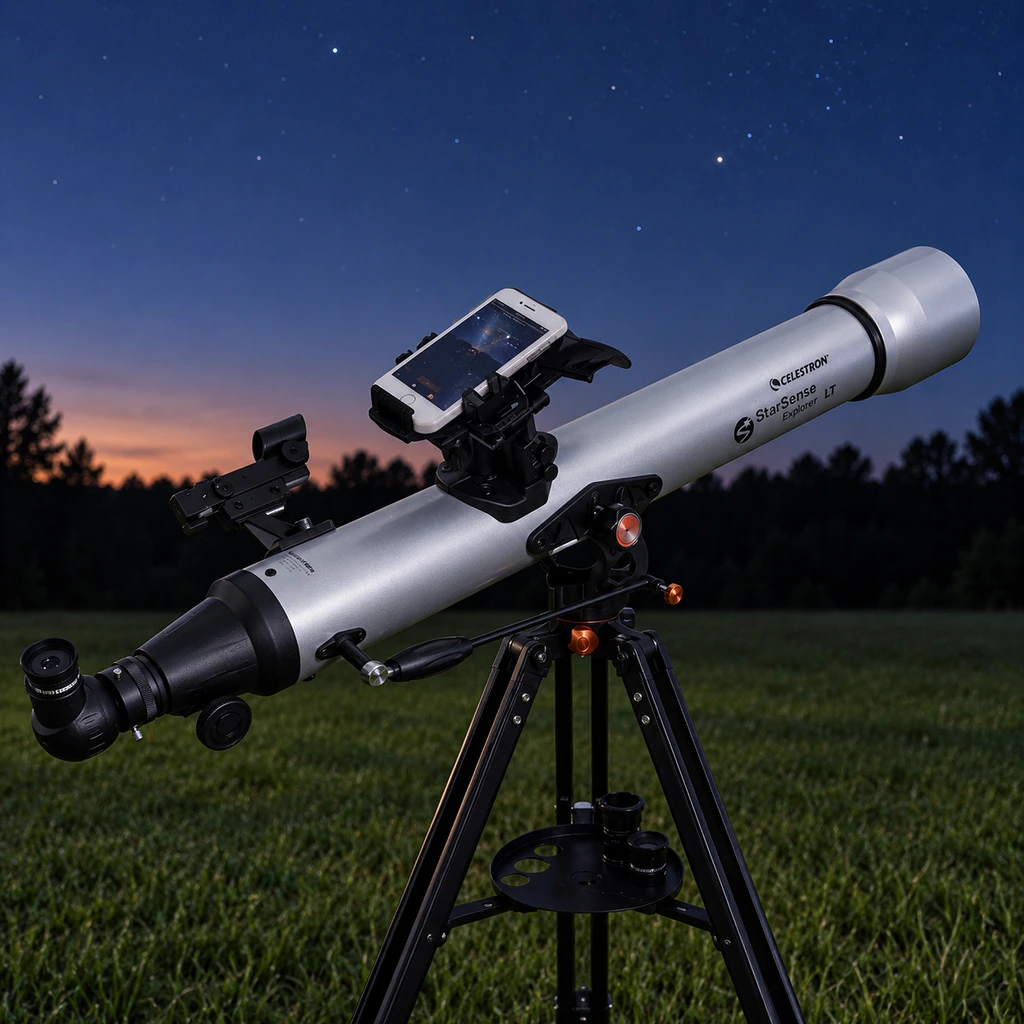
Gskyer 70mm 400mm: Best Budget
Twenty two thousand reviews at 4.3 stars makes this the most bought beginner telescope on Amazon by a wide margin, and for a first scope for a child or a curious adult it is a reasonable place to start. Seventy millimetres of aperture at 400mm focal length, f/5.7, with fully coated optics.
The accessory bundle is generous: two eyepieces plus a 3x Barlow lens that triples each one, a 5×24 finderscope, a phone adapter, a wireless camera remote, an adjustable aluminium alloy tripod and a carry bag. The Barlow is the piece to be sceptical of, because pushing a 70mm scope to high magnification produces a dim, soft image.
Be realistic about what it shows: excellent Moon detail, Jupiter’s moons as points and its main cloud belts, Saturn’s rings as a distinct shape, and very little in the way of galaxies. For under the price of a decent pair of boots, that is a fair trade.
Specs That Matter
- Optics: 70mm aperture, 400mm focal length, f/5.7, fully coated glass
- Included: two eyepieces, 3x Barlow lens, 5×24 finderscope
- Extras: phone adapter, wireless camera remote, carry bag
- Mount: adjustable aluminium alloy tripod for varied viewing positions
- Rating: 4.3 stars across 22,057 reviews
Who It Is For
First telescopes on a tight budget, gifts for children, and anyone testing whether the interest is real before spending more.
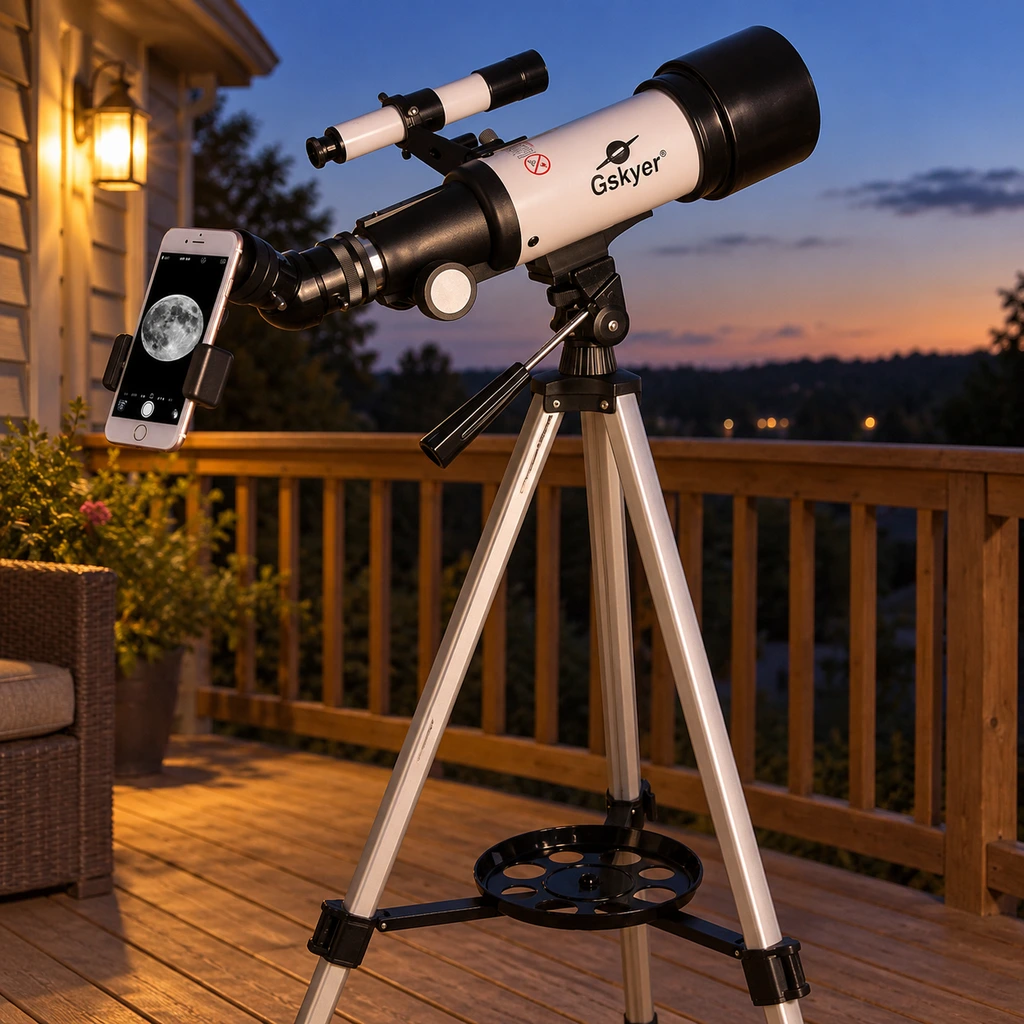
Celestron Travel Scope 70mm: Best Portable
The Travel Scope’s whole argument is that it comes with you. A 70mm fully coated refractor, a full height tripod and every accessory pack into an included padded backpack, and the whole thing sets up in seconds with no tools.
That matters more than it sounds, because dark skies are somewhere else. A scope that lives in a cupboard at home shows you nothing, and a scope you throw in the car for a weekend away shows you a genuinely dark sky. Nearly fifteen thousand reviews suggest a lot of people use it exactly that way.
Twenty and ten millimetre eyepieces cover wide and closer views, and because it is a refractor with an erect image capable setup it doubles for daytime use on landscapes and wildlife. At 4.2 stars it is the lowest rated pick here, and the tripod is the weak point, as it is on every scope at this price.
Specs That Matter
- Optics: 70mm fully coated glass refractor, good for sky and land
- Portability: padded backpack included, full height tripod, no tool setup
- Eyepieces: 20mm and 10mm, plus finderscope and star diagonal
- Extras: free Starry Night software download
- Rating: 4.2 stars across 14,797 reviews
Who It Is For
Campers, travellers and anyone whose best skies are a drive away rather than out the back door.
How to Choose Between Them
You Want to See the Most
The AstroMaster 130EQ. Aperture beats everything for faint objects, and the equatorial mount is what makes high magnification bearable. Accept that the mount takes a session to learn, the way any technique-dependent kit does.
You Are Worried About Giving Up
The StarSense Explorer 114AZ. Being unable to find anything is what kills first telescopes, and phone guidance removes that failure directly. The tabletop base also means the image holds still, which matters more on cold nights when you are wearing gloves and layers and fumbling the controls.
Buying for a Child
The Gskyer 70mm. It is cheap enough not to matter if the interest fades, the accessory bundle keeps a child busy, and Moon views through it are genuinely impressive. Pair it with our stargazing guide and start on the Moon.
Your Dark Sky Is a Drive Away
The Travel Scope 70mm. The backpack is the feature, and a portable scope used at a dark site beats a bigger one used in a streetlit garden. It packs down small enough for a night at a dispersed campsite.
You Have No Table and No Patience
The StarSense Explorer LT 80AZ. App guidance on a free standing tripod, a refractor that never needs collimating, and nothing to assemble beyond the tripod. Good for a garden session with a reclining chair and a flask.
Aperture, Mounts and Magnification: What the Specs Mean
Aperture Is the Only Number That Really Counts
Aperture is the diameter of the light collecting lens or mirror, and it sets both brightness and the finest detail the scope can resolve. Doubling aperture quadruples the light gathered. Every other specification is a refinement of what aperture allows.
Refractor Versus Reflector
Refractors use lenses, need no alignment, hold their setup permanently and give crisp high contrast views of the Moon and planets. Reflectors use mirrors, give far more aperture per pound spent, and occasionally need collimating. For faint deep sky objects, a reflector at the same price wins clearly. Neither is better in the abstract, the same way canvas and nylon each win at different things.
Altazimuth, Equatorial or Dobsonian
Altazimuth moves up, down and across, which is intuitive and fine at low magnification. Equatorial aligns with the Earth’s axis so one knob follows the sky, which is what you want above about 100x. A Dobsonian base is an altazimuth mount that sits on the ground or a table and is far more stable than a tripod at the same price.
Ignore the Magnification on the Box
Useful maximum magnification is roughly 50x per inch of aperture, and the atmosphere often caps it lower. A 70mm scope tops out near 140x on a good night, so a box claiming 675x is describing an image you will never use. Judge a scope by aperture and mount and treat the magnification number as noise, exactly as with lumen claims on headlamps.
Using It Well and Making It Last
Start on the Moon at low magnification, every time. It is bright, unmistakable, full of detail and it teaches you how the controls behave before you attempt anything faint. The single commonest beginner mistake is starting with the highest magnification eyepiece on a dim target and concluding the telescope is broken.
Let the scope cool to outdoor temperature before expecting sharp views, which takes twenty to thirty minutes for a reflector carried out of a warm house. Warm air currents inside the tube blur everything until it equalises, and people routinely blame the optics for what is really thermal. Dress for standing still in the cold, which is a different problem from walking, as any autumn evening outdoors will teach you.
Use a red light and give your eyes half an hour to dark adapt, exactly as you would for watching a meteor shower. A single glance at a white phone screen undoes most of it.
Never clean the optics unless you genuinely must, and never with a shirt. Dust does far less harm to the image than the scratches from wiping it off. Cap it, store it dry, and keep a reflector’s mirror facing down when it is put away, the same principle as storing gear properly.
Frequently Asked Questions
What is the best telescope for a complete beginner?
The StarSense Explorer 114AZ if you can afford it, because it removes the finding problem that ends most first attempts. The Gskyer 70mm if the budget is tight or it is a gift for a child.
What can I actually see with a beginner telescope?
The Moon in genuine detail, Jupiter’s cloud bands and four moons, Saturn’s rings, Venus as a phase, and the brighter nebulae and star clusters. Galaxies are faint smudges even in a 130mm, and nothing you buy at this level shows colourful photographs.
Refractor or reflector for a first telescope?
A refractor is lower maintenance and better for the Moon and planets. A reflector gives more aperture for the money and is much better for faint objects. If you mostly want planets, refract; if you want to hunt deep sky, reflect.
Do I need a motorised or computerised mount?
No. Manual mounts teach you the sky and cost far less. Phone guided systems like StarSense are the useful middle ground: they help you find things without the cost and battery dependence of full motorisation.
How much should I spend on a first telescope?
Enough to get a stable mount, which in practice means avoiding the very cheapest tripods. Beyond that, put every additional pound into aperture rather than accessories, because eyepieces can be added later and aperture cannot.
If your interest is already real, the AstroMaster 130EQ shows you the most for the money. If you are worried about the first night being frustrating, the StarSense Explorer 114AZ removes exactly that risk. And if it is a gift or an experiment, the Gskyer 70mm is the low stakes way in. Start on the Moon, and read our stargazing guide before the first clear night. The Orionid meteor shower in late October needs no telescope at all.
Discover more from Maive Verse
Subscribe to get the latest posts sent to your email.