This post may contain affiliate links. If you buy through them, we may earn a small commission at no extra cost to you.
The best trekking poles do two unglamorous jobs very well. They take load off your knees on the way down, and they give you two extra points of contact when the ground stops being flat. Everything else on the spec sheet, the shaft material, the lock design, the grip, is really just a set of trade offs around weight, packed size and how much abuse the pair will absorb before something gives.
Below are six of the best trekking poles genuinely stocked on Amazon right now, each chosen for a different kind of hiker rather than ranked one to six. Ratings and specifications were checked at the time of writing. If you are still putting a kit together, our complete guide for beginner hikers covers what belongs in the pack before you start adding poles.
Table of Contents
What Separates the Best Trekking Poles
Four things actually distinguish one pair from another once you get past the marketing. Price tracks only some of them, which is why a mid priced aluminium pair often outlasts a carbon pair costing three times as much. The same logic applies to choosing hiking boots, where fit beats the badge every time.
- Shaft material. Aluminium bends under a bad load and can often be straightened enough to finish a hike. Carbon is lighter and stiffer but fails suddenly, usually by splintering, and usually at a scratch or a clamped section.
- The locking system. External lever locks are quicker to adjust in gloves and easier to tension when they slip. Twist locks are cleaner and snag less, but they seize when grit gets inside. This is the part that fails first on cheap poles.
- Grip material. Cork moulds to your hand over a season and handles sweat better than anything else. EVA foam is warmer in the cold and cheaper. Hard rubber is the most durable and the least comfortable over long days.
- Packed length. Telescoping poles collapse to around 24 inches. Folding, or tri fold, poles break down to about 15 and disappear into a day pack or a carry on bag.
The case for carrying poles at all is strongest on descents. A study in Medicine and Science in Sports and Exercise measured hikers walking downhill under load and found meaningfully lower forces at the knee when poles were used. That effect compounds over a long day, which is why they turn up so often on autumn day hikes where the miles are longer and the light is shorter.
The Best Trekking Poles at a Glance
Rule four of them out here, then read the two that are left. The best trekking poles on this table differ mostly in weight and packed length. Weight matters most if you already count grams on a lightweight day pack setup, and packed length matters most if the poles have to travel.
| Poles | Shaft | Lock | Grip | Best for |
|---|---|---|---|---|
| Cascade Mountain Tech Aluminum | 6061 aluminium | Quick lever lock | Cork with EVA down grip | Best overall |
| Foxelli Carbon Fiber | Carbon fibre | Quick flip lock | Cork with foam extension | Best lightweight |
| Black Diamond Alpine Carbon Cork | 100 percent carbon | FlickLock | Cork with foam extension | Best premium |
| Trekology Trek-Z | Aircraft aluminium | Metal flip lock | Cork | Best packable |
| KINGGEAR 7075 Aluminum | 7075 aluminium | Quick flip lock | Cork with EVA base | Best budget |
| TheFitLife Anti-Shock | Aluminium alloy | Twist lock | Ergonomic rubber | Sore knees and Nordic walking |
The Six Best Trekking Poles in Detail
Cascade Mountain Tech Aluminum: Best Overall
This is the pair most hikers should buy, and the reason is the down grip. Below the cork handle sits an extended EVA section that runs several inches down the shaft, so on a steep climb you can drop your hand rather than shortening the pole. That one detail removes most of the fiddling that puts people off poles in the first place.
The shaft is aircraft grade 6061 aluminium at about ten ounces per pole, which is heavier than carbon but far more forgiving. Aluminium of this grade dents and bends rather than snapping, and a bent pole still walks you back to the trailhead. The quick lever lock adjusts across a 26 to 54 inch range without breaking stride.
The accessory kit is unusually complete for the money: tungsten carbide tips for year round grip, rubber tip covers for pavement and rock, plus snow and mud baskets and a travel bag. At 4.6 stars across more than fourteen thousand ratings, this is the most consistently recommended aluminium pair on Amazon.
Specs That Matter
- Aircraft grade 6061 aluminium shafts, about 10 ounces each
- Adjusts from 26 to 54 inches on a quick lever lock
- Cork grip with an extended EVA down grip for climbs
- Tungsten carbide tips plus snow, mud and rubber accessories
- Collapses for pack carry and includes a travel bag
Who It Is For
Hikers who want one dependable pair for day hikes and backpacking, and anyone who climbs enough to want a down grip.
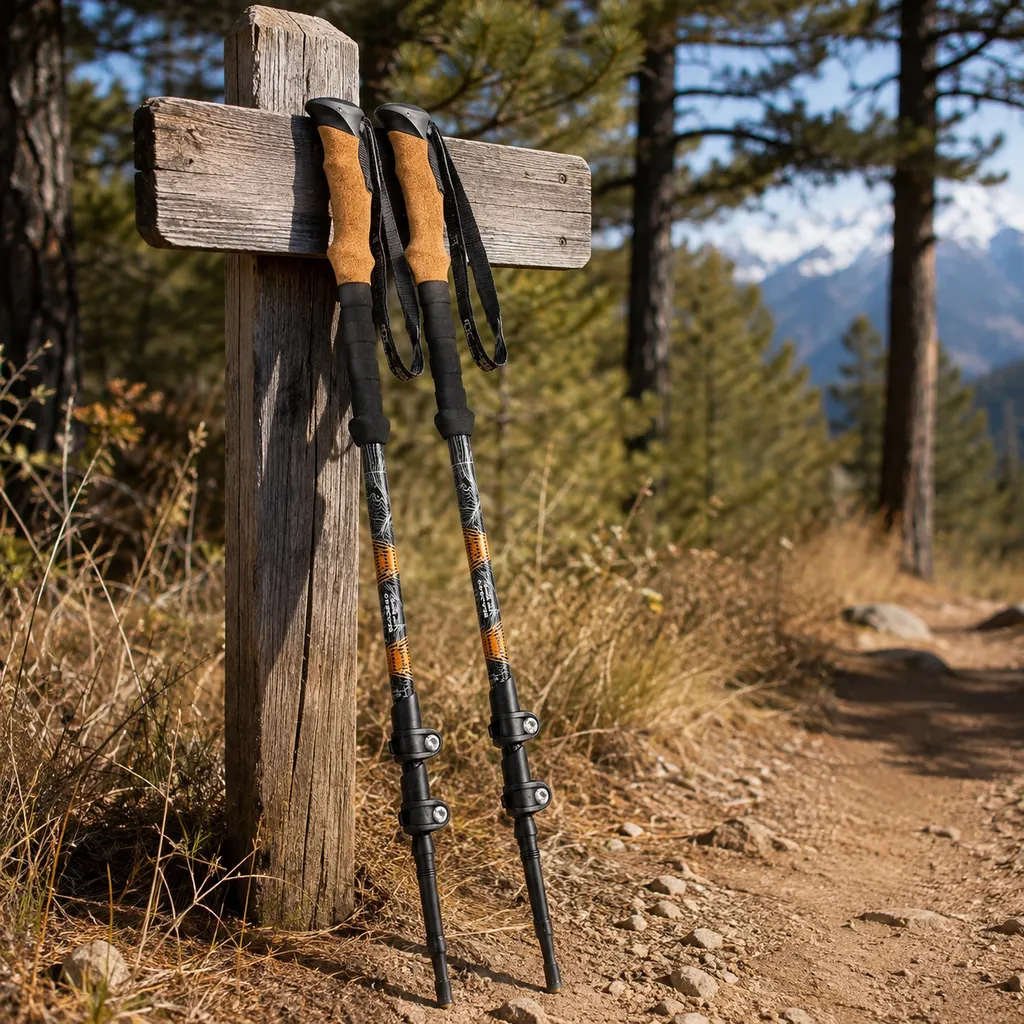
Foxelli Carbon Fiber: Best Lightweight
Carbon fibre is the obvious upgrade when your arms are doing thousands of small lifts an hour, and this pair is the most reviewed carbon option that does not carry a specialist price. The saving over aluminium is a few ounces per pole, which sounds trivial until you multiply it by a full day of swing.
What makes it worth trusting is where the material has been reinforced. Carbon fails at stress concentrations, typically where a lock clamps the shaft or where a scratch has started, so Foxelli has thickened those zones rather than simply building the lightest tube possible. The quick flip locks hold tension well and stay adjustable in gloves.
Comfort is handled by natural cork handles, EVA foam extensions below them and padded straps, and the poles adjust from 24 to 54 inches, which is a wide enough range to share across a household. Tungsten carbide tips and interchangeable baskets come in the box. It sits at 4.7 stars over eight thousand ratings.
Specs That Matter
- Carbon fibre shafts, noticeably lighter than aluminium
- Reinforced high stress zones to resist cracking
- Quick flip locks that stay usable with gloves on
- Natural cork grips with EVA foam extensions and padded straps
- Adjusts from 24 to 54 inches, tungsten tips and baskets included
Who It Is For
Hikers covering long distances who want the weight saving of carbon without paying alpine prices.
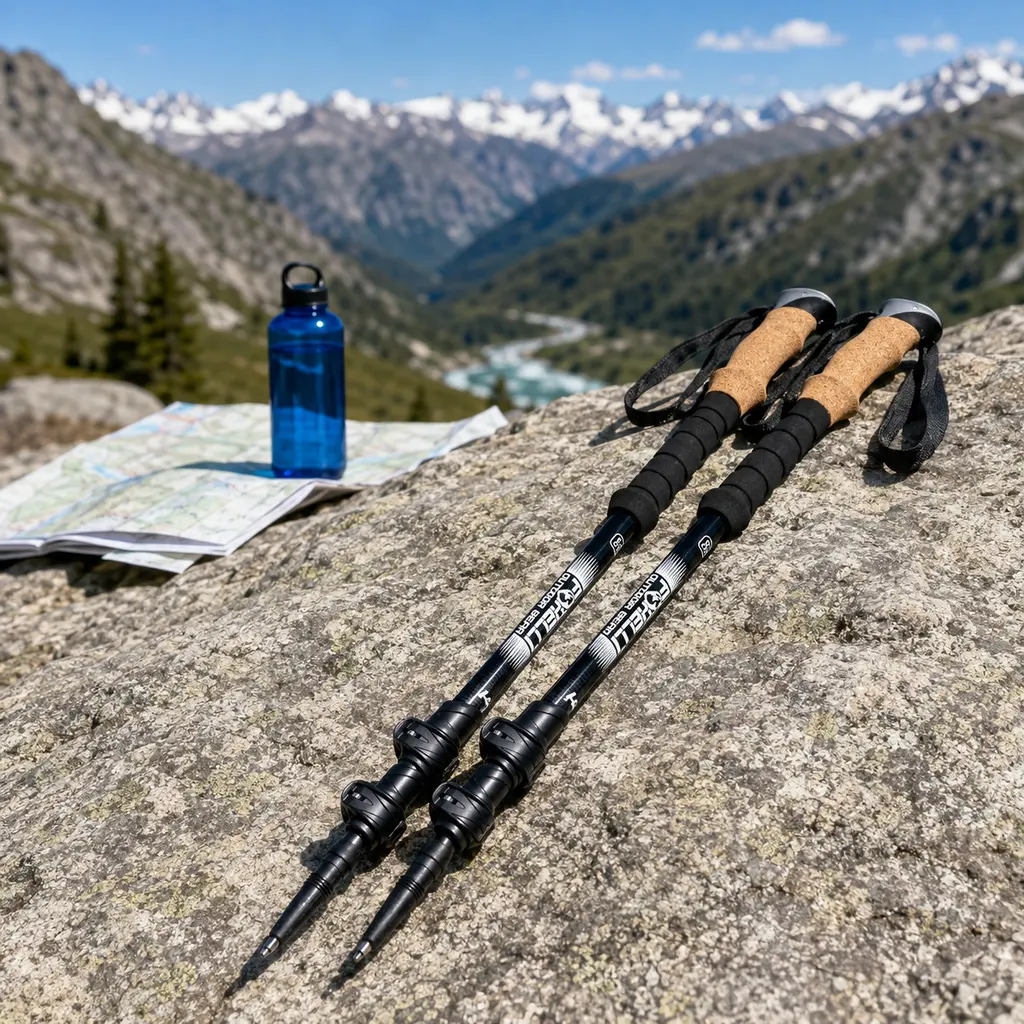
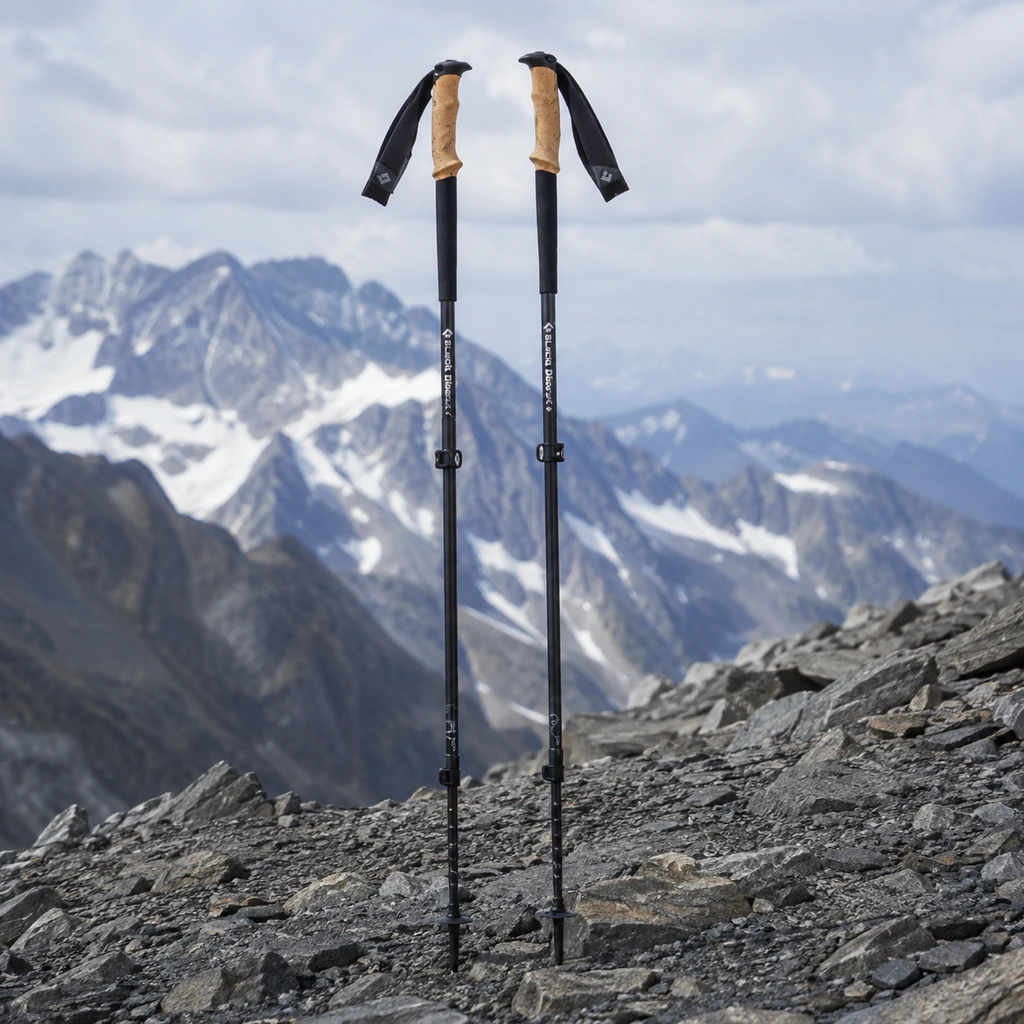
Black Diamond Alpine Carbon Cork: Best Premium
If poles are core equipment rather than an occasional aid, this is the pair worth saving for. It is 100 percent carbon, built stiff enough to lean on properly, and it is the model you see on mountaineering and long trail gear lists more than any other.
The FlickLock mechanism is the reason. It is an external lever that clamps the shaft directly, and it can be re tensioned in the field with a single screw when it eventually starts to creep. That is a real advantage over sealed internal mechanisms, which you cannot service at all once they start slipping.
The grip system is a cork handle with Bloom foam extensions running down the shaft, so there is a second and third hand position for steep ground. Interchangeable carbide Tech Tips and trekking baskets cover dirt, rock and snow, which makes this a genuine four season pair rather than a summer one.
Specs That Matter
- 100 percent carbon fibre construction, stiff and light
- FlickLock levers that can be re tensioned with a screwdriver
- Natural cork grips with Bloom foam grip extensions
- Interchangeable carbide Tech Tips and trekking baskets
- Adjustable, sold as a pair, built for four season use
Who It Is For
Serious hikers, backpackers and anyone heading into alpine terrain who wants field serviceable hardware.
Trekology Trek-Z: Best Packable
Folding poles solve a problem telescoping poles cannot. This pair breaks into three sections on an internal cord and collapses to roughly 15 inches, which is short enough to sit inside a day pack rather than strapped to the outside where it catches on branches.
That matters more than it sounds on mixed days. Poles are a hindrance on scrambles, on ladders and anywhere you need hands, so being able to stow them in seconds rather than fighting a 24 inch bundle changes how often you actually use them. Assembly is a snap together action, then a flip lock sets height between 110 and 130 centimetres.
The shafts are aircraft grade aluminium at about 11.5 ounces per pole, and the handles are natural cork. Trekology notes that the cork grips have a slight rotational flex, which is deliberate and takes some torque out of an awkward plant rather than passing it into your wrist.
Specs That Matter
- Tri fold design collapses to about 15 inches
- Aircraft grade aluminium shafts, roughly 11.5 ounces each
- Metal flip lock, adjustable from 110 to 130 centimetres
- Natural cork grips with a deliberate anti torque flex
- Fits inside a day pack or a carry on bag
Who It Is For
Hikers who scramble, travel by air, or simply want poles that vanish into the pack when the ground gets technical.

KINGGEAR 7075 Aluminum: Best Budget
The interesting thing here is the alloy. Most budget poles use 6061 aluminium, and this pair uses 7075, which is the higher strength grade normally reserved for pricier hardware. It is lighter than 6061 at the same stiffness and it tolerates being leaned on harder.
The rest of the build follows the pattern that works: a natural cork handle that wicks sweat and moulds to your hand, an EVA foam section beneath it for lower hand placement, and a quick flip lock covering 25.5 to 54 inches. That range is wide enough to hand the same pair to a tall adult and a teenager.
The accessory set includes compressed tungsten carbide tips and swappable baskets for mud and snow, and the poles carry a lifetime guarantee, which is a meaningful commitment at this price. They hold 4.7 stars across more than three thousand ratings.
Specs That Matter
- 7075 aluminium shafts, stronger than the usual 6061
- Quick flip lock adjusting from 25.5 to 54 inches
- Natural cork grip with an EVA foam lower section
- Compressed tungsten carbide tips and swappable baskets
- Backed by a lifetime guarantee
Who It Is For
First time pole users and anyone who wants cork grips and a strong alloy without spending much.

TheFitLife Anti-Shock Nordic Walking Poles: Best for Sore Knees
This is the most bought pair on the list by a wide margin, with more than eighteen thousand ratings, and the reason is the internal anti shock spring. Each plant is damped rather than transmitted straight up the shaft into your elbow and shoulder, which is exactly what people with sore joints are looking for.
It is also the most travel friendly. The poles extend to 51.2 inches, collapse to 25.6, and separate into three sections that measure 21.46 inches, short enough to lie diagonally in most suitcases. The TSA rules for hiking poles put them in checked baggage, so packed length is the deciding factor.
Height is set by a glove friendly twist lock rather than an external lever, which keeps the shaft clean and snag free. The grip is a non slip ergonomic rubber rather than cork, and each pole weighs 9.92 ounces. A full accessory kit of rubber tips, walking caps, mud baskets and snow baskets is included.
Specs That Matter
- Internal anti shock spring damps each pole plant
- Extends to 51.2 inches, collapses to 25.6, separates to 21.46
- Glove friendly twist lock with no external levers
- Non slip ergonomic rubber grip, 9.92 ounces per pole
- Rubber tips, walking caps, mud and snow baskets included
Who It Is For
Walkers with sensitive knees or elbows, Nordic walkers, and anyone who flies to their trailheads.

How to Choose Between Them
The best trekking poles for you are the ones matched to the ground you actually walk on rather than the trip you are planning for next year. Trail choice narrows it faster than any spec sheet, and our guide to finding snow free trails is a good place to start.
Day Hikes, Most Weekends
Buy aluminium with cork grips and stop thinking about it. The weight penalty over carbon is a few ounces you will not notice on a five mile loop, and the durability advantage is real. Pair it with the rest of a sensible hiking outfit and you are set for three seasons.
Long Distances and Big Ascent
This is where carbon earns its price. You lift a pole roughly once per stride, so a few ounces multiplied across twenty thousand strides is a genuine saving. Combine it with the load discipline in our multi day gear list thinking and the whole kit gets lighter together.
Flying to the Trailhead
Packed length decides it. A folding pair at about 15 inches fits inside checked luggage and inside a day pack once you arrive. Telescoping poles at 24 inches or more will usually need to be strapped to the outside of the bag.
Knees That Complain on Descents
Anti shock is worth having, and so is a longer setting for downhill use. Lengthen the poles by five to ten centimetres before a sustained descent so your arms are not reaching down for the ground on every step. The cumulative load is worth understanding if you hike big days, and our piece on what long distance hiking does to the body covers it.
Spending as Little as Possible
Do not buy poles without cork or foam grips, and do not buy poles with plastic locks. Beyond that, a well made budget aluminium pair does the same job as an expensive one, just heavier. Save the difference for boots that fit properly, which change far more about a day on the trail.
Locks, Shafts and Grips: What the Specs Mean
Lever Locks Beat Twist Locks on the Trail
An external lever clamps the shaft from outside and can be tightened with a small screw when it starts to creep. A twist lock relies on an internal expander, which works cleanly until grit or ice gets in, and cannot be serviced in the field. Lever locks are also far easier to work in gloves.
Carbon Is Lighter, Aluminium Is More Forgiving
Carbon is stiffer per gram and transmits less vibration, but it fails suddenly and often without warning. Aluminium bends first, which gives you a damaged pole rather than two broken halves. If your trips are remote, that failure mode matters more than the weight on paper. Either way the poles only help if the engine does, which is what our elevation training guide is about.
Cork Wins Over a Season
Cork wicks sweat, does not go slippery when your hands are wet, and slowly takes the shape of your grip. EVA foam is warmer in freezing weather and softer at first. Rubber lasts longest and blisters soonest. Almost every pair worth owning uses cork or foam with a foam extension below it.
Sizing, Care and When to Replace
Set pole length so that with the tip on the ground beside your foot, your elbow sits at roughly ninety degrees. Most adults land between 110 and 130 centimetres. Shorten by five to ten centimetres for sustained climbs and lengthen by the same for sustained descents. Our companion guide to using trekking poles properly covers the strap technique that makes the difference between poles helping and poles being carried.
After a wet or sandy hike, pull the sections apart, wipe them down and let them dry fully before collapsing them. Grit inside a twist lock is the single most common cause of a pole that will not hold height. Replace carbide tips when they go rounded and stop biting, and swap baskets to suit the season rather than leaving summer baskets on through the snow. Between trips they store best hanging or loosely collapsed rather than clamped tight, the same principle behind the rest of our gear storage advice. Poles are also the easiest way to stay on durable surfaces without widening a trail, which is the whole point of the Leave No Trace principles.
Retire aluminium poles when a shaft is bent badly enough that the sections no longer slide, and retire carbon poles at the first sign of a crack, a splinter or a soft spot. Carbon does not give a second warning.
Frequently Asked Questions
Do trekking poles really help?
Yes, most measurably on descents and when carrying weight. They add two points of contact for balance on uneven ground and river crossings, and they move some of the braking effort from your knees into your arms and shoulders. On flat, smooth ground the benefit is small.
Do I need one pole or two?
Two. A single pole helps with balance but leaves you asymmetric, which is uncomfortable over a long day and does far less for your knees. Almost every pair sold for hiking is sold as two for this reason.
What length trekking poles should I buy?
Buy a pair whose adjustment range covers your elbow at ninety degrees, which for most adults means a range that includes 110 to 130 centimetres. A wider range matters if the poles will be shared or used in very steep terrain.
Are carbon poles worth the extra money?
If you hike long days or count grams, yes. If you hike occasionally, or you go somewhere remote where a broken pole is a real problem, aluminium is the smarter buy. The performance gap is smaller than the price gap.
Can I take trekking poles on a plane?
In checked baggage, yes. They are not permitted in carry on luggage in the United States, so packed length is what decides whether they fit your case. Folding poles at around 15 inches are the easiest to travel with.
Any of these six will do the job, and the best trekking poles are simply the pair you carry often enough to get good with. If you want the least thinking, take the aluminium pair with the down grip. If you count every ounce, take the carbon. Then read our guide to using trekking poles before the first hike, because technique is worth more than the badge on the shaft.
Discover more from Maive Verse
Subscribe to get the latest posts sent to your email.


