
Master hiking with kids with our expert guide. Discover 5 engaging trail games to manage pacing, prevent cognitive fatigue, and build outdoor skills.
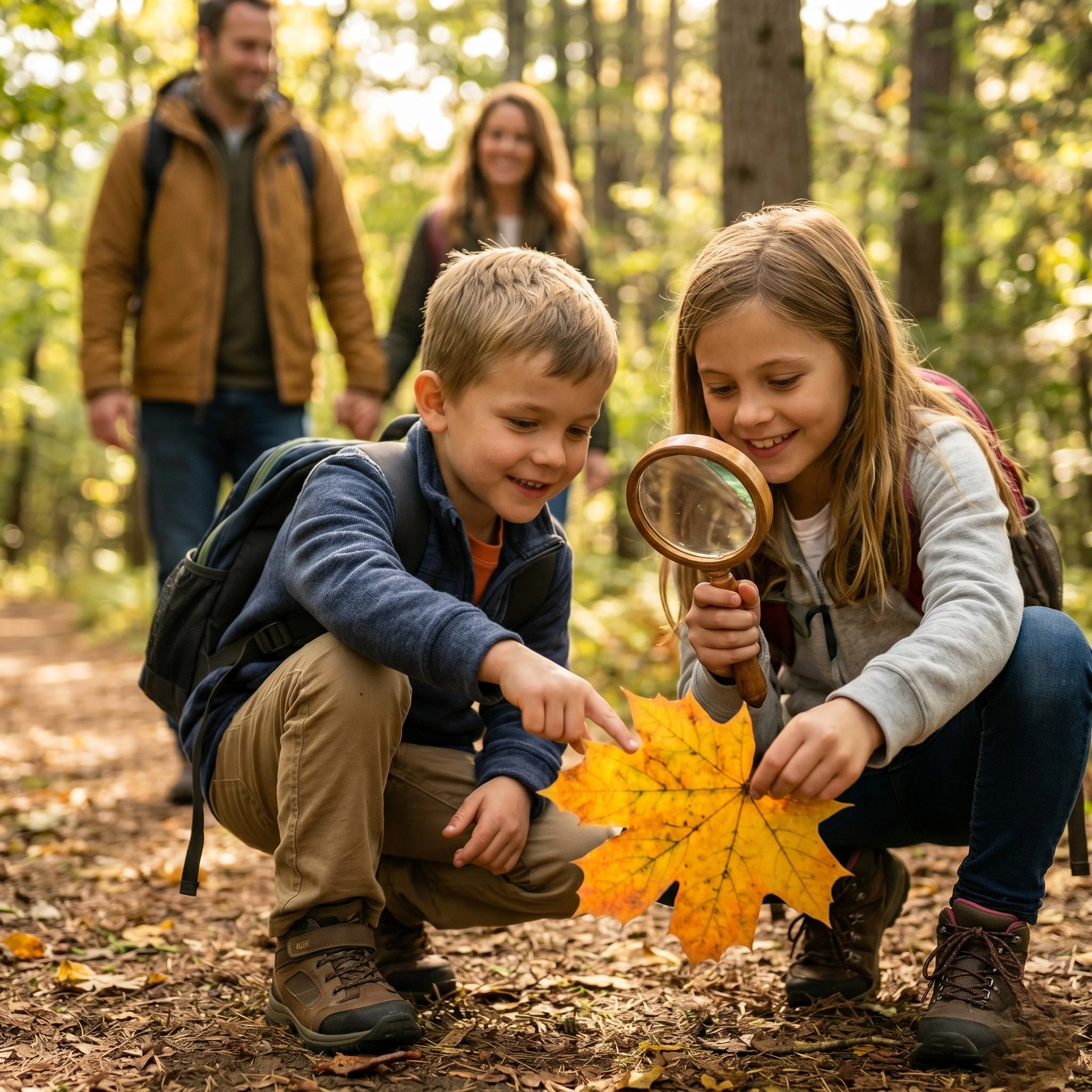
Table of Contents
Introduction: The Psychology of Play in the Wilderness
Implementing a structured approach to hiking with kids is a technical necessity for preventing cognitive fatigue and maintaining physical momentum on the trail. While adults are often motivated by long-range goals, such as reaching a summit or completing a specific distance, a child’s experience of the outdoors is dictated entirely by immediate sensory inputs. When these inputs become repetitive or monotonous, children experience rapid neurological exhaustion—frequently misdiagnosed as physical muscular failure. To sustain an efficient pace, parents and educators must gamify the journey, transforming the trail into a dynamic interactive environment.
This approach is highly compatible with the restorative principles analyzed in our Soft Hiking Guide. By shifting the focus from high-speed progress to detailed local exploration, hikers can dramatically lower the baseline stress levels of younger participants. The relative metabolic energy expenditure ($EE$) of a child on a trail can be modeled as a function of body mass ($m$), slope gradient ($\theta$), and movement velocity ($v$):$$EE = f(m, \theta, v) \times \psi_{\text{motivation}}$$
Where $\psi_{\text{motivation}}$ represents a psychological coefficient. When engagement is high, the perceived exertion decreases, optimizing the energetic efficiency of the entire group. This guide outlines five technically designed games that leverage children’s natural curiosity to build spatial awareness, observation skills, and wilderness safety.
5 Engagement Games for Hiking with Kids
The following protocols are designed to be executed on any established wilderness trail. They require minimal equipment, ensuring that pack weight is not compromised.
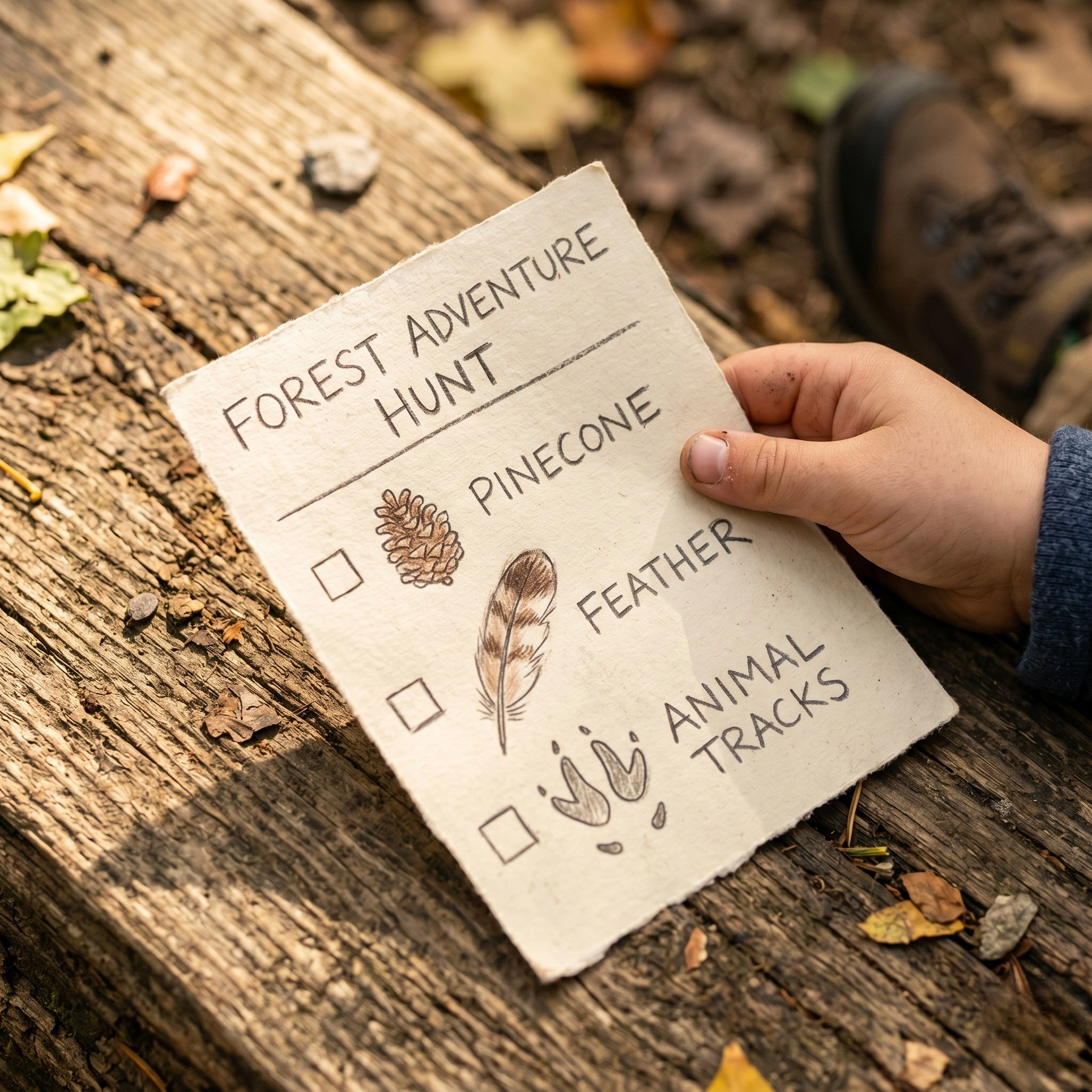
1. The Trail Scavenger Hunt (Visual Scanning)
The Scavenger Hunt is a highly effective tool for developing visual scanning and spatial awareness. Instead of looking ahead at a distant trail corridor, children are prompted to search the immediate environment for specific physical textures and biological specimens. This focused search engages the brain’s visual cortex, preventing the onset of boredom.
Before departing, the guide should establish a list of targets appropriate for the local ecosystem. To ensure success, targets should vary in difficulty. The probability ($P$) of locating a specific target can be expressed as:$$P(\text{find}) = \frac{A_{\text{target}}}{A_{\text{search}}} \times \sigma_{\text{visibility}}$$
Where:
- $A_{\text{target}}$ is the surface area of the item.
- $A_{\text{search}}$ is the active search radius.
- $\sigma_{\text{visibility}}$ is a factor based on forest density.
For beginners, include highly visible items like “a textured pinecone” or “a smooth river stone.” For more advanced participants, include specialized targets like “three different varieties of lichen” or “bird tracks in damp mud.” This progressive difficulty keeps children engaged across varying terrains.
2. The Soundscape Count (Auditory Isolation)
Nocturnal and crepuscular forest life is often heard rather than seen. The Soundscape Count is a quiet, meditative game designed to develop auditory isolation and lower heart rate variability. It is particularly useful for managing group dynamics during steep climbs where physical pacing must be controlled.
The protocol requires the group to stop and stand in total silence for exactly 60 seconds. Each participant closes their eyes and holds up a fist. Every time a unique natural sound is identified—such as the wind rustling through pine needles, a bird call, or the crackle of a dry twig—the participant extends one finger. At the end of the minute, the group whispers their count and compares observations. This exercise trains the mind to filter out internal monologue and synchronize with the ambient soundscape of the forest.
3. The Micro-Terrain Explorer (Microscope Vision)
When large mountain vistas fail to engage a child’s attention, the guide must shift the scale of exploration downward. The Micro-Terrain Explorer gamifies the inspection of microscopic ecosystems, focusing on geology, moss structures, and insect life.
This game utilizes a small, lightweight magnifying glass. The guide designates a specific 3-foot by 3-foot area along a durable trail surface. The children are given 5 minutes to map and document everything occurring within that micro-grid. They must observe the interaction between soil moisture, decay, and fungal growth. This direct interaction teaches the foundational concepts of biology and earth science, turning a simple rest break into an active clinical lesson in ecology.
4. “Twenty Questions” Trail Edition (Cognitive Pacing)
On flat, monotonous fire roads or long, straight trail sections, physical boredom can manifest rapidly. “Twenty Questions” Trail Edition provides intellectual stimulation that passes the miles without requiring the child to stop or slow down.
The rules are adapted to focus exclusively on items found in the local environment. One participant selects a biological, meteorological, or geological subject (e.g., a Douglas fir tree, a cumulonimbus cloud, or a granite boulder). The other participants ask up to twenty “yes or no” questions to narrow down the identity of the subject. This game requires the child to utilize deductive reasoning and apply their knowledge of wilderness science, making it a highly educational trail utility.
5. Camouflage Hide-and-Seek (Boundary Awareness)
This game is a structured, safety-focused variation of hide-and-seek designed to teach children about trail boundaries and natural cover. It is an excellent way to practice situational awareness and distance management in the backcountry.
The “seeker” stands in the center of the trail and closes their eyes, counting to 20 out loud. The other participants must hide using only natural features like boulders or trees. However, they must adhere to two strict safety rules: they must remain within 10 feet of the trail edge and they must always keep the seeker in their line of sight. When the seeker opens their eyes, they must scan the terrain without leaving their spot. This game teaches children how to assess cover, understand perspective, and respect trail boundaries.
Environmental Stewardship and Safety Protocols
Even during play, maintaining safety and ethical standards is a technical requirement. The guide must ensure that games do not result in trail damage or the harassment of wildlife.
All participants must strictly follow Leave No Trace Center for Outdoor Ethics guidelines. This means that items identified during the Scavenger Hunt or Micro-Explorer games must never be collected, pockets must remain free of natural debris, and living plants must not be damaged. Playing near steep drops, water hazards, or unstable scree fields is prohibited. By integrating environmental ethics directly into the rules of the games, children learn that preserving the wilderness is a mandatory part of outdoor recreation.
Conclusion: Developing Lifelong Outdoor Stewardship
Gamifying the trail is the most effective method for ensuring a successful, low-stress outdoor experience when hiking with kids. By understanding the psychological and biological mechanics of children’s fatigue, guides can utilize structured play to maintain physical momentum and prevent cognitive burnout. Whether through the visual scanning of a Scavenger Hunt (Section 1) or the meditative focus of the Soundscape Count (Section 2), these games transform the wilderness into an accessible, educational playground.
Remember that the ultimate goal of these activities is to foster a lifelong passion for nature. Every hike is an opportunity to build confidence, resilience, and a deep respect for the natural world. Keep your preparation high, your pack weight low, and your mind open to the unique perspective of a child on the trail. By investing in their engagement today, you ensure the preservation of these wild spaces for tomorrow.
Discover more from Maive Verse
Subscribe to get the latest posts sent to your email.