This post may contain affiliate links. If you buy through them, we may earn a small commission at no extra cost to you.
The best binoculars for stargazing are almost never the most powerful ones. Magnification amplifies your heartbeat along with the starlight, so a 25x pair held in the hands shows you a shaking blur while a steady 7x pair shows you Jupiter and four of its moons. Aperture and stability decide what you actually see; the magnification number decides how much of it you can hold still.
That trade off is the whole decision. A 50mm handheld pair is the right first purchase for nearly everyone. A 70mm or 80mm pair gathers far more light and will show you genuinely faint objects, but it needs a tripod, and a tripod turns a spontaneous ten minutes in the garden into a small expedition.
Below are six pairs genuinely stocked on Amazon right now, chosen for different jobs rather than ranked one to six. Ratings and specifications were checked at the time of writing. If you are new to the night sky, our guide to stargazing for beginners covers the technique that matters more than the glass does.
Table of Contents
What Makes the Best Binoculars for Stargazing
Four numbers, and they interact more than the marketing suggests.
- Aperture. The second number, in millimetres, is the diameter of the front lenses. It decides how much light reaches your eye, and light is the entire game at night. 50mm is the practical handheld maximum for most people; 70mm and 80mm see much more but need support.
- Magnification. The first number. Above roughly 10x, hand shake becomes the limiting factor rather than the optics. High magnification also narrows the field of view, which makes finding anything harder.
- Exit pupil. Aperture divided by magnification. A 7×50 gives 7.1mm, about as wide as a young dark-adapted pupil, which is why 7×50 is the classic night glass. A 12×25 gives 2.1mm and is noticeably dimmer after dark.
- Prism type and coatings. BaK-4 prisms and fully multi-coated optics pass more light and keep the edges of the field sharp. On a cheap pair this is usually where the cost was cut.
Weight belongs on the list too, because it decides whether you keep using them. The same principle drives our advice on daypack fit: the item you actually carry beats the better one you leave at home. And no optic beats a clear sky, so check the forecast first; the satellite-app approach in our guide to predicting trail weather works just as well for cloud cover at night.
The Best Binoculars for Stargazing at a Glance
| Binocular | Aperture | Magnification | Tripod needed | Best for |
|---|---|---|---|---|
| Celestron SkyMaster 15×70 | 70mm | 15x | Recommended | Best overall |
| Celestron Cometron 7×50 | 50mm | 7x | No | Beginners and wide views |
| Nikon Aculon A211 10×50 | 50mm | 10x | No | Best handheld all-rounder |
| Celestron SkyMaster 25×70 | 70mm | 25x | Yes | High magnification |
| Celestron SkyMaster 20×80 | 80mm | 20x | Yes | Deep sky and faint objects |
| Occer 12×25 Compact | 25mm | 12x | No | Best budget and travel |
The Six Best Binoculars for Stargazing in Detail
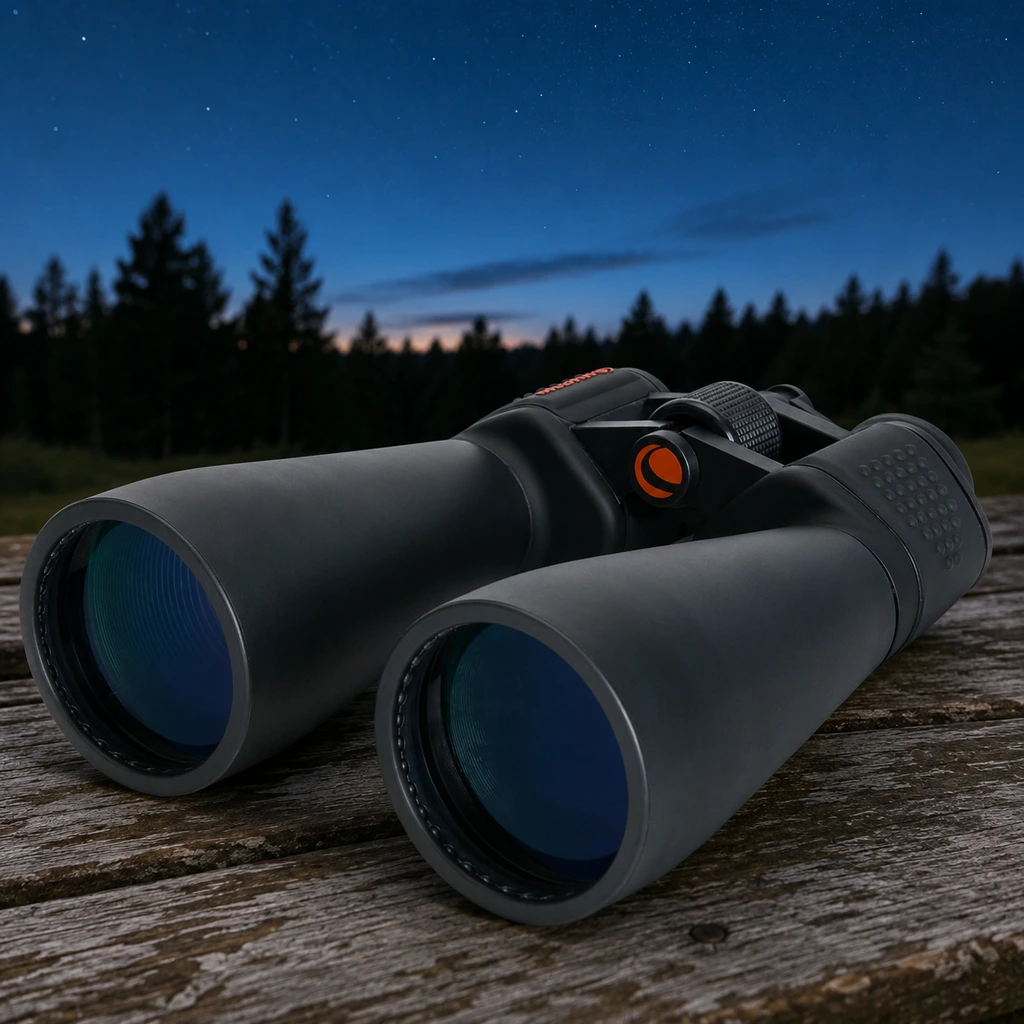
Celestron SkyMaster 15×70: Best Overall
If you buy one pair specifically for the night sky, this is the one that gives you the most for the money. Seventy millimetre objectives gather roughly twice the light of a 50mm pair, and at 15x the image is still wide enough to find things without a chart. That combination is why the SkyMaster 15×70 has been the default recommendation in astronomy circles for years.
BaK-4 prisms do the optical work, and Celestron pitch these squarely at people observing in dim conditions near dawn and dusk or at night. The housing is rubber-armoured and water-resistant, which matters more than it sounds: dew is the standard hazard of a still, clear night, and these shrug it off.
Be honest with yourself about the tripod. Celestron themselves note that most owners mount SkyMasters on a photo tripod because of the size and weight, and there is a quarter-twenty adapter built in for exactly that. Handheld they are usable in short bursts; on a tripod they are transformed. At 4.4 stars across more than eight thousand five hundred ratings, this is the most consistently recommended astronomy binocular on Amazon.
Specs That Matter
- 70mm objective lenses with 15x magnification
- BaK-4 prisms tuned for low light observing
- Built-in quarter-twenty adapter for a standard photo tripod
- Rubber-armoured, water-resistant housing
- 4.4 stars from over 8,500 ratings
Who It Is For
Anyone who wants serious light-gathering without moving to a telescope, and is willing to use a tripod for the best of it.
Celestron Cometron 7×50: Best for Beginners
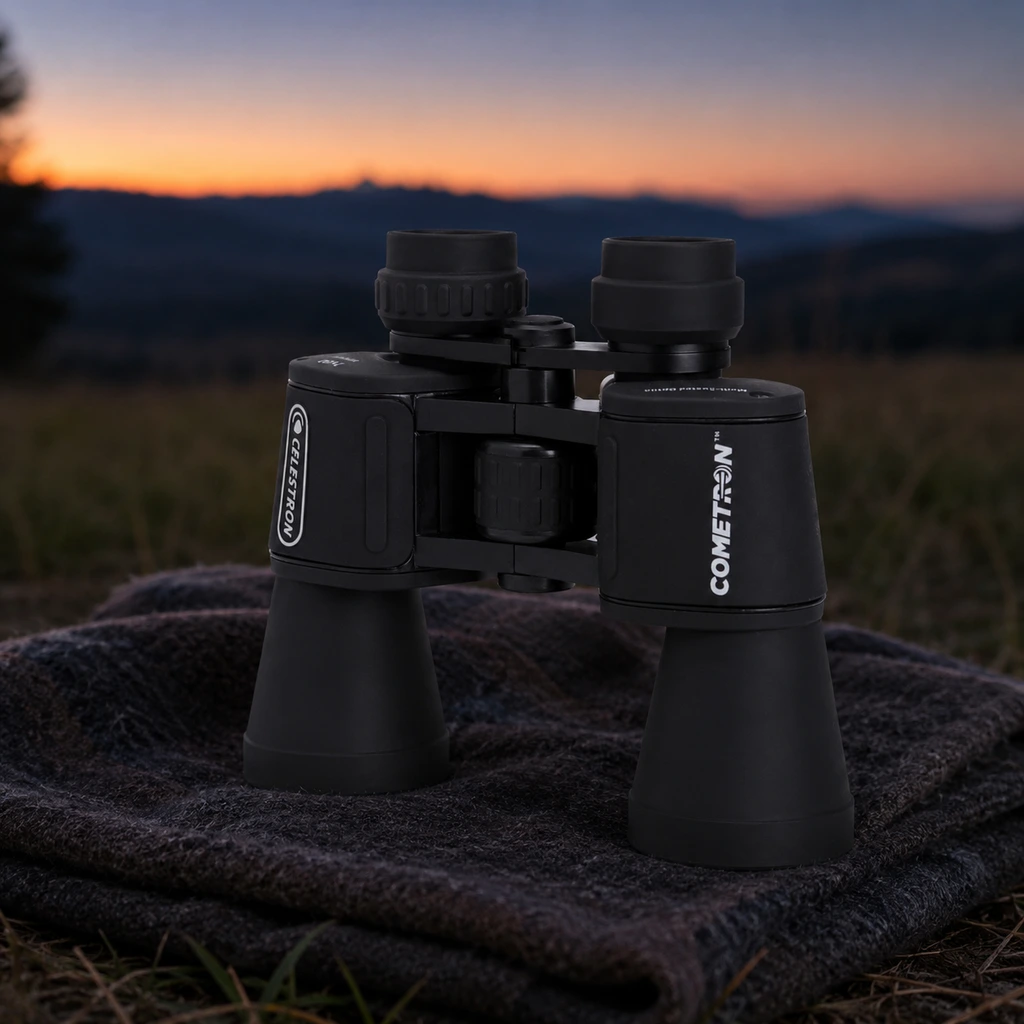
Seven power sounds low until you use it in the dark. The wide 6.6 degree field means you can sweep along the Milky Way and actually keep track of where you are, and at 7x you can hold them steady with no support at all. For a first pair this matters far more than reach.
Fifty millimetre objectives with multi-coated optics give an exit pupil of about seven millimetres, which is close to the widest a dark-adapted eye can use, so essentially all the light these collect reaches your retina. Celestron position them as an easy, affordable way to learn the night sky, and that is exactly what they are.
They are not night-only. Close focus is 26.2 feet, which makes them perfectly good for birds and scenery by day, and there is a tripod adapter socket if you later want shake-free views of the moon. At 4.5 stars from over four thousand ratings, they are the safest first purchase here.
Specs That Matter
- 50mm objectives with multi-coated optics
- 7x magnification with a wide 6.6 degree field of view
- Roughly 7mm exit pupil, matched to a dark-adapted eye
- Close focus of 26.2 feet, so they double for daytime use
- 4.5 stars from over 4,000 ratings
Who It Is For
A first pair, anyone observing without a tripod, and sweeping the Milky Way and large star clusters.
Nikon Aculon A211 10×50: Best Handheld All-Rounder
Ten by fifty is the classic compromise, and Nikon build the most comfortable version of it at this price. You keep the 50mm aperture that makes a binocular useful after dark, gain a little reach over a 7×50, and stay just inside the magnification where most people can hold an image steady.
The details are what separate it. Turn-and-slide rubber eyecups let spectacle wearers get their eyes to the right distance, which is the usual reason people find binoculars uncomfortable. Aspherical multicoated Eco-Glass lenses keep the image bright, the central focus knob is smooth enough to work in gloves, and the rubber armour grips even when everything is wet with dew.
It is a Porro prism design, which is why it looks old-fashioned and why it performs above its price: Porro prisms deliver more depth and better light transmission per pound than a roof prism of similar cost. At 4.6 stars this is the highest rated pair on the list, and it is tripod adaptable when you want it to be.
Specs That Matter
- 50mm objectives at 10x, the classic handheld compromise
- Porro prism design with aspherical multicoated Eco-Glass lenses
- Turn-and-slide rubber eyecups suited to spectacle wearers
- Rubber-armoured non-slip body, tripod adaptable
- 4.6 stars, the highest rated pair here
Who It Is For
One pair for astronomy and wildlife both, spectacle wearers, and anyone who wants to observe without carrying a tripod.
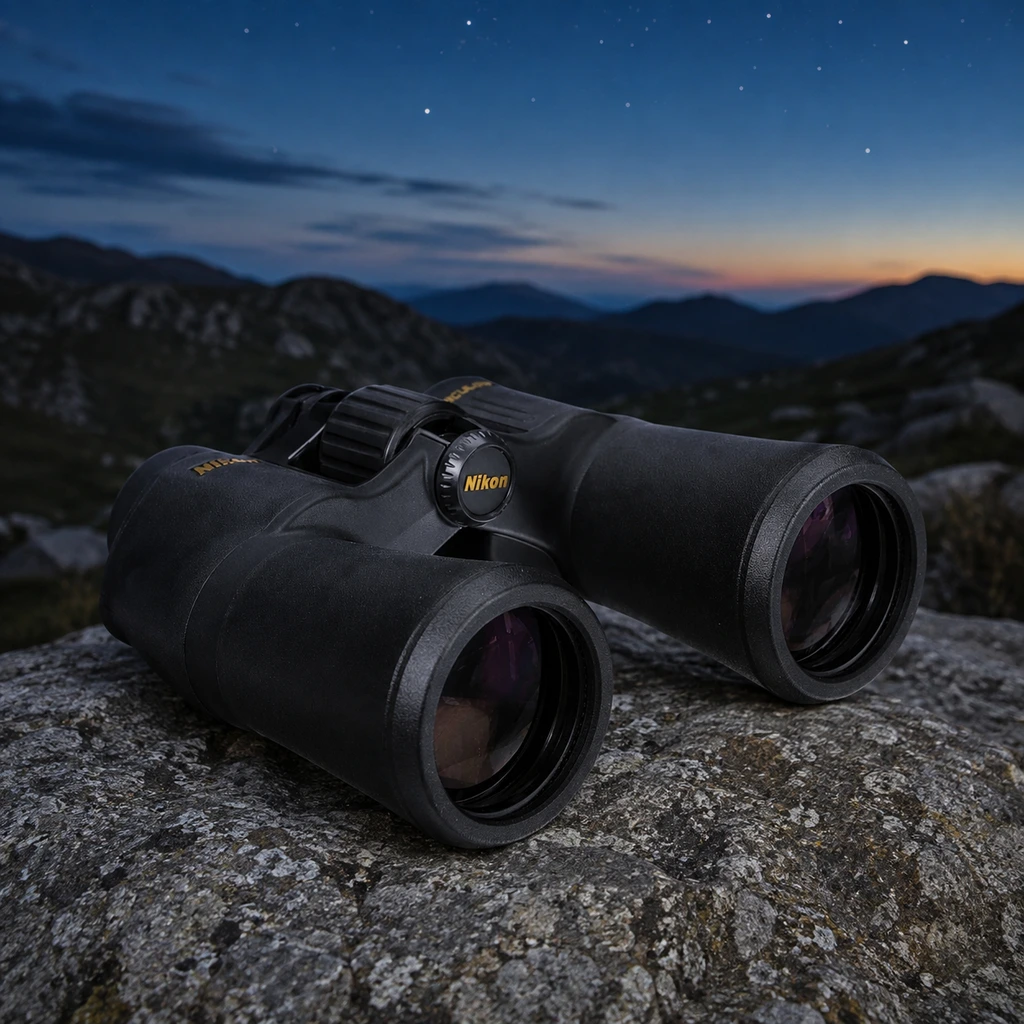
Celestron SkyMaster 25×70: Best High Magnification
Same 70mm aperture as the 15×70, considerably more reach. Twenty five power pulls in lunar craters, the phases of Venus and the disc of Jupiter at a scale the lower-powered pairs cannot manage, and on a tripod the view of the moon along the terminator is genuinely startling.
The cost is stability and field of view. At 25x every tremor is magnified with the image, so these are a tripod instrument and Celestron say as much, pointing to the size, weight and high magnification as the reason. The quarter-twenty adapter is built in. The narrower field also makes finding a target harder, so it helps to locate things with the naked eye first and then look.
BaK-4 prisms and the same rubber-armoured, water-resistant housing as the rest of the SkyMaster line. With over nine thousand ratings at 4.3 stars, it is the most reviewed pair here, and the reviews that pull the average down are almost always from people who tried to hold them.
Specs That Matter
- 70mm objectives with 25x magnification
- BaK-4 prisms, the same optical platform as the 15×70
- Built-in quarter-twenty tripod adapter, and a tripod is required in practice
- Rubber-armoured, water-resistant housing
- 4.3 stars from over 9,000 ratings
Who It Is For
Lunar detail and planets from a fixed observing spot, for someone who already owns a sturdy tripod.

Celestron SkyMaster 20×80: Best for Deep Sky
Eighty millimetres is where binoculars stop being an accessory and start being an instrument. The aperture gathers roughly two and a half times the light of a 50mm pair, which is the difference between knowing a faint galaxy is there and actually seeing it. Twenty power keeps the field wide enough to remain navigable.
These are unambiguously a mounted instrument. They are heavy, they are large, and the built-in quarter-twenty adapter is not optional equipment. Paired with a decent tripod, or better a parallelogram mount, they turn a dark site into a serious observing session, and two eyes on a star cluster is an experience no single-eyepiece telescope reproduces.
BaK-4 prisms and the water-resistant rubber armour carry over from the rest of the line, and the Celestron limited lifetime US warranty applies. At 4.3 stars from more than three thousand five hundred ratings, the consistent theme is that people are astonished by the views and unprepared for the weight.
Specs That Matter
- 80mm objectives, the largest aperture on this list
- 20x magnification with BaK-4 prisms
- Built-in quarter-twenty adapter; a sturdy tripod is essential
- Rubber-armoured, water-resistant housing
- 4.3 stars from over 3,500 ratings
Who It Is For
Deep-sky observing from a dark site, for someone committed enough to carry and mount them.

Occer 12×25 Compact: Best Budget and Travel
Twenty five millimetre objectives are small for astronomy and there is no arguing otherwise: the exit pupil is around two millimetres, so these are dimmer after dark than any of the 50mm pairs above. What they are is genuinely pocketable, cheap, and vastly better than nothing.
For the moon, the brighter planets, bright star clusters and casual constellation sweeping they work perfectly well, and they weigh little enough to live in a daypack permanently. The BAK4 prisms and FMC multilayer coating are better than the price suggests, and the field of view is a usable 273 feet at 1,000 yards.
The eyecups fold down for spectacle wearers, the body is ABS with a life-waterproof rating, and with nearly thirty four thousand ratings at 4.4 stars this is one of the most reviewed binoculars on Amazon in any category. Treat it as the pair you always have with you rather than the pair you plan a night around.
Specs That Matter
- 25mm objectives at 12x, compact and pocketable
- BAK4 prisms with FMC multilayer broadband coating
- 273 feet field of view at 1,000 yards
- Fold-down eyecups for spectacle wearers, life-waterproof ABS body
- 4.4 stars from nearly 34,000 ratings
Who It Is For
A travel and daypack pair, children, and anyone wanting to try binocular astronomy before committing.

How to Choose Between Them
Your Very First Pair
The Cometron 7×50. Wide, bright, steady in the hands and cheap enough that a change of mind costs little. Nearly everyone who starts with a 7×50 keeps using it even after buying something larger, which is not true in the other direction. Pair it with the technique in our guide to stargazing for beginners and you will see more than most people manage with a telescope. Autumn is the easiest season to begin, for the reasons our guide to fall hiking sets out: long nights before the real cold arrives.
One Pair for Day and Night
The Nikon Aculon A211 10×50. It is the most comfortable pair here over long sessions and the extra reach over a 7×50 is welcome on wildlife. If you already do any birdwatching, this is the pair that serves both hobbies without compromise.
The Most Sky for the Money
The SkyMaster 15×70, provided you accept the tripod. The jump from 50mm to 70mm is the single largest visible upgrade on this list, and 15x is the highest magnification most people can still occasionally hand-hold. Budget for a red headlamp at the same time, and see how many lumens you actually need, because brighter is actively worse for night vision.
Faint Objects From a Dark Site
The SkyMaster 20×80, and plan the evening around it. These reward exactly the conditions our guide to dispersed camping helps you reach: no moon, no streetlights, and enough time to set up properly. The National Park Service night skies programme is a good place to find protected dark skies near you.
Something to Keep in the Bag
The Occer 12×25. It will not show you a galaxy, but it lives in a daypack indefinitely and turns an unexpected clear sky into an hour of looking. It is the pair most likely to actually be with you, which counts for a lot, in the same way the kit list in our guide for beginner hikers favours what gets carried over what looks best on paper.
Aperture, Exit Pupil and Magnification: What the Numbers Mean
Aperture Decides What You Can See
The second number is the diameter of the front lenses in millimetres, and it governs light gathering, which scales with area rather than diameter. A 70mm pair collects almost twice the light of a 50mm pair, and an 80mm pair around two and a half times. Nothing else on the specification sheet changes what is visible as much as this does. NASA’s monthly skywatching guide is a good way to decide what to point them at.
Magnification Is Limited by Your Hands
The first number is how much larger the image appears. The practical ceiling handheld is around 10x for most people and 12x for the steady-handed, because tremor is magnified along with the view. Beyond that a tripod stops being an upgrade and becomes a requirement, which is a decision about how you will actually observe rather than about optics.
Exit Pupil Is Why 7×50 Persists
Divide aperture by magnification and you get the width of the beam of light leaving the eyepiece. A 7×50 produces about 7.1mm, which roughly matches a fully dark-adapted young pupil, so almost none of the gathered light is wasted. Pupils narrow with age, which is why an older observer often prefers a 10×50 with its 5mm exit pupil: the image looks sharper and no light is lost.
Prisms and Coatings Are Where Cost Is Cut
BaK-4 prisms and fully multi-coated lenses transmit noticeably more light and keep stars as points rather than smears at the edge of the field. Porro prism designs, which are the wide-bodied ones, generally give better light transmission per pound than roof prisms. If a specification lists neither the prism glass nor the coating, assume both are the cheap option.
Holding Them Steady and Looking After Them
Bracing beats strength. Leaning against a wall or a car roof, sitting down and propping your elbows on your knees, or lying back in a reclining chair will all steady the view more than any amount of effort. That last one is also the only comfortable way to look near the zenith, and the reason a reclining camp chair is standard astronomy equipment.
Dew is the real enemy of a clear still night. Never wipe wet lenses on a sleeve; let them dry pointing down, or fit dew shields on the larger pairs. Store them somewhere dry with the caps on, and give them a few minutes outside before you start so the glass reaches air temperature and stops fogging. The general principles in our guide to storing outdoor gear apply here too, and if you would rather lie flat than sit, an insulating pad from our round up of sleeping pads keeps the cold ground out of your back.
Take a red light and something warm. Standing still in the dark is colder than it sounds, and one flash of white light undoes half an hour of dark adaptation, which is why our round up of the best headlamps flags which models have a genuine red mode. If you are walking to a site after dark, our night hiking guide covers getting there and back safely.
Frequently Asked Questions
Are binoculars really better than a telescope for beginners?
For a first instrument, yes. They are easier to aim, show a wide field you can navigate, work straight out of the box and are useful in daylight. A cheap telescope has a narrow inverted view on a wobbling mount, which is the most common reason people abandon the hobby in the first month.
What magnification is best for stargazing?
Between 7x and 10x if you are holding them, because beyond that your own tremor limits the view. From a tripod, 15x to 25x opens up lunar detail and planets. The best binoculars for stargazing are the ones matched to how you will support them, not the ones with the biggest first number.
Do I need a tripod?
Not with a 50mm pair at 7x or 10x. With 70mm and 80mm pairs, effectively yes: they are heavy and the magnification is beyond comfortable hand-holding. All the SkyMaster models here have a quarter-twenty adapter built in for a standard photo tripod.
Can I use my birdwatching binoculars for astronomy?
Yes, and you should start there. A typical 8×42 birding pair works well on the moon, star clusters and the brighter planets. The limitation is aperture: 42mm gathers less light than 50mm, so the faintest objects stay out of reach. Otherwise the same pair does both jobs.
Will binoculars show planets and galaxies?
Planets yes, as small discs rather than detailed images, and you will clearly see the four bright moons of Jupiter. Galaxies are visible as faint smudges from a genuinely dark site, with Andromeda the obvious first target. Star clusters are where binoculars genuinely outperform small telescopes, because the wide field shows the whole cluster at once.
Match the pair to how you will use it rather than to the biggest number on the box. If you want one answer: buy the Cometron 7×50 to learn the sky, and add the SkyMaster 15×70 and a tripod when you know you are staying with it. Then pick a moonless week, check the forecast, and go and look.
Discover more from Maive Verse
Subscribe to get the latest posts sent to your email.


