
Master weight distribution in skiing with our 4 fundamental rules. Learn how to shift pressure (fore/aft and lateral) to transform your turns into effortless arc.
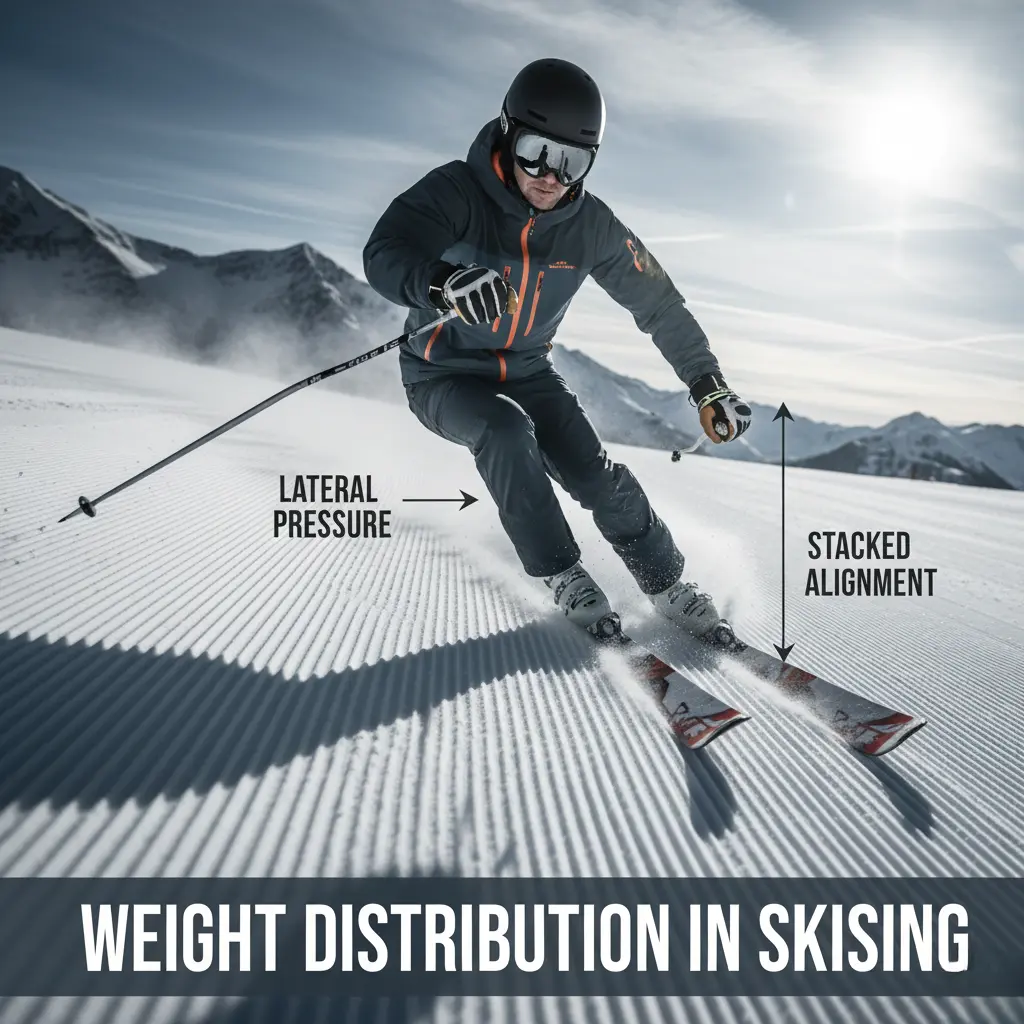
Table of Contents
The Invisible Skill
Of all the technical skills required in alpine skiing, weight distribution in skiing is the most complex yet most fundamental. It is the invisible force that connects the skier’s intent to the performance of the equipment. Properly executed weight distribution allows the skier to engage the ski’s edge, carve a clean arc, and control speed without relying on inefficient braking. Poor weight distribution, conversely, leads to the infamous “backseat” stance, thigh burn, and uncontrolled skidding.
This skill is not about brute strength; it is about subtle timing and precise alignment. It requires the skier to constantly shift their center of mass (COM) relative to the skis throughout the turn cycle. A mastered weight shift transforms skiing from a battle against gravity into a fluid, rhythmic dance with the slope.
This guide simplifies this advanced concept into four core rules, deconstructs the essential fore/aft and lateral movements, and provides targeted drills to refine weight distribution in skiing for dynamic control across all types of terrain.
Rule 1: Master Lateral Pressure (Outside Ski Dominance)
The most critical rule in dynamic skiing is the committed transfer of weight onto the outside (downhill) ski. This concept is foundational to creating the necessary edge grip for carving and stability.
The Physics of Lateral Pressure
During a turn, centrifugal force naturally pulls the skier toward the outside of the arc. To counteract this force and prevent falling outward, the skier must lean into the turn and direct pressure onto the outside ski. This action tips the skis onto their edges (angulation).
- The Power Ratio: In high-speed, carved turns, up to 80% or more of the skier’s weight should be directed onto the outside ski. The inside ski serves primarily as a stabilizer and a steering aid.
- The Result: Committing weight fully to the outside ski ensures that the maximum force is applied to the active edge, allowing the ski’s sidecut to bend and carve a clean line.
Why Inside Ski Pressure Fails
A common intermediate error is maintaining a 50/50 weight distribution in skiing. This results in split pressure, which has two major flaws:
- Reduced Edge Grip: Neither ski receives enough concentrated pressure to bend and hold an edge effectively, leading to uncontrolled skidding.
- Inside Ski Dominance: When the skier fails to commit, the inside ski often takes over and causes the skier to lean too far inward, resulting in the dreaded “A-frame” stance and inability to hold the turn.
Progressive Weight Transfer
The transfer of weight should not be a sudden movement but a progressive build-up of pressure:
- Initiation: Pressure is neutral as the turn begins. The skier releases the edge and moves slightly into the fall line.
- Build-Up: As the ski travels through the fall line (where speed is greatest), the skier progressively increases angulation and directs pressure onto the outside ski.
- Completion: Maximum pressure is applied at the finish of the turn, allowing the ski to complete the arc and control speed, setting up the initiation for the next turn.
This progressive pressure is the defining difference between a skidded versus a carved turn.
Rule 2: Maintain Fore/Aft Balance (The Stance Control)
Fore/Aft balance, maintaining pressure along the length of the ski is the second vital element of precise weight distribution in skiing. It determines which part of the ski is engaged with the snow (tip, center, or tail).
The Athletic Stance and the Sweet Spot
The goal of fore/aft balance is to keep the skier’s center of mass directly over the center of pressure of the ski, the “sweet spot.”
- Perfect Balance: This ideal alignment is achieved when the shins press firmly against the front of the boots (flexed ankles), allowing the skier to engage the entire length of the ski evenly. This stance is detailed in our guide on Perfect Skiing Posture .
- The Role of Ankles: The ankle joint is the primary control point for fore/aft movement. Small movements forward or backward with the shin result in large changes in pressure across the ski base.
The Problem: Backseat Skiing
The most common failure in fore/aft balance is the backseat stance (leaning backward). This occurs when the hips drop behind the heels, resulting in:
- Loss of Tip Engagement: The ski tips float and become difficult to steer.
- Excessive Tail Pressure: The tails of the skis are locked, forcing the ski to skid heavily and preventing the skier from initiating the next turn.
Adjusting Pressure for Terrain
A dynamic skier uses slight fore/aft adjustments to adapt to conditions:
- Forward Pressure (Aggressive): Pressing slightly forward (more shin pressure) shortens the radius of the turn, making the skis turn quicker. This is ideal for short-radius turns and moguls.
- Neutral/Centered (All-Mountain): Maintains pressure directly over the middle of the foot for predictable steering on groomed slopes.
- Slightly Aft (Flotation): In very deep, heavy powder, shifting the center of mass slightly backward helps the ski tips rise, increasing flotation. Caution: This shift must be minimal to avoid going fully into the backseat.
The biomechanics of weight distribution in skiing can be complex; understanding the body’s center of mass is key. Biomechanical studies confirm that stable center of mass management is essential for injury prevention and performance.
Rule 3: Use Vertical Movement (Absorbing and Extending)
The vertical movement of the body (flexion and extension of the ankles, knees, and hips) is the most powerful method for rapidly changing the pressure applied to the skis.
Unweighting for Initiation
Vertical movement is used to briefly reduce pressure on the skis, making them easy to pivot and initiate the turn.
- The Action: As the skier finishes one turn, they rapidly rise (extend) to release the pressure, or relax (flex) the joints to remove resistance just as they begin to turn across the fall line.
- The Timing: This brief moment of unweighting allows the skis to flatten and transition effortlessly from the old edge to the new edge. This rapid release is essential for managing tough terrain and linking turns quickly.
Compressing and Extending for Pressure
Vertical movement is also used to increase pressure suddenly, which is essential for grip and control:
- Compression/Absorption: As the skier encounters a bump or a sharp increase in slope angle, they rapidly flex their joints to compress their center of mass, absorbing the shock and preventing them from being launched into the air.
- Extension/Pressing: A quick extension of the legs down the slope increases the pressure exerted onto the snow, enhancing edge grip, which is used to carve the skis cleanly.
Vertical Movement in Bumps and Moguls
Mogul skiing is a constant dialogue with the snow surface using vertical movement:
- Absorption: Flexing the legs rapidly to absorb the energy as the skis ride up the face of a mogul.
- Extension: Extending the legs back toward the snow as the skis drop into the trough between the moguls to maintain contact and control.
This constant vertical motion is the primary skill taught in any Mogul Progression Guide.
Rule 4: Drill for Dynamic Weight Transfer
To transform theoretical knowledge into automatic muscle memory, targeted drills are necessary. These drills force the skier to consciously manage their weight distribution in skiing outside of their comfort zone.
Drill 1: The One-Ski Turn (Lateral Commitment)
- Goal: Force the skier to commit 100% of the weight laterally onto the turning ski.
- Execution: On a gentle Green or Blue run, lift the inside (uphill) ski completely off the snow. Execute a series of turns relying only on the outside ski. Hold the inside ski close to the outside ski.
- Focus: Feel the strong, consistent pressure running down the outside leg. This eliminates the 50/50 split and trains the hip stabilizers.
Drill 2: Pole Touch (Fore/Aft Centering)
- Goal: To confirm that the skier is maintaining a centered fore/aft stance throughout the turn.
- Execution: While skiing, extend one pole forward and try to touch the snow directly in front of the boot toe (the tip of the ski). Then, extend the other pole back and try to touch the snow behind the boot heel (the tail of the ski).
- Focus: Successfully touching both ends proves the skier is balanced over the middle. If the skier falls forward, they are too far back. If they fall backward, they are too far forward.
Drill 3: The Slow-Motion Turn (Pressure Mapping)
- Goal: To feel the precise moment maximum pressure is applied laterally and vertically.
- Execution: Find an open, quiet run and execute exaggerated, slow-motion turns. Consciously narrate when you are releasing pressure (start of turn), building pressure (through the fall line), and unweighting (end of turn).
- Focus: This trains the mental mapping of pressure application, which is crucial for timing. The timing is often taught using the PSIA’s Skier Essentials framework, focusing on how pressure changes the shape of the turn.
Drill 4: Traverse Pressure Shifts (Angulation and Edge Control)
- Goal: To isolate lateral pressure adjustment without turning.
- Execution: Traverse a Blue slope. Without changing direction, rapidly rock the ankles and knees side-to-side, increasing the edge angle of the downhill ski and then flattening it.
- Focus: This demonstrates that the edge angle is independent of rotation. Feel the powerful grip created when the edge angle is increased. This drill is foundational for dynamic skiing.
Conclusion
Mastering weight distribution in skiing is the key to unlocking dynamic, tireless performance. It is a four-pronged mechanical skill built on committed lateral pressure (Rule 1), centered fore/aft stance (Rule 2), active vertical movement (Rule 3), and relentless drilling (Rule 4). By consciously practicing the One-Ski Turn and the Traverse Pressure Shifts, skiers transition from fighting the mountain to using the forces of gravity and inertia to their advantage, ensuring effortless, precise turns on any slope.
Discover more from Maive Verse
Subscribe to get the latest posts sent to your email.