Learn the simple, 5-step formula for how to choose ski length. We demystify height, weight, ability, and terrain to ensure you get the perfect skis every time.
Introduction: Why How to Choose Ski Length Matters
Determining the correct ski length is arguably the single most important decision when purchasing or renting equipment. The length of a ski directly impacts its maneuverability, stability, and control, effectively defining the difficulty of the skiing experience. A ski that is too short feels unstable at speed and performs poorly in deep snow, while a ski that is too long is cumbersome, difficult to turn, and overly taxing on the skier’s muscles.
For decades, the simple rule of thumb was to choose a ski that reached somewhere between the chin and the top of the head. However, modern ski technology including changes in ski shape (sidecut) and profile (rocker) has rendered this height-based method obsolete as a standalone measure. Today, effective sizing requires synthesizing multiple personal and technical factors.
This guide simplifies the complex process of how to choose ski length by breaking it down into a systematic, five-factor formula. This approach moves beyond simple height and weight to consider ability, terrain preference, and modern design, guaranteeing a final length that perfectly matches the skier’s goals.
Factor 1: The Starting Point – Height and Weight
The primary physical dimensions of the skier: height and weight, establish the foundational baseline for all ski sizing decisions. This initial measurement ensures the ski is proportionate to the skier’s body.
The Height Reference Range
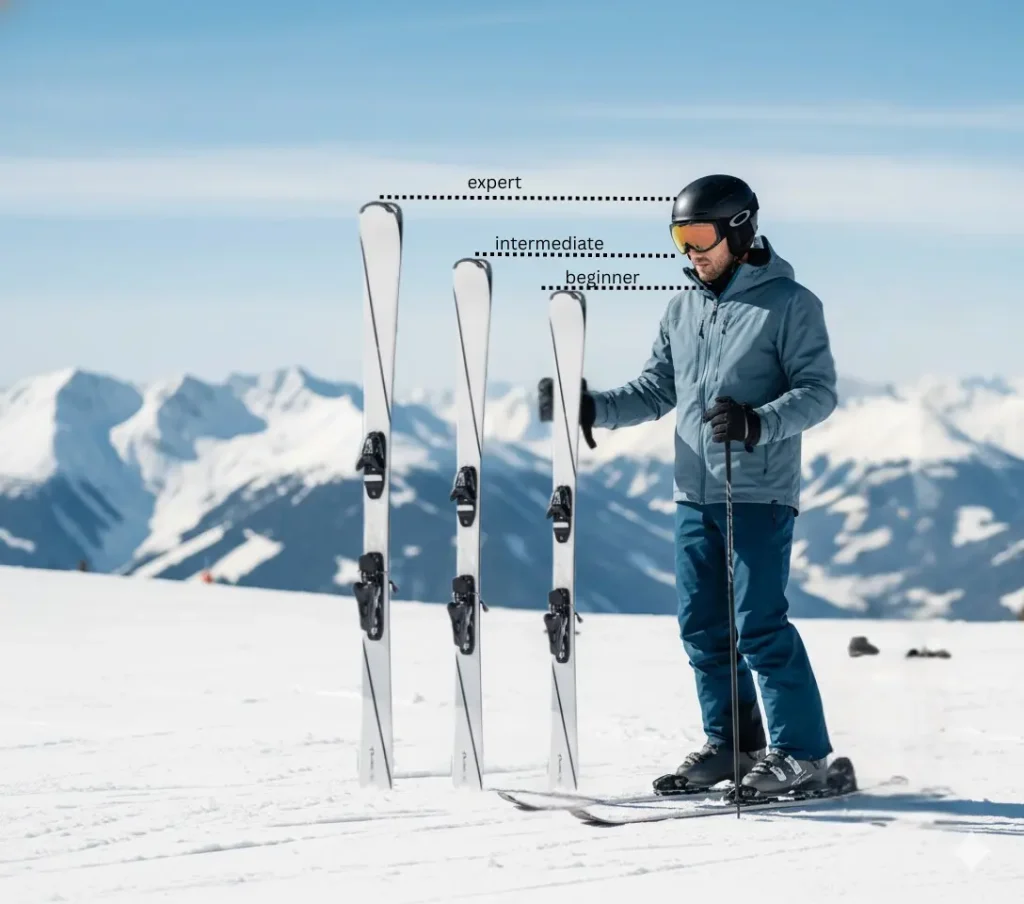
The classic starting point remains relevant as a reference, though it is no longer the final word. When standing the ski on its tail, the length should generally fall within the following range:
- Beginner: Between the chest and the chin. Shorter skis are easier to initiate turns with.
- Intermediate: Between the chin and the nose. This is the comfort zone for most skiers.
- Expert: Between the nose and slightly above the forehead. Longer skis offer greater stability at high speed.
The Weight Adjustment Principle
Weight is often a more critical factor than height. A heavier skier requires a longer, stiffer ski for adequate support and stability, while a lighter skier needs a shorter, more forgiving ski to manipulate easily.
- Heavier than Average: If a skier’s weight is significantly above the average for their height, the ski length should be increased by 5 to 10 centimeters from the baseline height recommendation. This ensures the ski’s effective edge is long enough to bear the load and maintain stability at speed.
- Lighter than Average: If a skier’s weight is significantly below average for their height, the ski length should be reduced by 5 to 10 centimeters. This prevents the ski from feeling too stiff or demanding, allowing the skier to flex the ski into a turn properly.
This weight adjustment is necessary because the ski is ultimately a platform supporting the skier’s mass. Without proper support, the skier may feel unstable or “overpowered” by the gear.
Factor 2: The Skill Assessment – Ability Level
The skier’s ability level is the single most defining variable in the how to choose ski length equation. A shorter ski forgives mistakes and requires less effort, while a longer ski rewards precision but punishes sloppy technique.
The Beginner Skier (Novice to Confident Green Run Skier)
- Recommended Length: 10–20 cm below the chin.
- Justification: The primary goal for a beginner is to stop and initiate turns easily. A shorter ski has a smaller surface area, making it easier to pivot and control speed, resulting in faster progression and less fatigue. When learning, focusing on basic technique is key; referencing a guide like the Complete Winter Skiing Equipment Guide 2025 (Internal Link) can ensure all gear, not just length, is appropriate.

The Intermediate Skier (Confident Blue Run Skier)
- Recommended Length: Between the chin and the nose.
- Justification: This skier can link parallel turns and maintain control on moderate slopes. They need a slightly longer ski to achieve stability at higher speeds and to handle variable snow conditions encountered on Blue Square runs. The added length provides a larger platform for balance and stability without sacrificing maneuverability.

The Advanced Skier (Confident Black Diamond Skier)
- Recommended Length: Between the nose and the top of the head (or slightly above).
- Justification: The advanced skier requires maximum stability and power for high-speed carving and tackling challenging terrain like moguls or icy slopes. The longer effective edge and overall length provide dampening and precision. For expert riders who frequently explore steep slopes and challenging terrain, a deep understanding of Ski Slope Difficulty (Internal Link) is essential for safety.
Factor 3: The Environment – Terrain and Snow
The conditions in which the ski will primarily be used significantly influence the ideal length. Different snow conditions and terrain types require different characteristics from the ski.
All-Mountain Skiing (General Resort Use)
- Length Preference: Medium length (Nose to mid-forehead).
- Reasoning: The most balanced option. This length provides enough tip-and-tail surface area for float in light powder while remaining short enough to maneuver quickly on groomed slopes and through trees. Since the majority of resort skiing is done on groomed or slightly variable snow, balance is key.
Powder Skiing (Deep, Untracked Snow)
- Length Preference: Longer (At or above head height).
- Reasoning: Longer skis provide maximum floatation, which is crucial for staying above deep snow and minimizing leg fatigue. The additional surface area acts like a boat hull, preventing the ski tips from diving. This length is usually paired with a wider ski profile to enhance the floatation effect further.
Park/Freestyle Skiing (Jumps and Rails)
- Length Preference: Shorter (Chin to nose).
- Reasoning: Agility and reduced swing weight are paramount in the terrain park. A shorter ski is easier to spin, grab, and control while in the air. The reduced weight at the tips and tails makes quick rotations possible, enabling freestyle maneuvers.
Moguls and Trees (Technical, Tight Terrain)
- Length Preference: Slightly Shorter (Chin to nose).
- Reasoning: Maneuverability is king in tight spaces. A shorter ski allows the skier to pivot and change direction quickly, which is necessary to navigate the troughs between moguls or weave through dense tree lines.
The Simple Formula and Final Adjustments
To summarize the decision process, a skier should first establish their baseline length using their height and then adjust that length based on their weight and ability.
The Final Formula
- Baseline: Determine the initial length based on the skier’s height and general ability (e.g., intermediate gets nose-level).
- Weight Adjustment: Add or subtract 5–10 cm based on whether the skier is heavier or lighter than average.
- Terrain Adjustment: Adjust an additional 5 cm for specialized conditions (e.g., add 5 cm for powder, subtract 5 cm for park).
Example: A 5’10” (178 cm) skier who is intermediate (baseline: 173 cm/nose-level) and heavy, who mainly skis powder, might add 10 cm for weight and 5 cm for powder, resulting in a final recommended length around 188 cm. Conversely, a light beginner should opt for the shortest end of their range.
Ultimately, proper ski length is an extension of effective technique. The Professional Ski Instructors of America (PSIA) often stress that proper stance and body movement are more crucial than centimeter measurements, but selecting the right tool for the job is the first step toward building sound skills. For more technical insight on the mechanics of the turn, consult resources from the Professional Ski Instructors of America (PSIA).
Conclusion
The question of how to choose ski length is best answered not by a single measurement, but by a systematic analysis of the skier’s physical characteristics and goals. While height and weight provide the necessary starting point, it is the honest assessment of ability. Are you turning aggressively, or still stopping in a wedge? that provides the final, critical adjustment. By using this five-factor approach, skiers can move beyond the guessing game and select a length that enhances stability, promotes faster skill progression, and ensures maximum confidence and performance on the mountain.
Discover more from Maive Verse
Subscribe to get the latest posts sent to your email.