

This post may contain affiliate links. If you buy through them, we may earn a small commission at no extra cost to you.
The best running headlamps are the ones you stop noticing about ten minutes into a run. A camping headlamp only has to light a tent and a trail at walking pace; a running light has to stay put while your head bounces a few hundred times a minute, throw enough light to read roots at speed, and last as long as you are out. Get the fit wrong and the beam jumps around until you give up and carry it in your hand.
Six lights below, from a minimalist run light to a 700 lumen expedition lamp, every one checked for stock, rating and the specifications on the listing. October is when this starts to matter: evening runs finish in the dark, and our fall trail running guide covers the rest of what changes once the days get short.
Table of Contents
What Separates the Best Running Headlamps
Fit and bounce come first. A running headlamp needs a low housing that sits close to the forehead and a band that holds without being cranked tight. Heavy lamps mounted far from the head act like a lever, and every stride turns into a small nod of the beam. Split or wide bands, rear battery packs and top straps all exist to fight this.
Then light you can actually use. The headline number is total output in lumens, but beam distance and runtime tell you more. A light that holds a modest setting for hours is worth more on a long trail run than one that hits a huge number for a few minutes and then steps down.
Then power. Built-in lithium-ion cells recharged by USB-C are the norm now and suit most runners. Lamps that take standard AA or AAA cells still make sense for multi-day races and remote trips, because you can swap batteries rather than wait for a charge.
Last, weather. Running in rain is normal, so look at the IP rating. IPX4 handles splashes and showers; IP66 and IP67 handle heavy rain and short submersion, which matters more than it sounds once a lamp has been through a few wet winter runs.
The Best Running Headlamps at a Glance
| Headlamp | Max Output | Power | Weather Rating | Best For |
|---|---|---|---|---|
| Nitecore NU25 UL | 400 lumens | USB-C, built in | IP66 | Best overall |
| Petzl Swift RL | 1,100 lumens | USB-C, 2350 mAh | Not stated | Reactive lighting |
| Black Diamond Deploy | 325 lumens | USB-C, built in | IPX4 | Minimalist runs |
| Black Diamond Spot 400-R | 400 lumens | Micro-USB, 1500 mAh | IP67 | Best value |
| BioLite Range 300 | 300 lumens | USB-C, built in | IP67 | Comfort fit |
| Black Diamond Icon 700 | 700 lumens | 4x AA or Icon battery | IP67 | Ultras and technical |
The Six Best Running Headlamps in Detail
Nitecore NU25 UL: Best Overall
Light, bright and simple is the right formula for most runners, and the NU25 UL nails it. Nitecore lists 400 lumens and a maximum beam distance of 144 yards at a total weight of just 1.65 ounces, which is light enough that the thin bungee band holds it still without pressure.
The color temperature switch is the unusual extra. You can move between warm, neutral and cool white, and warm light genuinely helps in fog and rain where cool white bounces back at you. There is also an auxiliary red light, SOS and beacon modes.
It recharges over USB-C in just over an hour according to the listing, carries an IP66 rating, and has 4.7 stars across 1,205 reviews, the best rating on this list.
Specs That Matter
- Output: up to 400 lumens
- Beam: up to 144 yards
- Weight: 1.65 oz listed
- Power: USB-C rechargeable
- Rating: IP66
Who It Is For
Most trail runners, from evening loops to long training runs.

Petzl Swift RL: Best Reactive Lighting
The Swift RL is the brightest light here at 1,100 lumens, and the listing puts its weight at only 100 grams. The real feature is reactive lighting: a sensor reads the ambient light and adjusts brightness and beam pattern on its own, so the lamp dims when you look at your watch and opens up when you look down the trail.
That matters on a run more than anywhere else, because you never have to take a hand off your stride to change modes, and the automatic dimming stretches the battery. Petzl uses a patented split headband for stability, which is exactly what a bright, heavier lamp needs to stop bouncing.
Continuous red light, a strobe for signaling, reflective detailing and a 2350 mAh battery that charges over USB-C with a five-level charge indicator round it out. Four point five stars across 1,253 reviews.
Specs That Matter
- Output: up to 1,100 lumens
- Weight: 100 g listed
- Power: 2350 mAh, USB-C
- Mode: reactive lighting sensor
- Fit: split headband
Who It Is For
Runners on technical trail who want maximum light without fiddling with buttons.

Black Diamond Deploy Run Light: Best Minimalist
The Deploy is built for running rather than adapted to it. The housing is low and contoured so it sits close to the forehead, which is the single biggest factor in a no-bounce fit, and the listing describes it as lightweight construction for endurance use.
Output tops out at 325 lumens, plenty for road running and smooth trail, with full dimming, strobe and a lockout so it does not switch on in a pocket. It recharges over USB-C.
The trade-offs are an IPX4 rating, which handles rain and splashes but not submersion, and a small review base of 61 at 4.4 stars. For short and medium runs where comfort matters more than raw power, it is the one to look at.
Specs That Matter
- Output: up to 325 lumens
- Fit: low-profile contoured housing
- Power: USB-C rechargeable
- Rating: IPX4
- Extras: dimming, strobe, lockout
Who It Is For
Road and smooth trail runners who want the lightest, least noticeable option.

Black Diamond Spot 400-R: Best Value
The Spot is the classic all-round headlamp, and the rechargeable 400-R version makes a sensible running light at a fair price. Four hundred lumens is enough for most trail running, and the low-profile build and adjustable band keep it stable.
The IP67 rating is the standout for the money: the listing says it survives submersion for up to 30 minutes, so heavy rain is not a concern. Modes cover full power, dimming, strobe, red night vision and lock.
One thing to know: the 1500 mAh battery charges over micro-USB rather than USB-C, so it may need its own cable. Four point four stars across 526 reviews.
Specs That Matter
- Output: up to 400 lumens
- Power: 1500 mAh, micro-USB
- Rating: IP67
- Modes: dimming, strobe, red, lock
- Fit: low profile, adjustable band
Who It Is For
Runners who want one reliable, weatherproof light for running and camping alike.

BioLite Range 300: Best Comfort Fit
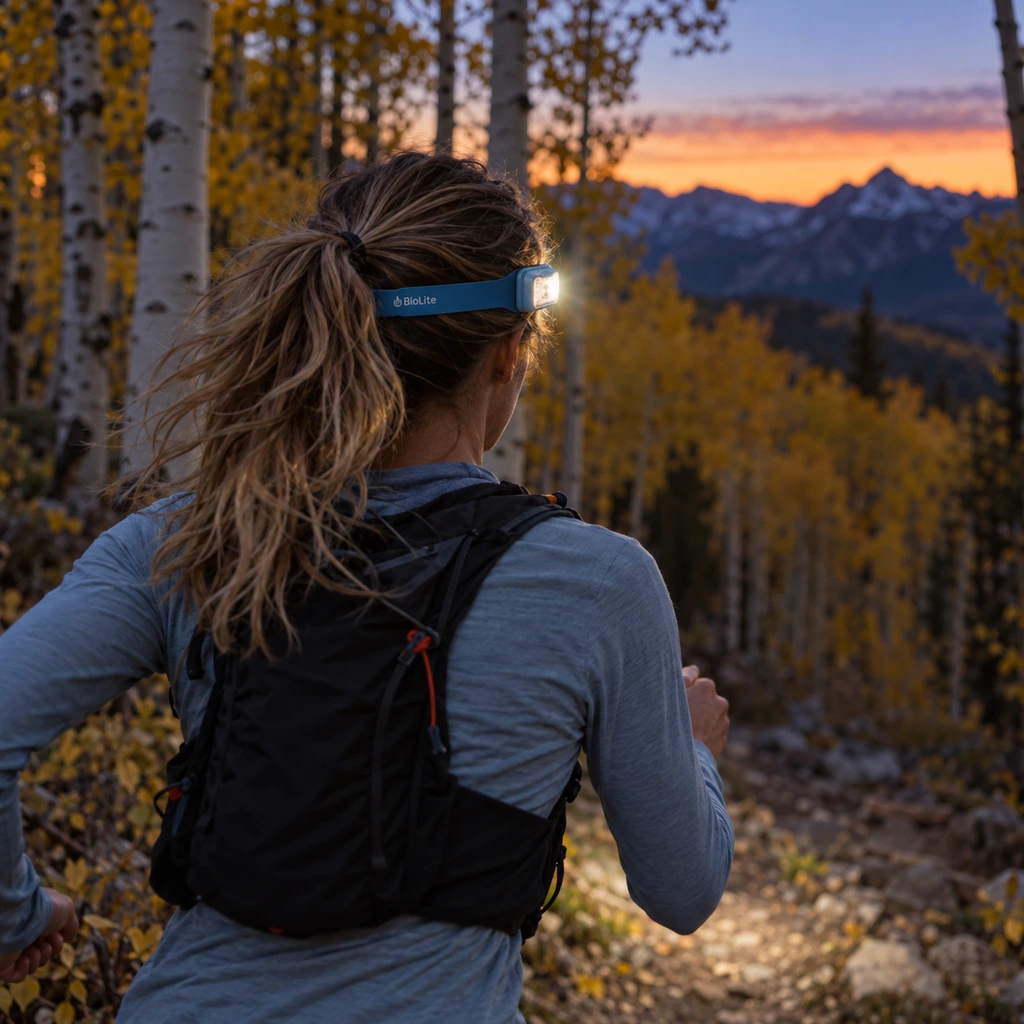
BioLite pays attention to the band, using moisture-wicking fabric that stays cooler and drier against the forehead, which is what you feel on a hot evening run or a long effort. The listing puts output at 300 lumens with a 75 meter beam.
Charging is quick: the listing says 0 to 80 percent in 30 minutes over USB-C, or an hour of light from an eight minute top-up. Runtime is listed as 100 hours on low and 4 hours on high, and the IP67 rating handles downpours and submersion.
The honest caveat is a small review base: 4.5 stars, but from only 28 reviews. It is a newer model, so expect fewer real-world reports than the others here.
Specs That Matter
- Output: 300 lumens
- Beam: 75 m
- Runtime: 100 h low, 4 h high listed
- Power: USB-C fast charging
- Rating: IP67
Who It Is For
Runners who prioritize comfort and quick charging, and do not mind a newer model.
Black Diamond Icon 700: Best for Ultras and Technical Terrain
The Icon 700 is not a minimalist light. It is a 700 lumen lamp with a rear battery pack and an over-the-top strap, which spreads the weight around the head and keeps the beam steady despite the bulk. On a technical mountain trail or a night section of an ultramarathon, that steadiness and reach are the point.
It runs on four AA batteries, included, or an optional rechargeable Icon battery sold separately. That is a real advantage on long races, because a fresh set of AA cells in a drop bag is faster and more reliable than waiting on a charge.
IP67 waterproofing, red night vision, dimming, strobe and lockout complete it. Four point four stars across 359 reviews.
Specs That Matter
- Output: up to 700 lumens
- Power: 4x AA or Icon battery
- Rating: IP67
- Fit: rear battery pack, top strap
- Modes: dimming, strobe, red, lock
Who It Is For
Ultrarunners and anyone running long, technical terrain in full darkness.

How to Choose the Right Headlamp
For Road and Urban Running
Being seen matters as much as seeing. Two to three hundred lumens is plenty on lit or smooth surfaces, and comfort and weight should drive the choice. The Black Diamond Deploy or the Nitecore NU25 UL make sense here, ideally paired with a rear red light or reflective gear.
For Trail Running
Trail running needs more reach and a steadier beam, because you are reading rocks and roots at speed. Four hundred lumens or more is a good target. The Nitecore, the Spot 400-R and the Petzl Swift RL all fit, and our guides on how to run downhill and how to run uphill explain why seeing the ground clearly matters so much on descents.
For Ultras and Long Nights
Long nights call for runtime and a plan for power. The Icon 700 with spare AA cells or the Petzl with a power bank in your running vest are the strongest options. Many ultrarunners also carry a small second light as a backup, and the Deploy or Nitecore work well in that role.
What the Specifications Mean
Lumens, Beam Distance and Runtime
Most headlamp numbers follow the ANSI FL1 standard. Lumens measure total light, beam distance measures how far the light reaches before it falls to a set level, and peak intensity tells you how concentrated the beam is. Runtime is measured until output drops to a fraction of the starting level, so the light may still be on but much dimmer by the end of a quoted runtime.
Reactive Lighting
Reactive or adaptive lighting uses a sensor to change output automatically. It saves battery and saves you from pressing buttons, but it can occasionally dim when you do not want it to, such as when a reflective sign or a runner ahead bounces light back. Most reactive lamps let you switch to a standard mode.
Waterproof Ratings
The second digit of an IP rating is water. IPX4 handles splashes and rain from any direction; IP66 adds protection from powerful jets; IP67 adds temporary submersion. For running in a wet climate, IP66 or IP67 removes a worry.
Color Temperature and Red Light
Warm white light, with a lower color temperature, gives better contrast in fog, rain and dust, while cool white looks brighter. Red light preserves your night vision at aid stations and checkpoints and avoids blinding other runners.
Using Running Headlamps Well
Wear the lamp lower than you think, just above the eyebrows rather than high on the forehead, which reduces bounce and puts the beam where you look. On technical trail, a second light at the waist casts shadows that make rocks and roots easier to read, a trick borrowed from night riding. For general night safety on trails, our night hiking guide applies to runners too.
Cold kills battery life. Lithium-ion cells lose capacity in freezing temperatures, so on a winter run keep the lamp or a spare battery inside a layer until you need it, and expect shorter runtimes than the box suggests. The same thinking applies to trail shoes and layers as the season turns.
Charge after every run rather than before the next one, wipe sweat off the band and housing, and wash the band occasionally. If you want to understand how much light you really need, our guide to how many lumens you need breaks down the numbers, and our camping headlamp picks cover lights for around camp.
New to running in the dark? Start on a route you know well in daylight, keep the pace easy, and build up. Our trail running for beginners guide covers the basics, and poles from our trail running poles round-up help on steep night climbs.
Frequently Asked Questions
How many lumens do I need for running?
Two to three hundred lumens works for road and smooth paths. For trail running, 400 lumens or more makes reading the ground at speed much easier. Very technical terrain or fast descents benefit from more.
How do I stop my headlamp from bouncing?
Choose a light, low-profile lamp, wear it lower on the forehead, and snug the band without overtightening. Heavier lamps need a top strap or a rear battery pack to stay steady.
Is a rechargeable headlamp better for running?
For most runners, yes: lighter, cheaper to run and always topped up after a charge. For long races or remote trips, a lamp that takes AA or AAA batteries lets you swap power quickly.
What waterproof rating do I need?
IPX4 is fine for occasional rain. If you run in heavy rain or wet winters, look for IP66 or IP67.
Should I carry a backup light?
On long or remote runs, yes. A small second light weighs very little and gets you home if your main lamp fails or the battery runs out.
For most runners, the Nitecore NU25 UL is the pick among the best running headlamps: light, bright and quick to charge. Choose the Petzl Swift RL if you want the most light with no button pressing, the Spot 400-R for value, and the Icon 700 for long, technical nights.
Discover more from Maive Verse
Subscribe to get the latest posts sent to your email.