


Master training for elevation from sea level. Learn 11 technical rules, including cardiovascular protocols, eccentric quad conditioning, and hypoxic science.

Table of Contents
Introduction: The Physiological Challenge of Hypoxia
Developing a structured protocol for training for elevation is a critical requirement for any sea-level athlete preparing to ascend into high-altitude environments. When traveling above $5,000\text{ feet}$ ($1,524\text{ meters}$), the human body is subjected to a decrease in barometric pressure, which subsequently reduces the partial pressure of oxygen. Without proactive conditioning, this atmospheric shift leads to rapid physical exhaustion, cognitive decline, and potentially life-threatening altitude illnesses. For those who have already established a baseline conditioning routine through a Bikepacking Training Plan, adjusting for elevation demands an advanced understanding of respiratory and cardiovascular bioenergetics.
The objective of altitude preparation from sea level is to maximize the efficiency of the body’s oxygen transport and utilization systems. While a sea-level athlete cannot easily replicate the low-oxygen air of the mountains, they can manipulate specific variables—such as capillary density, stroke volume, and respiratory muscle strength—to compensate for the decreased pressure. This preparation is the physiological equivalent of the Bikepacking Mindset Guide required to overcome long-distance fatigue. This guide provides a detailed, data-driven analysis of 11 rules designed to prepare your body for high-altitude ascents.
The Science of Altitude: Understanding Hypoxia and Pressure Changes
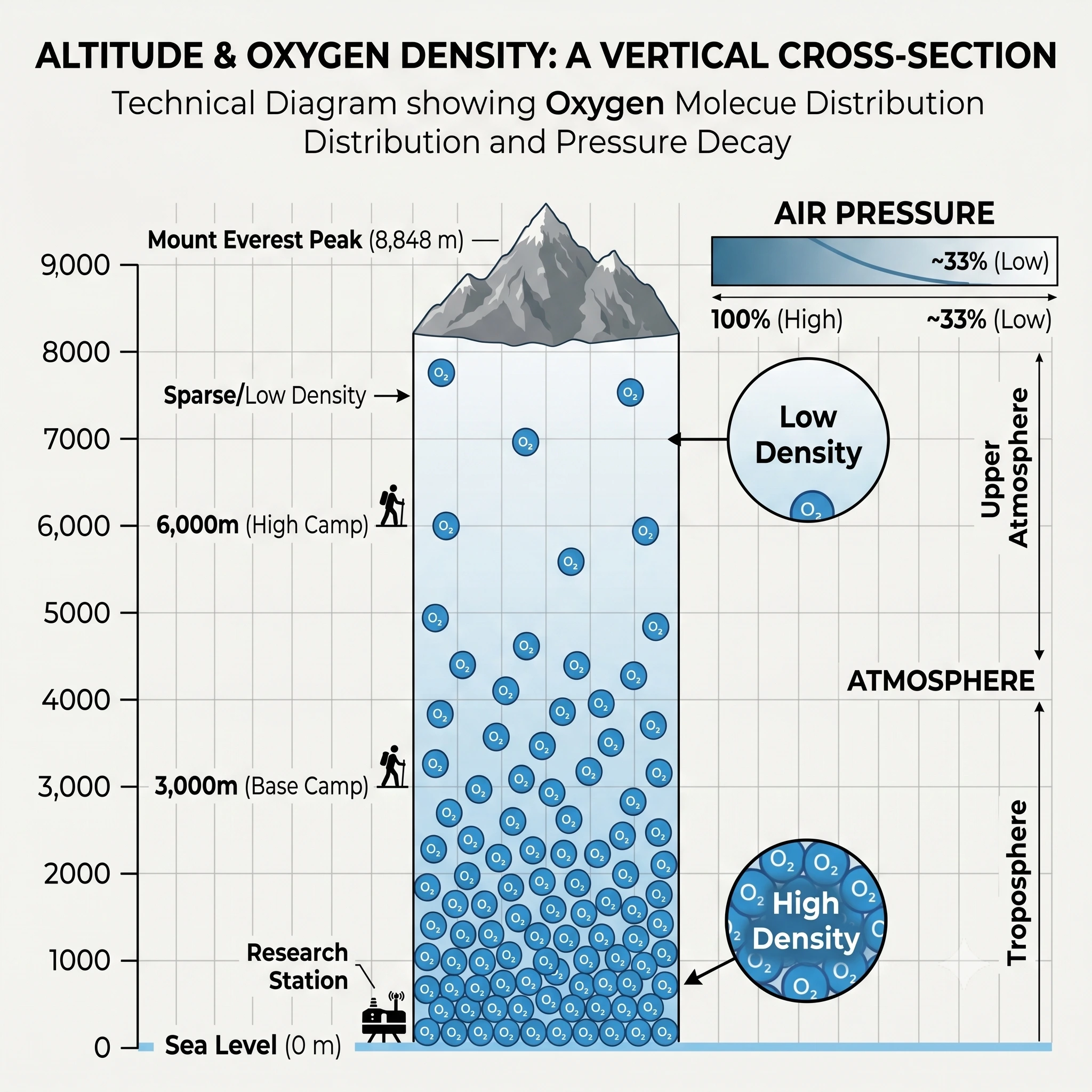
At sea level, the air consists of approximately $20.9\%\text{ oxygen}$, with a barometric pressure of $760\text{ mmHg}$. As elevation increases, the percentage of oxygen in the air remains constant at $20.9\%$, but the density of the air molecules decreases. This is a crucial distinction for understanding how to prepare for high-altitude climbs.
The Partial Pressure of Oxygen ($P_{\text{O}_2}$)
The decrease in barometric pressure directly reduces the partial pressure of oxygen ($P_{\text{O}_2}$) in the lungs. This relationship is governed by Dalton’s Law of Partial Pressures:$$P_{\text{O}_2} = (P_{\text{B}} – P_{\text{H}_2\text{O}}) \times F_{\text{O}_2}$$
Where:
- $P_{\text{B}}$ is the barometric pressure at a given altitude.
- $P_{\text{H}_2\text{O}}$ is the vapor pressure of water in the lungs ($\approx 47\text{ mmHg}$ at body temperature).
- $F_{\text{O}_2}$ is the fractional concentration of oxygen ($0.209$).
At sea level, the inspired $P_{\text{O}_2}$ is approximately $149\text{ mmHg}$. At $10,000\text{ feet}$ ($3,048\text{ meters}$), barometric pressure drops to $523\text{ mmHg}$, reducing the inspired $P_{\text{O}_2}$ to approximately $99\text{ mmHg}$. This significant drop reduces the pressure gradient between the alveoli in the lungs and the blood, slowing the rate of oxygen diffusion into the bloodstream.
Acute Mountain Sickness (AMS) and Arterial Saturation ($S_{\text{a}}\text{O}_2$)
When the oxygen diffusion rate slows, arterial oxygen saturation ($S_{\text{a}}\text{O}_2$) drops below the typical sea-level baseline of $98\%$. If $S_{\text{a}}\text{O}_2$ drops below $90\%$, the individual enters a state of hypoxia. This condition triggers Acute Mountain Sickness (AMS), characterized by headaches, nausea, peripheral edema, and sleep disruption.