
Master ski edge control by understanding pressure and release. Learn four essential drills to transform your skidding turns into stable, powerful, carved arcs.
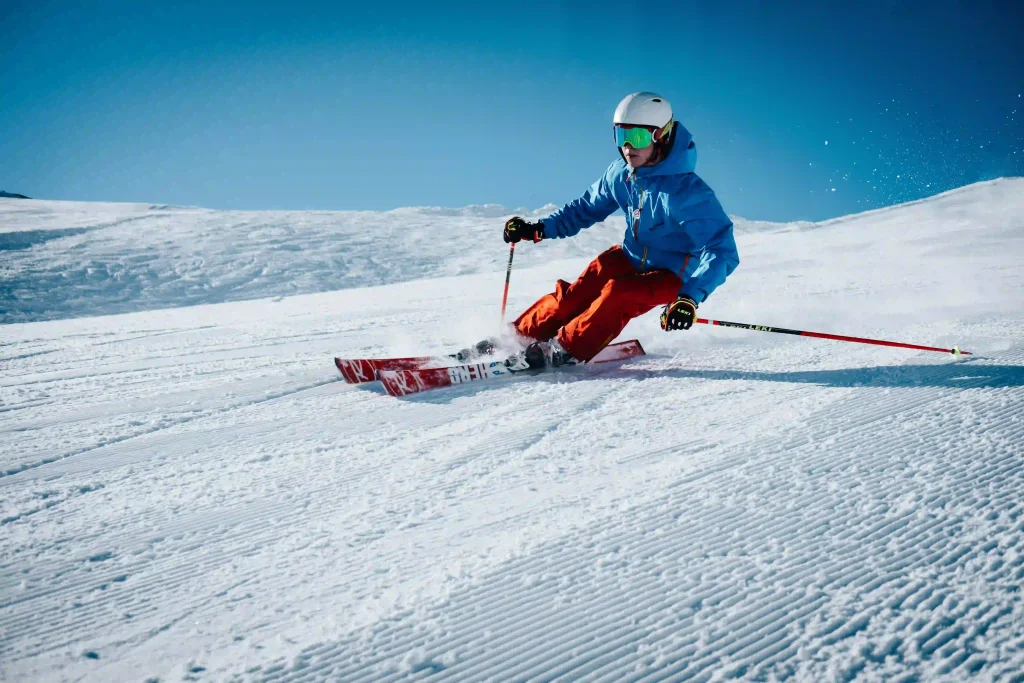
Table of Contents
The Essence of Edge Control
Edge control is the essence of skiing—it is the direct interaction between the metal edge of the ski and the snow, dictating whether a skier glides, slides, accelerates, or stops. Without precise control over the edge, a skier is merely reacting to the terrain. With it, the skier dictates the speed, shape, and rhythm of every turn. This mastery is built upon the ability to manipulate two fundamental forces: edge angle and pressure application.
For beginners, edge control is used primarily for braking (the wedge or snowplow). For advanced skiers, it is the primary tool for carving a clean, high-speed line. The difference between a turn that skids versus a turn that carves lies entirely in the skier’s ability to maintain and adjust the edge angle relative to the snow’s surface. Mastering this complex mechanical relationship is the single greatest step toward dynamic, powerful skiing.
This guide breaks down the physics of ski edge control, explains the concept of pressure management (fore/aft and lateral), and provides key drills to help skiers achieve surgical precision in every turn.
The Mechanics of the Edge
The successful use of the edge is based on manipulating the ski’s geometry and utilizing the mechanical connection provided by the boot.
Edge Angle vs. Banking
Many skiers confuse leaning the body into a turn (banking) with tilting the ski onto its edge (edge angle). The distinction is critical:
- Edge Angle: This is the angle created between the base of the ski and the snow surface. A higher edge angle means the ski is tipped further onto its side, increasing grip. This angle is achieved primarily through the flexion of the ankle and knee joints.
- Banking: This is leaning the entire body toward the inside of the turn. Pure banking causes the body’s center of gravity to move too far inside the turn, leading to a loss of pressure on the outside ski and a tendency for the inside ski to lift or slide out.
True ski edge control requires angulation, where the skier bends at the ankles, knees, and hips to create an angle while keeping the hips balanced over the outside ski. This keeps maximum force directed through the edge and into the snow, maximizing grip.
The Role of the Boot and Binding
The ski boot and binding system is the transmission for edge control.
- Boot Stiffness: A stiff boot provides instantaneous feedback and allows the skier to tilt the ski with minimal foot movement. A soft boot dampens this feedback and requires more aggressive movement to initiate the same edge angle.
- Forward Lean: The slight forward lean built into modern boots is crucial. It forces the shins to press against the tongue of the boot, placing the skier in an athletic stance ready to apply pressure immediately.
- Torsional Stiffness: This refers to the ski’s resistance to twisting along its length. A ski with high torsional stiffness holds a cleaner edge on icy terrain, as it resists the forces attempting to flatten the ski during a turn.
The Phases of the Turn
Every turn cycle has a distinct relationship with the edge:
- Initiation (Edge Release): The skier flattens the ski entirely (releases the old edge) and tips the ski onto the new inside edge. This is the moment of least control.
- Control Phase (Edge Application): The skier progressively increases the edge angle, using angulation to manage the turn arc and control speed.
- Completion (Edge Release/Transition): The skier once again reduces the edge angle to flatten the ski, preparing to initiate the next turn in the opposite direction.
Pressure Management (Fore/Aft and Lateral)
Edge control is inert without the force of the skier’s body pressure directed into the edge. Pressure must be applied in two dimensions: along the length of the ski (Fore/Aft) and across the width of the ski (Lateral).
Lateral Pressure (The Edge Setter)
Lateral pressure is the force directed sideways into the downhill (outside) ski, and it is what generates the edge angle.
- Outside Ski Dominance: The outside ski handles approximately 70–80% of the turning pressure in most scenarios. This pressure is transferred primarily through the downhill foot.
- Progressive Pressure: Pressure should be applied progressively throughout the turn. It starts light during initiation and builds to maximum pressure near the fall line, where the ski is fighting the most gravitational force.
Fore/Aft Pressure (The Control Modifier)
Fore/Aft pressure (forward/backward balance) dictates which part of the ski is engaged. This is crucial for adapting to different terrain and speed requirements.
- Pressure Forward (Tips): Applying pressure toward the shovel (tip) of the ski results in a shorter, quicker turn radius. This technique is necessary for bumps, short turns, and technical terrain.
- Pressure Aft (Tails): Applying slight pressure toward the tail increases the stability of the turn and is often used in deep powder to help the tips float. However, excessive tail pressure causes the ski to skid and slows the ability to initiate the next turn.
Pressure in Variable Terrain
In unpredictable snow, pressure application must be dynamic. The legs should act as hydraulic suspension, constantly absorbing (compressing) and extending to maintain a consistent force on the ski’s edge, preventing the ski from bouncing or skipping. In mogul fields, for example, precise pressure management is the difference between skiing smoothly over the bumps and being tossed by them. Mastering pressure release is paramount when navigating a technical descent like those found in the Mogul Progression Guide.
Four Drills for Mastering Ski Edge Control
To translate theoretical knowledge into reflexive skill, consistent practice through focused drills is essential. These exercises should be performed on a gentle, groomed Blue or easy Black run.
Drill 1: The Side Slip (Controlling Pressure Release)
- Goal: To isolate the feeling of edge release and application without the distraction of rotational movement.
- Execution: Start traversing across the hill. Flatten both skis simultaneously to allow them to slip directly sideways (side-slip). To stop the slip, immediately increase the edge angle of both skis by tipping the knees and ankles uphill.
- Focus: The goal is to control the rate of the slip purely by the degree of edge angle applied. The body should remain stable and facing downhill.
Drill 2: The Railroad Tracks (Maintaining Parallelism)
- Goal: To prevent the inside ski from lagging behind or drifting during the turn, ensuring both skis maintain the same edge angle.
- Execution: Traverse across the hill. Initiate a turn and try to make the tracks left in the snow look like two perfect parallel lines, with no evidence of skidding or the skis diverging.
- Focus: This requires equal pressure and edge angle on both skis, a challenging feat often achieved by pressing down equally with both feet and keeping the inside hand slightly forward.
Drill 3: One-Ski Gliding (Developing Lateral Pressure)
- Goal: To force the skier to place 100% of their lateral pressure onto the outside ski, eliminating the reliance on the inside ski for balance.
- Execution: Lift the inside ski slightly off the snow while traversing. Steer and turn the outside ski through a series of wide arcs, relying entirely on the downhill ski to maintain balance and edge grip.
- Focus: This drill directly trains the stabilizing muscles in the ankle and hip that are responsible for creating the necessary angulation without banking. The importance of properly tuned equipment cannot be overstated, as the transmission of pressure relies on a well-fitted system; ensure your gear is ready using this guide on Boot and Binding Mechanics.
Drill 4: Tipping the Shins (Initiation Cue)
- Goal: To train the ankle and shin movement as the primary initiator of edge change.
- Execution: While traversing, rapidly move the shins from side to side (first press the shins into the uphill boot tongue, then the downhill boot tongue). Observe how this small ankle movement immediately causes the skis to tip and change edge engagement.
- Focus: This drill reinforces the idea that turns start not with a twisting of the torso, but with a slight, precise ankle and shin movement inside the boot.
Conclusion
Mastering ski edge control is the defining characteristic of dynamic skiing. It transforms the skier from a passenger reacting to gravity and friction into an active pilot dictating their path. This mastery is achieved through the disciplined practice of angulation and progressive pressure application both laterally (for grip) and fore/aft (for radius). By consistently integrating specialized drills like the Side Slip and One-Ski Gliding into practice, skiers can develop the reflexive skill required to seamlessly transition from a controlled skid to a powerful, clean carve across all terrain and snow conditions.
Discover more from Maive Verse
Subscribe to get the latest posts sent to your email.